Welding Electrode Baking Guide — Temperatures, Procedures & Best Practices
Welding electrode baking is one of the most critical — and most frequently neglected — quality control steps in SMAW fabrication. Low-hydrogen electrodes such as E7018, E7016, and the stainless steel series are hygroscopic: their flux coatings absorb atmospheric moisture in a matter of hours once packaging is opened. If these electrodes are used without proper baking and storage, dissolved hydrogen enters the weld pool, diffuses into the heat-affected zone, and can trigger hydrogen-induced cracking — a failure mode that is characteristically delayed and often invisible to the naked eye until catastrophic.
This guide sets out everything a welding engineer, CWI, fabrication supervisor, or inspector needs to know about electrode baking: the science behind why it is necessary, the three-stage temperature protocol from initial reconditioning through to field quiver use, the specific requirements for different electrode classes, the governing AWS and ASME standards, and the practical quality controls required on demanding oil and gas, power, and structural projects. Whether you are writing a welding procedure specification, auditing a fabrication shop, or troubleshooting weld porosity on site, the information in this article applies directly.
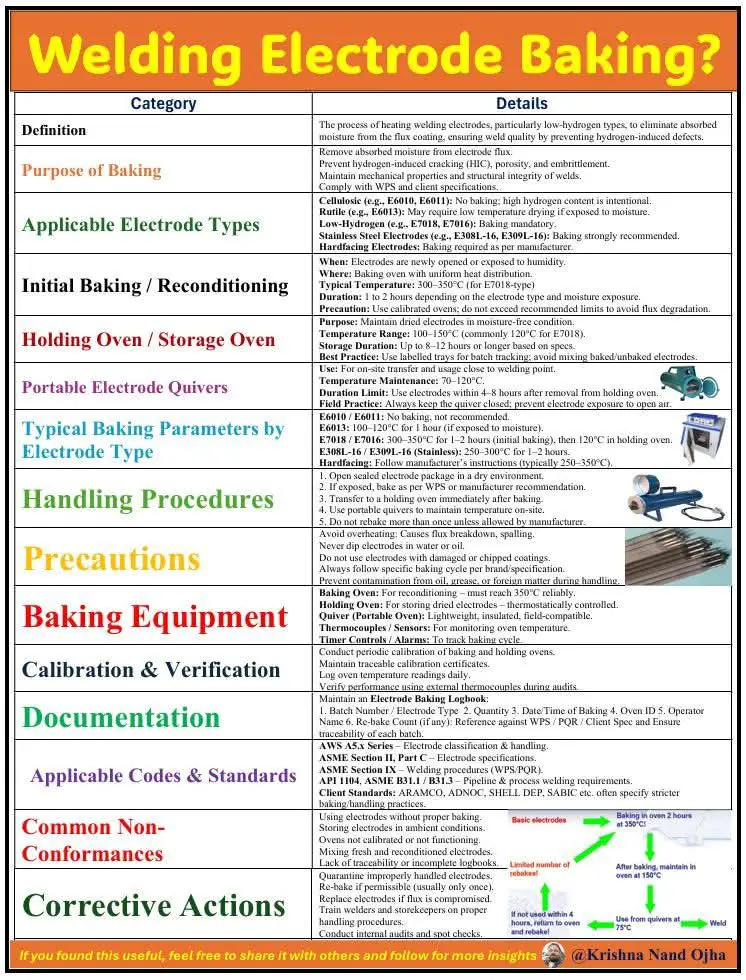
What Is Electrode Baking and Why Does It Matter?
Electrode baking — also called electrode reconditioning or electrode drying — is the controlled application of heat to welding electrodes prior to use, for the purpose of driving off absorbed moisture from the flux coating. The process is mandatory for low-hydrogen electrode classifications because their flux coatings, which typically contain carbonates, fluorides, and iron powder, have a high affinity for water vapour.
The concern is not the presence of free water on the electrode surface but rather the chemically and physically absorbed moisture within the flux matrix. When this moisture is carried into the arc, it undergoes thermal dissociation at temperatures exceeding 2,000°C and releases atomic hydrogen directly into the weld pool. Atomic hydrogen has a much smaller radius than molecular hydrogen and diffuses rapidly through the crystal lattice of solidifying steel. When it concentrates at zones of high residual stress — particularly the coarse-grained HAZ immediately beneath the fusion line — it can cause catastrophic cracking that may not manifest for hours or even days after welding is complete.
Scope Note: This guide primarily addresses flux-coated SMAW electrodes. For flux-cored wires (FCAW) and submerged arc fluxes (SAW), separate baking and storage requirements apply — see SAW Flux Classification Guide for SAW-specific requirements.
Why Flux Coatings Absorb Moisture
The hygroscopic behaviour of low-hydrogen flux coatings is driven primarily by the calcium fluoride (CaF2) and calcium carbonate (CaCO3) compounds in the coating matrix. These compounds adsorb water vapour from the atmosphere at the micro-pore surfaces within the dried coating. The rate of absorption increases significantly above 80% relative humidity and at temperatures below 15°C, conditions common on outdoor construction sites and in coastal environments. Even vacuum-sealed electrodes can become contaminated if damaged packaging is stored in humid conditions before opening.
Consequences of Using Moisture-Contaminated Electrodes
- Hydrogen-induced cracking (HIC) — also called cold cracking, delayed cracking, or stress corrosion cracking under load
- Porosity and blowholes — caused by hydrogen and steam bubbles trapped during solidification
- Underbead cracking — cracking in the coarse-grained HAZ immediately beneath the weld
- Embrittlement — reduction in notch toughness, critical for pressure vessel and pipeline applications
- Unstable arc — excessive spatter and arc instability due to volatile moisture in the flux
Caution: Hydrogen-induced cracks are typically tight, sub-surface features that are not detectable by visual inspection. On safety-critical welds, they may only be revealed by phased array UT or TOFD examination — often after the structure is in service. Prevention through correct electrode baking is far less costly than weld repair or structural failure.
The Three-Stage Electrode Baking Protocol
A complete electrode baking and storage system involves three distinct temperature stages: initial reconditioning (baking), holding oven storage, and field quiver storage. Each stage has different temperature requirements and time limits. Failing to maintain any one stage compromises the protection provided by the others.
Stage 1: Initial Baking (Reconditioning)
Initial baking removes deeply absorbed moisture from electrodes that have been exposed to ambient conditions — either through opened packaging or damaged packaging. The baking temperature is the highest of the three stages and must be sufficient to drive moisture from deep within the flux matrix without damaging the coating chemistry. Low temperatures will only evaporate surface-adsorbed moisture, leaving bound moisture that will be released in the arc.
Engineering Tip: Place electrodes in the oven in a single layer on wire mesh racks, with adequate spacing to allow uniform heat penetration. Stacking electrodes in bundles severely reduces the effectiveness of the baking cycle for the inner electrodes. Do not place electrodes directly on a solid oven shelf, as this restricts air circulation around the lower surface of the coating.
Stage 2: Holding Oven Storage
Immediately after baking, electrodes must be transferred to a holding oven before they cool to ambient temperature. A holding oven maintains electrodes at a temperature sufficient to prevent re-absorption of atmospheric moisture without applying the high temperatures of the reconditioning cycle. The holding oven is the electrode storage point from which welders draw their daily or shift allocation. Batch size in the holding oven should be managed against the rate of electrode consumption to avoid electrodes sitting in the holding oven for excessive periods.
Holding ovens must be calibrated and equipped with thermostats that maintain temperature within ±10°C of the set point. Each holding oven must have a logbook recording the oven ID, thermocouple calibration date, electrode batch numbers, issue dates, and the name of the person issuing electrodes. This logbook forms part of the quality record and is subject to client and third-party audit on major projects.
Stage 3: Portable Field Quivers
For field and overhead welding locations remote from the holding oven, welders use portable heated quivers — thermos-flask-style containers with a built-in heating element. Quivers prevent rapid moisture re-absorption during the time the welder is actively working. The quiver must be plugged in and pre-heated to the operating temperature at least 30 minutes before electrodes are loaded. Welders must keep the quiver lid closed when not withdrawing electrodes.
Electrodes that have been taken out of a quiver and placed on a bench, on the ground, or attached to the job with a magnet holder are considered compromised — they have been exposed to ambient conditions without temperature control and must be treated as having exceeded their out-of-oven time limit.
Electrode Baking Temperature Reference Table
The table below provides a consolidated reference for baking temperatures and hold times across common SMAW electrode classifications used in structural, pressure vessel, pipeline, and petrochemical fabrication. All values represent industry-standard guidance; the manufacturer’s data sheet for the specific product always takes precedence.
| Electrode Class | Examples | Baking Temp | Baking Time | Holding Oven | Max Out-of-Oven | Baking Required? |
|---|---|---|---|---|---|---|
| Low-hydrogen (mild steel) | E7016, E7018 | 300–350°C | 1–2 hrs | 120–150°C | 4 hrs (AWS D1.1) | Mandatory |
| Low-hydrogen high-strength | E9018, E10018, E12018 | 370–430°C | 2 hrs | 120–150°C | 30 min–2 hrs | Mandatory |
| Stainless steel (austenitic) | E308L, E316L, E309L | 200–250°C | 1 hr | 100–120°C | 4 hrs | Mandatory |
| Nickel alloy | ENiCrFe-3, ENi-1 | 120–150°C | 1 hr | 100–120°C | 4 hrs | Mandatory |
| Rutile (mild steel) | E6013, E6012 | 70–150°C | 1 hr | 50–80°C | 8 hrs | If exposed |
| Cellulosic | E6010, E6011 | N/A | N/A | N/A | N/A | Never bake |
| Cast iron | ENiFe-CI, ENi-CI | 100–120°C | 1 hr | 80–100°C | 4 hrs | Recommended |
| Hardfacing / surfacing | Per manufacturer | Per data sheet | Per data sheet | 80–100°C | 4 hrs | Recommended |
AWS D1.1 Exposure Limits: AWS D1.1 Table 4.7 specifies that E7016 and E7018 electrodes exposed to ambient conditions for more than 4 hours must be rebaked or discarded. E7018M electrodes have a maximum exposure time of 30 minutes at relative humidity above 90%. The code permits rebaking once only unless the electrode manufacturer specifies otherwise.
Electrode Classification and Baking Requirements in Detail
Low-Hydrogen Electrodes (E7016, E7018)
These are the most widely used electrodes in structural, pressure vessel, and pipeline fabrication — and the most sensitive to moisture contamination. The “16” and “18” suffixes in the AWS classification denote low-hydrogen coating types (16 = lime-fluoride, 18 = lime-fluoride with iron powder). Both types require mandatory baking after exposure to ambient conditions. E7018-1 and E7018M variants are moisture-critical grades used where notch toughness requirements apply at sub-zero temperatures; these have the most stringent out-of-oven time limits.
For P91 chrome-moly pressure vessel and piping welding, the consequences of hydrogen-induced cracking are particularly severe because the high-hardenability steel forms a martensitic HAZ that is acutely susceptible to hydrogen embrittlement during and after welding. P91 WPS requirements therefore typically specify E9018-B9 electrodes with enhanced baking procedures and often restrict the maximum atmospheric exposure time to 2 hours or less.
Stainless Steel Electrodes
Austenitic stainless steel electrodes in the E308, E309, E316 series require baking at lower temperatures (200–250°C) than carbon steel low-hydrogen types. Excessive temperatures can volatilise or chemically alter the titanium and niobium stabilising additions in the flux, changing the as-deposited weld metal composition and potentially compromising corrosion resistance. For duplex stainless steel electrodes (E2209, E2553), always consult the manufacturer’s data sheet — duplex grades are particularly sensitive to both moisture and excessive baking temperature.
Cellulosic Electrodes — Never Bake
The most important negative rule in electrode baking is that cellulosic electrodes (E6010, E6011) must never be baked. The cellulose (wood pulp) in their coating decomposes and burns at temperatures above approximately 150°C, destroying the coating and permanently altering the arc characteristics. Cellulosic electrodes intentionally produce a hydrogen-rich shielding gas envelope that provides the deep, forceful arc penetration needed for root passes in pipeline welding. If you accidentally bake a cellulosic electrode, it must be discarded — it cannot be reconditioned.
Caution — Field Risk: Cellulosic (E6010) and low-hydrogen (E7018) electrodes are both commonly present on pipeline and structural construction sites. They look similar. Clearly segregate electrode storage and label all containers with electrode classification, lot number, and baking status. Mixing baked low-hydrogen electrodes with unbaked electrodes — or accidentally placing cellulosic electrodes in a baking oven — are serious quality non-conformances.
Governing Standards and Code Requirements
Electrode baking requirements are established by a hierarchy of codes, standards, and client specifications. Understanding which document governs a specific project is essential for writing compliant welding procedure specifications and inspection plans.
| Document | Scope | Electrode Baking Relevance |
|---|---|---|
| AWS A5.1 / A5.5 | Carbon and low-alloy SMAW electrodes | Classification, standard conditioning, moisture testing requirements |
| AWS D1.1 | Structural welding — steel | Table 4.7: exposure times for E7016, E7018, E7018M |
| ASME Section II Part C | Welding consumables | Electrode material requirements and SFA specifications |
| ASME Section IX | Welding procedure qualification | Governs essential variables including filler metal and base material affecting WPS |
| ASME B31.1 / B31.3 | Power and process piping | Consumable handling requirements referenced from ASME Section IX and II Part C |
| API 1104 | Pipeline welding | Low-hydrogen electrode storage and out-of-oven time requirements |
| EN ISO 2560 | European carbon steel SMAW electrodes | Moisture conditioning requirements for H-suffix (low-hydrogen) grades |
| Client Specifications | Project-specific | Often impose stricter limits; Saudi Aramco, Shell DEP, ADNOC, SABIC standards typically require 2-hour max out-of-oven time and calibrated oven records |
ASME Section IX Note: ASME Section IX itself does not specify electrode baking temperatures in detail, but it governs the WPS essential variables under which electrodes are consumed. The Section IX WPS essential variable framework means that changes in electrode classification or flux type may require procedure requalification — making correct electrode selection and handling part of the broader qualification compliance picture. Refer to ASME Section II Part C SFA-5.1 and SFA-5.5 for specific electrode conditioning requirements.
Quality Control Requirements for Electrode Baking
Calibrated Oven Requirements
Both baking ovens and holding ovens must be equipped with calibrated temperature-indicating instruments. Temperature uniformity within the oven must be demonstrated through periodic surveys (typically using a multi-point thermocouple or data logger) to confirm that all areas of the oven reach the required temperature. Records of oven calibration must be maintained and available for client audit.
The calibration frequency for oven thermostats and temperature controllers is typically specified as 6-monthly or annually, though major oil and gas clients often require 3-monthly calibration. Any oven operating outside its calibrated range must be immediately taken out of service until recalibrated.
Electrode Baking and Issue Logbook
A baking and issue logbook is a mandatory quality record on all coded welding projects. The minimum information required on each logbook entry is: electrode classification and diameter, manufacturer name, lot or heat number, quantity, baking oven ID, baking temperature and duration, date and time of baking, date and time of issue, welder ID or welding station, and issuing inspector name. Many projects also require that unused electrodes returned to the holding oven at the end of a shift are logged with their return time and rebake status.
Practical Tip: Use colour-coded trays or containers to segregate electrode status — for example, red for unbaked/incoming stock, orange for currently in the baking oven, green for baked and in holding oven, and white for issued to quiver. This visual management system is simple to implement and dramatically reduces the risk of baked and unbaked electrodes being mixed.
Segregation of Baked and Unbaked Electrodes
One of the most common non-conformances observed during fabrication shop audits is the co-mingling of baked and unbaked electrodes in the same storage area or container. Once mixed, it is not possible to distinguish a baked electrode from an unbaked one by visual examination. Physical segregation — using separate marked containers, locked ovens, and a formal issue system — is the only reliable control. Electrodes found outside a labelled container or oven must be treated as unbaked and sent for reconditioning before use.
Common Non-Conformances and Corrective Actions
Frequent Field Non-Conformances
- Electrodes used directly from opened cartons without baking, particularly at the start of a new batch when no previous defects have been observed
- Holding ovens with faulty thermostats operating below the required temperature — the oven appears to be on but the temperature has drifted below 80°C
- Quivers not connected to power supply, or quivers with failed heating elements not identified during daily pre-use checks
- Electrodes placed in quivers with the quiver not yet at operating temperature, negating the benefit of the holding oven stage
- Out-of-oven time limits exceeded because production pressure prevents welders from returning unused electrodes to the oven at breaks
- Absence of a baking logbook, or logbook entries completed retrospectively rather than in real time
- Repeated rebaking of the same electrode batch beyond the manufacturer-permitted number of cycles
Corrective and Preventive Actions
When a non-conformance is identified, the immediate corrective action depends on the nature of the deviation. Electrodes used from unverified sources must be quarantined and the affected welds subjected to additional non-destructive examination, typically magnetic particle testing (MT) or phased array UT (PAUT), to confirm the absence of hydrogen cracks. If cracking is found, weld repair must be executed under a controlled procedure with verified electrode baking.
Preventive actions should address the root cause. Oven faults require repair and re-calibration before the oven is returned to service. Procedural gaps require revision of the welding quality plan. Personnel issues require documented training with sign-off. Project quality managers should review baking records weekly on large projects to identify trends before they produce defects.
Caution — Rebaking Limits: Do not rebake electrodes more times than the manufacturer permits. Each reconditioning cycle applies thermal stress to the flux coating. After the permitted number of cycles, the coating chemistry is degraded, the flux may become friable, and the arc characteristics are compromised. Degraded coatings are also more susceptible to physical damage during handling. Electrodes that have reached their rebaking limit must be marked with a paint marker or tape and removed from service.
Documentation and Traceability
On any project governed by a quality management system — whether to ISO 9001, ASME quality control programme requirements, or a client-specific welding quality plan — electrode baking records are traceable quality documents. They link a completed weld to the specific electrode batch, the baking cycle parameters, the holding oven, and the issuing person. This traceability is essential for effective root cause analysis in the event of a weld failure and for demonstrating compliance to third-party inspectors and client representatives.
Electrode traceability typically starts with the manufacturer’s mill test certificate (MTC) or certificate of conformance, which records the lot number, chemical composition of deposited metal, mechanical properties, and moisture testing results. This certificate is received with the electrode delivery and must be retained as a quality record. The lot number is then carried forward through all baking logbook entries, linking the finished weld to the original material certification.
For high-integrity applications such as nuclear, aerospace, and offshore structural welding, some clients require weld travellers — documents that travel with the joint through every stage of fabrication — to include a dedicated section for electrode baking entries, signed and countersigned by the welding inspector at each stage.
Digital Record Keeping: Modern fabrication projects are increasingly adopting digital welding quality management systems (WQMS) that record baking events in real time via barcode scanning or RFID. These systems link the electrode batch number directly to the weld joint record, eliminating the risk of retrospective log falsification and providing an auditable digital trail. If you are managing welding quality for a large project, consider a digital WQMS as part of your quality control infrastructure.
Practical Pre-Welding Electrode Baking Checklist
Use this checklist as the basis for a site or shop-level electrode management procedure. It can be adapted to match the specific requirements of your project quality plan and any applicable client specification.
| Item | Check | Responsible | Record Required |
|---|---|---|---|
| Electrode MTC / certificate of conformance received and filed | Pre-receipt | QC Inspector | Yes — incoming material log |
| Electrode classification and lot number match purchase order | Pre-receipt | QC Inspector | Yes — incoming inspection |
| Baking oven calibration current (within calibration period) | Daily | Welding Engineer / QC | Yes — calibration sticker on oven |
| Baking oven set to correct temperature for electrode type | Daily | Welding Supervisor | Yes — baking logbook |
| Electrodes loaded in single layer on wire mesh racks | Each bake | Welding Supervisor | Yes — logbook note |
| Bake start and end time recorded in logbook | Each bake | Welding Supervisor | Yes — mandatory |
| Holding oven temperature verified before transfer | Each transfer | Welding Supervisor | Yes — logbook |
| Field quiver pre-heated 30 min before loading | Per shift | Welder | Supervisor sign-off |
| Out-of-oven time tracked and not exceeded | Ongoing | Welder / Supervisor | Yes — logbook or timer |
| Unused electrodes returned to holding oven before limit | End of shift | Welder | Yes — return log entry |
Recommended Reading on Welding Quality and Consumables
Frequently Asked Questions
At what temperature should E7018 electrodes be baked?
E7018 low-hydrogen electrodes should be baked (reconditioned) at 300–350°C (570–660°F) for 1.5–2 hours in a controlled oven. After baking, they must be transferred immediately to a holding oven maintained at 120–150°C (250–300°F). Always follow the manufacturer’s specific data sheet, as some premium low-hydrogen grades specify higher reconditioning temperatures up to 430°C. Verify oven calibration before each baking cycle and record all baking parameters in the electrode logbook.
How many times can you rebake a welding electrode?
Most manufacturers permit a maximum of two to three rebaking cycles for low-hydrogen electrodes. Repeated baking degrades the flux coating — it can cause the coating to crack, spall, or lose its chemical balance, altering arc characteristics and weld metal composition. After the permitted number of cycles, the electrode must be rejected and replaced. Always check the manufacturer’s certificate or data sheet for the maximum permitted rebake cycles, and record each cycle in the baking logbook to maintain traceability.
Do cellulosic electrodes (E6010) need baking?
No. Cellulosic electrodes such as E6010 and E6011 must never be baked. Their flux coating is intentionally formulated with a high organic (cellulose) content that generates a hydrogen-rich, high-penetration arc. Baking them destroys the cellulosic components, permanently alters the arc characteristics, and renders the electrodes unsuitable for their intended application — particularly root passes in pipeline welding. Any cellulosic electrode accidentally subjected to reconditioning temperatures must be discarded.
What is the maximum out-of-oven time for low-hydrogen electrodes?
AWS D1.1 specifies a maximum atmospheric exposure time of 4 hours for E7016 and E7018 class electrodes in normal humidity conditions, and as low as 30 minutes for E7018M or E10018–E12018 series electrodes. Many oil and gas client specifications (Saudi Aramco, Shell, ADNOC) impose limits as strict as 2 hours regardless of electrode class. Electrodes that exceed the applicable limit must be rebaked before use, provided the total permitted rebake count has not been exceeded. Always consult the project-specific welding quality plan for the applicable out-of-oven time limit.
What defects result from using undried low-hydrogen electrodes?
Using moisture-contaminated low-hydrogen electrodes introduces atomic hydrogen into the weld metal and HAZ, which can cause hydrogen-induced cracking (HIC), also known as cold cracking or delayed cracking. Other defects include porosity, blowholes, underbead cracking, and transverse cracking. These defects may not be visible immediately and can manifest hours or days after welding, making electrode baking critical for safety-critical fabrication. Phased array UT or TOFD is often required to detect sub-surface hydrogen cracks that are not visible on radiographs.
What temperature should a portable electrode quiver be maintained at?
Portable electrode quivers for field use should be maintained at 70–120°C (160–250°F), with 80°C being a typical practical setting. They should be switched on and verified at operating temperature at least 30 minutes before electrodes are loaded. The quiver lid must remain closed when electrodes are not being withdrawn. Electrodes in quivers should be used within 4–8 hours, depending on the electrode class and the prevailing relative humidity at the worksite — stricter limits apply in coastal, tropical, or monsoon environments.
Which standards govern electrode baking and storage requirements?
The primary references are AWS A5.1 and A5.5 (carbon and low-alloy steel electrodes), which specify conditioning and storage conditions. AWS D1.1 Table 4.7 provides exposure time limits for structural welding. ASME Section II Part C (SFA-5.1, SFA-5.5) specifies electrode material requirements, and ASME Section IX governs the welding procedures under which electrodes are used. API 1104 applies to pipeline welding. Project clients in oil and gas (Aramco SAES, Shell DEP, ADNOC) often impose additional requirements through project-specific welding quality plans that supersede the underlying codes.
Can you use a domestic oven for electrode baking?
No. Domestic ovens are not suitable for electrode baking. They cannot reliably reach or maintain the 300–350°C temperatures required for low-hydrogen electrode reconditioning, they lack calibrated thermocouples and traceability, and they cannot provide the uniform temperature distribution needed across the electrode batch. Industrial electrode baking ovens are purpose-built for this application, with calibrated temperature controllers, even heat distribution, and wire rack systems for single-layer electrode loading. Calibration records for these ovens form a mandatory part of the quality documentation on any coded welding project.
Conclusion
Electrode baking is not an administrative formality. It is a direct technical control on the hydrogen content of your weld metal and, by extension, on the fracture toughness and delayed cracking behaviour of your completed weldment. In industries where weld failure carries life-safety consequences — pressure vessels, pipelines, offshore structures, power generation — the cost of inadequate electrode management is measured not in the price of a replacement electrode but in the cost of inspection, repair, or failure.
The three-stage system — baking oven at 300–350°C, holding oven at 120–150°C, field quiver at 70–120°C — combined with calibrated equipment, accurate logbooks, physical segregation, and trained personnel, provides a robust defence against hydrogen-induced cracking. Maintain calibration records, enforce out-of-oven time limits, and never compromise on electrode traceability, and you will meet the requirements of AWS, ASME, API, and client specifications on any project.
Related Reading: For SMAW electrode classification and decoding the AWS designation system, see the Welding Consumable Nomenclature guide. For consumable selection guidance across all processes, see the SMAW Welding Process Guide.