PART QW — WELDING · ARTICLE I
ASME Section IX — Part QW Article I:
General Requirements Complete Training Guide
ASME BPVC Section IX Part QW governs the qualification of welding procedures and welding personnel for all fusion welding processes used in pressure equipment fabrication. Article I (QW-100 through QW-199) establishes the general framework — from WPS requirements and qualification purpose through weld positions, mechanical test types, and acceptance criteria. This guide covers every QW Article I clause in depth, followed by a timed 10-question knowledge-check quiz and a feedback form.
Scope, WPS Requirement & Records
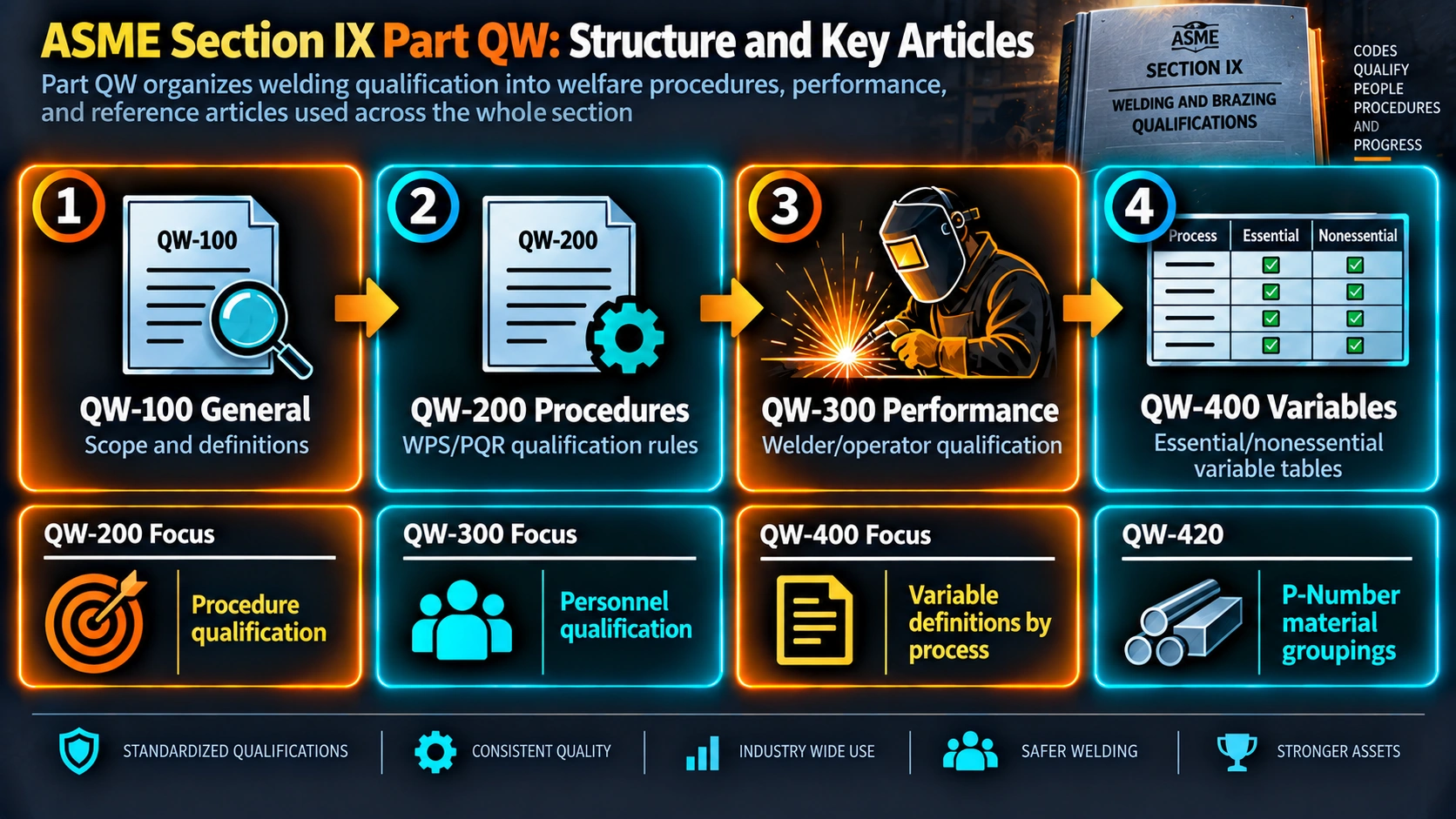
QW-100 · QW-101 · QW-103 — Foundation of Part QW
What Part QW Covers
Rules for preparing Welding Procedure Specifications (WPS) and qualifying welding procedures, welders, and welding operators for all manual, semiautomatic, machine, and automatic welding processes permitted in Section IX. Rules may also apply to other welding processes referenced in other ASME Sections (e.g., Section I, Section VIII, B31.3).
QW-101 — WPS Requirement
Production welding shall be performed in accordance with a qualified WPS. The WPS used by an organisation shall be either:
- Qualified by that organisation per Article II of Part QW, or
- A Standard Welding Procedure Specification (SWPS) from Mandatory Appendix E, adopted per Article V
Organisational Obligations
- Each organisation shall conduct the tests required to qualify welding procedures and the performance of welders/operators who apply them
- Each organisation shall maintain records of results obtained in welding procedure and welder/operator performance qualifications
- Records shall be available to the Authorised Inspector and the referencing Code’s inspection authority
Recommended Record Forms
- Refer to recommended forms in Nonmandatory Appendix B of Section IX
- QW-483 — Suggested format for WPS
- QW-484 — Suggested format for PQR
- QW-484A — Suggested format for SWPS
- QW-485 — Suggested format for Welder/Operator Performance Qualification (WPQ)
Section Summary — Key Takeaways
- All production welding shall be performed per a qualified WPS — either organisation-qualified (Article II) or SWPS per Appendix E / Article V.
- A WPS must address all essential and nonessential variables for each process; supplementary essential variables when toughness is required.
- Each organisation is responsible for conducting its own qualification tests and maintaining the records per QW-103.
- Recommended forms: WPS → QW-483, PQR → QW-484, WPQ → QW-485.
Procedure Qualification Purpose
To determine that a weldment made by a specific process is capable of producing joints with the required mechanical properties. It qualifies the process and variables, not the person.
Result documented in a Procedure Qualification Record (PQR). Supports one or more WPS.
Performance Qualification Purpose (QW-102)
- Welder: Basic criterion is to determine the welder’s ability to deposit sound weld metal
- Welding Operator: Purpose is to determine the operator’s mechanical ability to operate the welding equipment
Result documented in a Welder/Operator Performance Qualification (WPQ).
| Qualification Type | Proves | Document | Who Requires |
|---|---|---|---|
| Procedure (WPS/PQR) | Process produces required mechanical properties | PQR → supports WPS | QW-200 (Article II) |
| Welder Performance | Welder can deposit sound weld metal | WPQ (QW-484/485) | QW-300 (Article III) |
| Welding Operator Performance | Operator can mechanically operate welding equipment | WPQ (QW-484/485) | QW-300 (Article III) |
Section Summary — Key Takeaways
- Procedure qualification tests the process; performance qualification tests the person.
- For a Welder — criterion is the ability to deposit sound weld metal.
- For a Welding Operator — criterion is the mechanical ability to operate the welding equipment.
- Procedure and performance qualification are independent — one does not substitute for the other (except the simultaneous qualification provision in QG-106.1(e)).
Orientations of welds are illustrated in Figures QW-461.1 and QW-461.2. Angular deviation of ±15° from specified horizontal or vertical planes is permitted; ±5° from a specified inclined plane is permitted during welding.
Plate Fillet (QW-130–131)
- 1F — Flat: weld axis horizontal, throat vertical
- 2F — Horizontal: weld on upper side of horizontal surface against vertical surface
- 3F — Vertical: weld axis vertical
- 4F — Overhead: weld on underside of horizontal surface against vertical surface
Pipe Fillet (QW-132)
- 1F — Flat pipe fillet: pipe axis 45° to horizontal, rotated
- 2F — Horizontal pipe fillet: pipe axis vertical, no rotation
- 2FR — Horizontal rotated: pipe axis horizontal, pipe rotated
- 4F — Overhead pipe fillet: pipe axis vertical, weld on underside
- 5F — Multiple pipe fillet: pipe axis horizontal, no rotation
Stud Weld Positions (QW-123)
Stud welds may be made in positions described in QW-121 (plate) and QW-122 (pipe), excluding 1G pipe. The stud shall always be perpendicular to the surface of the plate or pipe.
Special Positions (QW-124 / QW-133)
Test positions other than those defined in QW-120–123 or QW-130–132 are defined as “special positions.” These require specific procedure and performance qualification for the unique orientation used — standard position qualifications do NOT cover them.
| Code | Type | Base | Key Feature |
|---|---|---|---|
| 1G / 1F | Groove / Fillet | Plate or Pipe | Flat — welding from above |
| 2G / 2F | Groove / Fillet | Plate or Pipe | Horizontal — pipe NOT rotated (2G) |
| 3G / 3F | Groove / Fillet | Plate | Vertical — weld axis vertical |
| 4G / 4F | Groove / Fillet | Plate or Pipe | Overhead — weld metal from underneath |
| 5G / 5F | Groove / Fillet | Pipe | Pipe axis horizontal, no rotation |
| 6G | Groove | Pipe | Pipe axis at 45°, no rotation — most restrictive |
| 2FR | Fillet | Pipe | Horizontal rotated — pipe axis horizontal, pipe rotated |
Section Summary — Key Takeaways
- Angular deviation: ±15° from specified horizontal/vertical planes; ±5° from an inclined plane.
- 6G is the most restrictive pipe groove position — pipe at 45°, no rotation — covers 1G, 2G, and 5G ranges.
- 1G pipe is the only pipe groove position excluded from stud weld qualification (QW-123).
- Positions outside the standard designations are “special positions” requiring dedicated qualification.
QW-142 — Welders
Radiographic or Ultrasonic examination per QW-191 may be substituted for mechanical testing (QW-141) for groove-weld performance qualification, as specifically permitted in QW-304.
QW-143 — Welding Operators
Radiographic or Ultrasonic examination per QW-191 may be substituted for mechanical testing for groove-weld performance qualification, as specifically permitted in QW-305.
Purpose of Visual Examination
Visual examination as described in QW-194 is used to determine that final weld surfaces meet specified quality standards. Required for performance test coupons as a baseline check before other test methods. Acceptance criteria per QW-194.
| Test / Exam | Clause | Applies To | Determines |
|---|---|---|---|
| Tension | QW-150 | Procedure | Ultimate tensile strength of groove welds |
| Guided Bend | QW-160 | Procedure & Performance | Soundness and ductility |
| Fillet Weld | QW-180 | Procedure & Performance | Size, contour, soundness |
| Toughness (Charpy) | QW-171 | Procedure (when required) | Impact toughness (ft-lb / J) |
| Drop Weight | QW-172 | Procedure (when required) | Nil-ductility transition temperature |
| Stud Weld | QW-192 | Procedure & Performance | Bend, hammer, torque, or tension strength |
| Radiography / UT | QW-191 | Performance — groove welds only | Weld soundness (NDE substitute) |
| Visual | QW-194 | Performance | Surface quality standards |
| Liquid Penetrant | QW-195 | Corrosion-resistant overlay | Surface discontinuities |
- May be used for all thicknesses of plate
- Up to and including 1 in. (25 mm): full-thickness specimen
- Greater than 1 in.: full-thickness OR multiple equal strips — each tested, each must pass
- Multiple sets = the entire thickness mechanically cut into minimum equal strips
- For pipe OD > 3 in. (75 mm) — all thicknesses
- Same thickness-splitting rules as plate (≤1 in. full; >1 in. may be multiple)
- For pipe OD ≤ 3 in. (75 mm): use Fig QW-462.1(c) reduced-section specimens
- ≤1 in.: single turned specimen — largest diameter D possible for coupon thickness
- >1 in.: multiple specimens through full thickness, centers not more than 1 in. (25 mm) apart
- Centers adjacent to surfaces shall not exceed 5/8 in. (16 mm) from the surface
May be used for pipe with OD of 3 in. (75 mm) or less. Uses the full pipe cross-section as the tension specimen. Per Fig QW-462.1(e).
Section Summary — Key Takeaways
- Four tension specimen types: QW-151.1 (reduced plate), QW-151.2 (reduced pipe), QW-151.3 (turned), QW-151.4 (full-section pipe ≤ 3 in. OD).
- For thickness > 1 in., coupons are cut into multiple strips — each individual strip must meet the tensile strength requirement.
- Acceptance: tensile strength ≥ minimum specified base metal tensile strength.
- Base-metal fracture outside the weld: acceptable if strength is not more than 5% below the base metal minimum.
Face Bend (QW-161.1)
The face of the weld is on the convex (outer) side of the bent specimen. Tests the weld face and outer HAZ in tension. Used for thin material.
Root Bend (QW-161.2)
The root of the weld is on the convex (outer) side of the bent specimen. Tests the weld root and inner HAZ in tension. Used for thin material.
Side Bend (QW-161.3)
Specimen bent with a cross-section of the weld exposed to tensile stress on the convex face. Used when material thickness ≥ 3/8 in. (10 mm). Tests fusion through the full thickness.
Low-Ductility: Macro-Etch (QW-161 preamble)
For base metals with less than 3% elongation, a macro-etch specimen replaces each bend test. Acceptance criteria per QW-183(a).
Specimen is wrapped around a mandrel of specified diameter. The die opening and mandrel diameter are governed by material type and thickness. The specimen is bent through 180° unless otherwise specified.
Alternative jig using rollers. Permitted as an alternative to the wrap-around jig. Both jig types must meet the dimensional requirements of Fig QW-466.1 or QW-466.2 as applicable to the material and specimen.
Section Summary — Key Takeaways
- Four specimen types: Face, Root (used for thinner material), Side (≥ 3/8 in. / 10 mm thickness), and Macro-etch (base metal elongation < 3%).
- Guided-bend jig: wrap-around or roller type, specimen bent 180°.
- Acceptance limit — groove welds: 1/8 in. (3 mm) max open discontinuity on convex surface.
- Acceptance limit — corrosion-resistant overlay: 1/16 in. (1.5 mm) max open discontinuity.
- Corner cracks: not considered unless they arise from fusion-type discontinuities or inclusions.
Toughness Tests
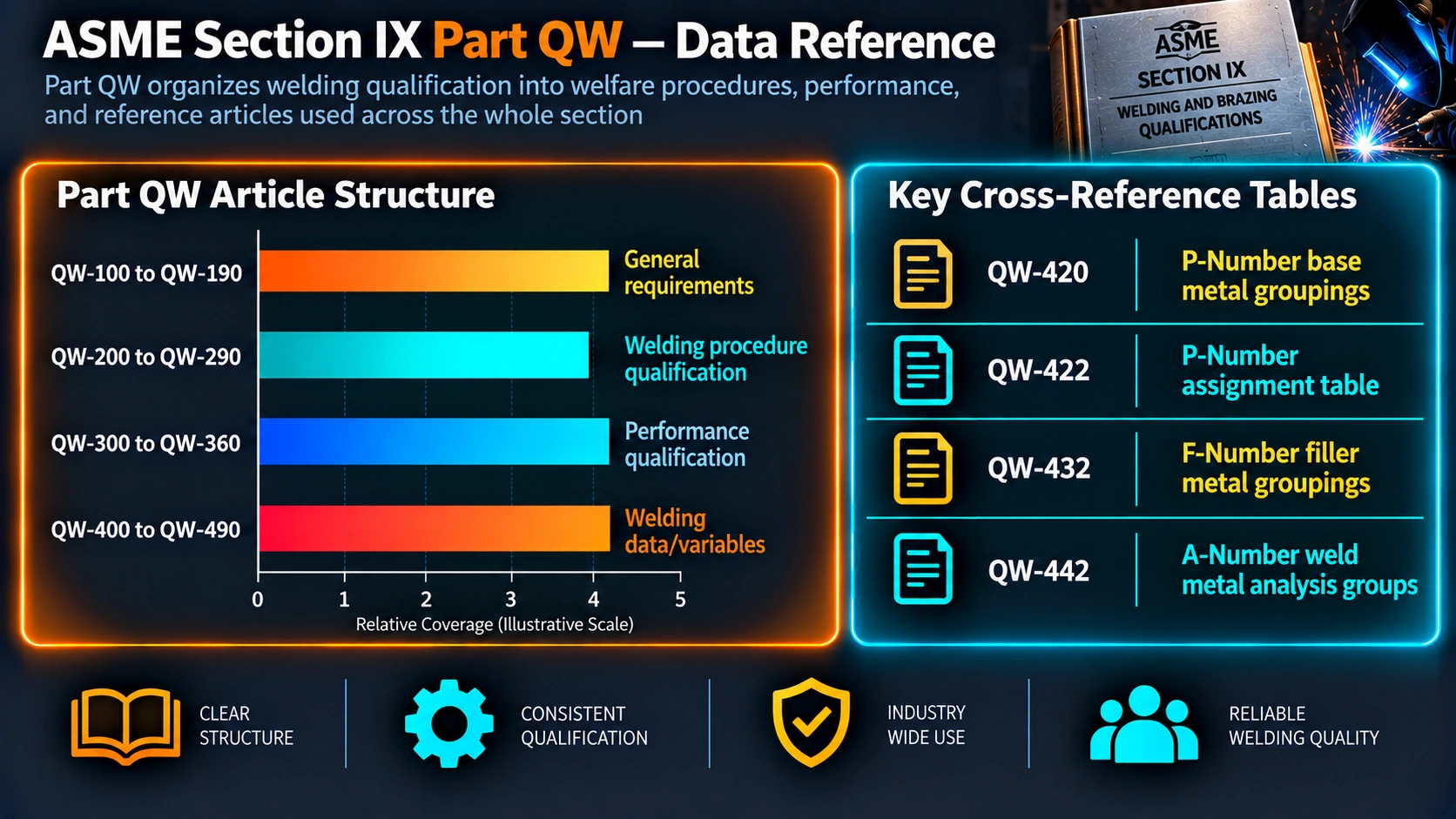
QW-170 · QW-171 · QW-172 — Charpy impact, drop-weight tests, and conditions for applicability
QW-171 — Charpy V-Notch Impact Tests
- Specimen notch location: weld metal, HAZ, or both as required
- Standard Charpy specimen: 10 mm × 10 mm × 55 mm
- Sub-size specimens permitted when full size cannot be obtained from the coupon
- Tests run at the temperature specified by the referencing Code or application
- Results reported in ft-lb (J) — average of three specimens
- Acceptance criteria set by the referencing Code (not Section IX directly)
QW-172 — Drop-Weight Tests
- Determines the Nil-Ductility Transition (NDT) temperature
- Applicable when required by the referencing Code (e.g., certain ASME Section VIII Div. 2 applications)
- Specimens contain a crack-starter bead of brittle weld metal
- Two specimens required per test condition
- Acceptance: both specimens must show no break (P/F) at the specified test temperature
Section Summary — Key Takeaways
- Toughness tests apply only when required by the referencing Code — not automatically for all welds.
- Charpy V-notch (QW-171): notch at weld metal and/or HAZ; standard specimen 10×10×55 mm; average of 3 specimens in ft-lb (J).
- Drop-weight (QW-172): determines NDT temperature; 2 specimens; pass/fail result; both must show no-break.
- When toughness tests are required, related supplementary essential variables must be addressed in the WPS.
Fillet weld qualification tests determine the size, contour, and soundness of fillet welds. They apply to both procedure qualification (QW-202.2) and performance qualification (QW-303.3).
QW-181.1 — Procedure Fillet Weld Test
Two test coupons required — one is macro-etched, one is fractured through the fillet weld (break test). The macro specimen must pass QW-183 acceptance criteria. The break test checks soundness through the fillet cross-section.
QW-181.2 — Performance Fillet Weld Test
A welder qualifying on fillet welds makes a test coupon which is either: macro-etched (cross-section), or subjected to a break test, or both depending on position and material. Visual examination per QW-144/QW-194 is also required.
Section Summary — Key Takeaways
- Fillet weld tests determine size, contour, and soundness — apply to both procedure and performance qualification.
- Procedure fillet test (QW-181.1): two coupons — one macro-etched, one break-tested.
- Macro acceptance (QW-183): complete fusion, no cracks, concavity/convexity ≤ 1/16 in. (1.5 mm), leg difference ≤ 1/8 in. (3 mm).
- Performance acceptance (QW-184) adds: linear indications ≤ 1/32 in. (0.8 mm).
Radiographic (RT)
- Performed per Section V Article 2 of ASME BPVC
- Applicable to groove-weld performance qualification only (QW-142/143)
- Acceptance per QW-191.1.2 — based on radiographic indication limits
- For welders: permitted per QW-304
- For welding operators: permitted per QW-305
Ultrasonic (UT)
- Performed per Section V Article 4 or Article 5 of ASME BPVC
- Same scope as RT — groove-weld performance qualification only
- Acceptance per QW-191.2.2
- UT acceptance: no indications exceeding reference calibration level as defined in QW-191.2
| Material Thickness (t) | Maximum Linear Indication Length | Maximum Round Indication |
|---|---|---|
| t < 3/8 in. (10 mm) | 1/8 in. (3 mm) | 3/16 in. (5 mm) longest dimension |
| 3/8 in. ≤ t ≤ 2-1/4 in. (10–57 mm) | 1/3t | 3/16 in. (5 mm) longest dimension |
| t > 2-1/4 in. (57 mm) | 3/4 in. (19 mm) | 3/16 in. (5 mm) longest dimension |
Requires 10 stud test welds:
- 5 studs — bend or hammer test (studs bent 30° from original axis; no fracture in weld or HAZ)
- 5 studs — torque test (or tension test per QW-192.1.1)
- Each of the 5 sectioned studs (bend test group) shall be macro-examined at 10× magnification
- Macro acceptance per QW-183(a): complete fusion, no cracks
- Requires 10 stud test welds (same as procedure)
- Same test split: 5 bend/hammer + 5 torque (or tension)
- The welder/operator who makes the studs is performance-qualified for the stud type and position tested
QW-193.1 — Procedure Qualification
Requires a mockup of 10 tube-to-tubesheet welds. Mock-up shall replicate the production configuration (tube OD, pitch, ligament, tube projection). All 10 welds examined by macro-examination (cross-section).
QW-193.2 — Performance Qualification
Requires a minimum of 5 tube-to-tubesheet welds in a mockup. Welder qualifies for the tube OD and tubesheet configuration of the test. Visual examination required per QW-194.
QW-194 — Visual Examination Acceptance
- No cracks or incomplete fusion
- No incomplete joint penetration in groove welds (except where partial penetration is specified)
- No porosity visible on the surface
- Undercut: not to exceed 1/32 in. (0.8 mm)
QW-195 — LP Examination (Overlay)
Required for performance qualification of corrosion-resistant overlay welds. Performed per Section V Article 6. Acceptance: no relevant indications > 1/16 in. (1.5 mm) in any direction. No linear indications regardless of length.
Section Summary — Key Takeaways
- RT/UT (QW-191) may substitute for mechanical tests in groove-weld performance qualification only — not in procedure qualification.
- Stud-weld qualification (QW-192): 10 studs total — 5 bend/hammer + 5 torque — same for procedure and performance.
- Tube-to-tubesheet procedure qualification (QW-193.1): 10 mockup welds; performance qualification (QW-193.2): minimum 5 mockup welds.
- Visual examination (QW-194): no cracks, no porosity on surface, undercut ≤ 1/32 in. (0.8 mm).
- LP examination (QW-195) for overlay: no relevant indication > 1/16 in. (1.5 mm); no linear indications.