Welding vs Bolting: When to Use Each in Structural and Fabrication Work
Welding is not always the right answer — and neither is bolting. Choosing between the two is an engineering decision, and if you cannot explain your reasoning to an inspector, a customer, or a structural engineer, you will lose that argument fast. This guide gives you the technical reasoning, the code references, the comparison tables, and a decision framework you can actually use on the job.
In structural steel, pressure equipment, and process-plant fabrication, both methods appear on the same structure — often within a metre of each other. A fabricated pressure vessel uses fully welded shell seams and nozzles, then switches to high-strength bolted flange pairs at every removable connection. A steel building frame relies on shop welds for stiffness and field bolts for safe, fast erection. Understanding why each method appears where it does is more useful than a blanket preference for one over the other.
This article covers the fundamental mechanics and metallurgy of both joint types, maps common applications to the method that typically governs, explains the relevant codes and standards, and ends with a four-question decision framework that produces a defensible answer on any project. Related reading: our guide to welding joint types and configurations and our overview of welding symbols on engineering drawings.
Why the Welding vs Bolting Decision Is an Engineering Call
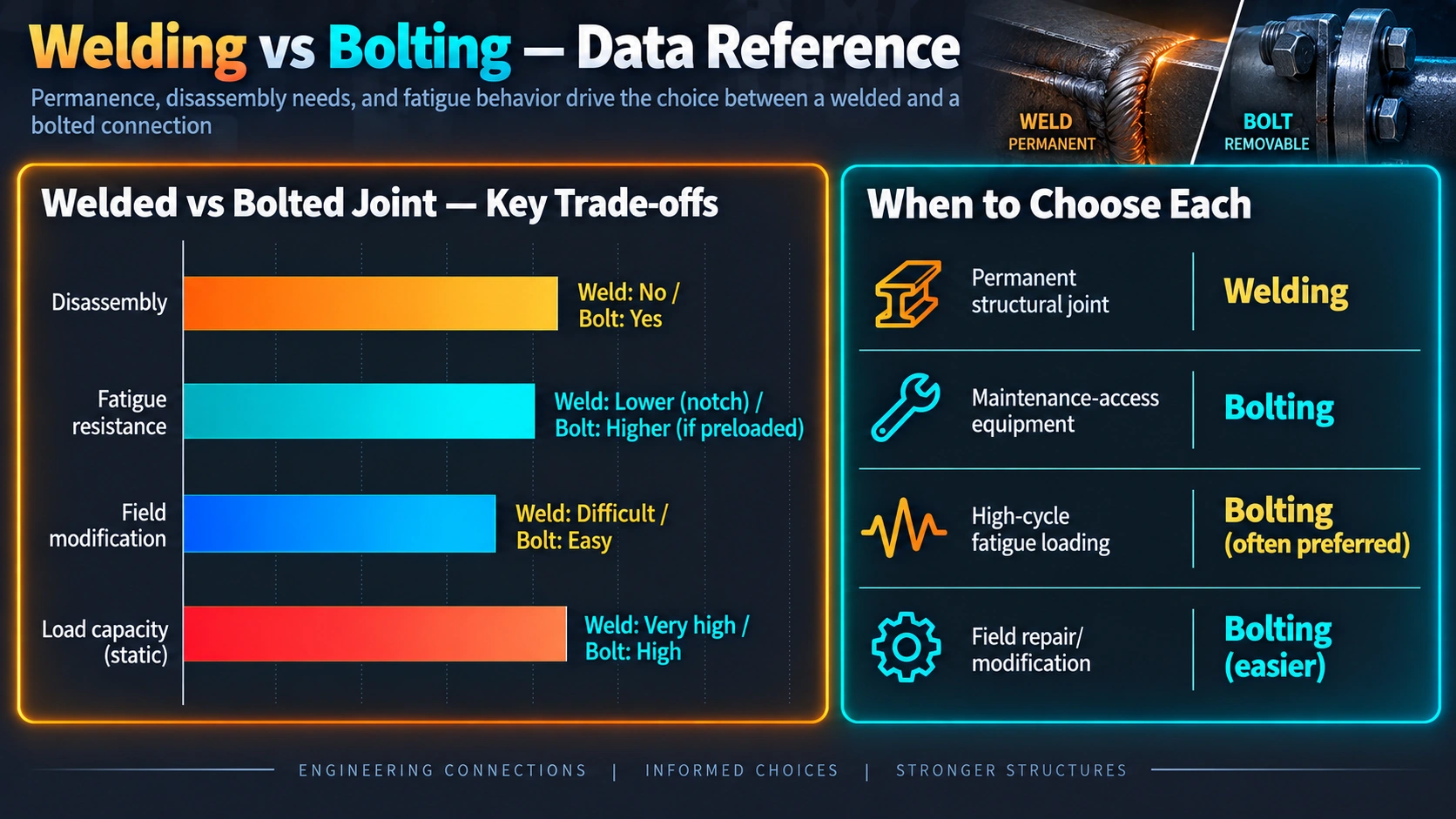
On any fabricated structure, the joint is usually the weakest element if it is under-designed, and the heaviest element if it is over-designed. Choosing the wrong method costs money through rework, inspection failures, future maintenance difficulties, or — in the worst case — structural failure. The decision hinges on four engineering variables: load type and direction, service environment, disassembly requirements, and applicable code or standard.
The temptation to default to welding because it looks cleaner, or to default to bolting because it is easier to fix, is a symptom of not running those four variables. An experienced fabrication engineer or structural designer works through them on every connection and arrives at a selection that is both technically defensible and cost-effective.
- Structural welding — AWS D1.1/D1.1M Structural Welding Code – Steel
- Pressure vessel welding — ASME Section VIII Division 1 (UW clauses) + ASME Section IX qualification
- Process piping welding — ASME B31.3
- High-strength bolted structural connections — AISC 360 + RCSC Specification for Structural Joints
- Flange bolting — ASME B16.5 / B16.47 for pipe flanges; ASME PCC-1 for joint integrity
When Welding Is the Right Choice
A welded joint achieves what no mechanical fastener can: a true metallurgical union between parent metal and filler material. The joint, when properly executed to a qualified Welding Procedure Specification (WPS), becomes a single continuous metallic entity. That fundamental fact drives most of welding’s advantages.
Full Joint Efficiency
A complete joint penetration (CJP) groove weld in structural steel can develop 100% of the base metal’s tensile strength. There is no net cross-section reduction from bolt holes, no faying-surface friction to rely on, and no bolt preload to maintain. For pressure vessels, ASME Section VIII Division 1 assigns joint efficiency values (E) up to 1.0 for double-welded butt joints subject to full radiographic examination (RT). That high joint efficiency is why the shell thickness formula rewards welding:
t = (P × R) / (S × E − 0.6 × P)
Where:
t = required shell thickness (mm or in)
P = design pressure (MPa or psi)
R = inside radius (mm or in)
S = allowable stress of shell material (MPa or psi)
E = joint efficiency factor
E = 1.00 → Full RT on double-welded butt joint
E = 0.85 → Spot RT
E = 0.70 → No RT (No. 1 joint category)
Higher E = thinner (lighter) shell for same pressure rating.
A bolted shell is not permitted under this Code.
Sealing and Pressure Containment
Welds eliminate the interface that all bolted joints share. There is no gasket to blow, no bolt to relax under thermal cycling, and no leak path between two mating surfaces. This makes welding mandatory for pressure vessel shells, pipework, tank shells, and any assembly where a leak to atmosphere or between fluids is a safety or process concern. Even when flanged connections are used at valves or instruments in a pipeline, the flange itself is welded to the pipe.
Stiffness and Dimensional Stability
Bolted connections, even fully pre-tensioned slip-critical joints, allow a finite amount of elastic deformation at the interface. Under cyclic or reversing loads, joints can “breathe” slightly. Welded frames and jigs are stiffer and hold their geometry under load — critical for machine tool bases, structural frames carrying dynamic loads, and trailer chassis where twisting under load is a fatigue driver.
Geometric Freedom
Some joint geometries physically cannot accommodate a fastener: the back of a closed hollow section, a tight internal corner in a fabricated box beam, a nozzle on a pressure vessel set at an oblique angle. Welding works wherever a torch or electrode can reach the joint. Bolting needs clearance for the bolt, the wrench, and often the tensioning tool.
Weight Optimisation
Bolted connections require flange plates, gussets, cleats, and end plates — all additional material. The bolt holes themselves remove cross-section from the plates. A welded assembly can deliver the same load capacity with significantly less added material, which matters in aerospace, automotive, marine, and trailer applications where weight is a direct operating cost.
Where Welding Has Limitations
These advantages come at a cost. The heat input that creates the metallurgical union also creates a heat-affected zone (HAZ) where the base metal microstructure is altered. In carbon and low-alloy steels, the HAZ can harden to martensite if cooling is too rapid, and may crack if hydrogen is present — the basis of hydrogen-induced cracking (HIC). This is why preheat requirements in AWS D1.1 and ASME Section IX are not optional. For high-alloy steels, the stakes are higher still. Our detailed article on welding P91 chrome-moly steel shows how carefully HAZ microstructure must be managed in creep service.
Welds are also permanent. Rework requires cutting, grinding, re-welding, re-testing, and often re-inspection — all costly. And every weld on a code-governed structure needs to be traceable: qualified WPS, qualified welder, inspection records. That administrative overhead is legitimate, not bureaucratic excess. Read how our ASME Section IX qualification framework governs this process.
When Bolting Is the Right Choice
A welder who knows when not to weld is more valuable than one who reaches for the torch every time. Bolting wins in five clearly defined scenarios, and experienced engineers recognise all of them without hesitation.
The Joint Must Be Disassembled
This is the clearest and most common reason to bolt. Any joint that will be opened during the life of the structure for inspection, maintenance, part replacement, or future modification must be bolted (or otherwise mechanically fastened). Pressure vessel manways, heat exchanger channel covers, machine covers, piping spools at equipment nozzles — all bolted, not because welding would be weaker, but because welded permanent closure removes the access that the design intent requires.
Field Assembly Under Uncontrolled Conditions
Quality welding requires clean, dry base metal, adequate preheat, control of interpass temperature, protection from wind (which disrupts gas shielding or removes preheat), and certified welders. On a bridge girder 30 metres above ground in January, or in the hold of a ship under construction, controlling all those variables is expensive and sometimes impossible. High-strength field bolting is faster, weather-tolerant, and produces a connection of known quality if correct installation procedures are followed — which is exactly why structural steel erection almost universally uses bolting for field splices.
Verifiable Preload Is Critical
Wind turbine tower flange connections, large equipment foundations, and pressure vessel heat exchanger shell flanges all depend on a specific, measurable, and re-verifiable clamping force. That is only achievable with bolts. Hydraulic bolt tensioners, calibrated torque wrenches (traceable per ISO 6789), tension-indicating (DTI) washers, and turn-of-nut methods all allow the installer to demonstrate and the inspector to verify that the required preload has been achieved. You cannot achieve the same level of traceability with a weld. ASME PCC-1 provides the reference procedure for bolted flange joint assembly and verification in pressure equipment.
Dissimilar Metals That Don’t Fuse Well
Fusion welding between dissimilar metals can produce brittle intermetallic phases, mismatched thermal expansion coefficients that generate stress at the weld line, and galvanic corrosion at the joint. Bolting — with appropriate isolation washers and compatible gaskets — sidesteps all of these. This is the standard solution at the junction of a carbon steel piping system and a titanium heat exchanger nozzle, or at structural connections between aluminium and steel members.
Hot Work Is a Hazard
In active refinery units, tank farms, fuel storage areas, and other hazardous-area locations, any spark-generating work requires a hot-work permit, gas testing, area isolation, and fire watch — adding significant cost and schedule risk. Bolted modifications and repairs are cold work, require no ignition-hazard precautions, and can often be done while adjacent equipment continues to operate. This makes bolted on-stream leak repair clamps and bolted tie-in flanges standard practice in operating facilities.
Limitations of Bolting
Bolt holes are stress concentrations. Under fatigue loading, cracks initiate at hole edges, particularly if the holes are punched rather than drilled and reamed. The net section through a row of bolt holes is always smaller than the gross section, reducing the plate’s tensile capacity. Bolted joints add weight through their flange plates, end plates, and the fasteners themselves. And slip — even in pre-tensioned joints — cannot be entirely eliminated unless the joint is specifically designed as slip-critical under the RCSC specification.
Choose Welding When…
- Joint must be permanent and leaktight
- Maximum strength-to-weight is needed
- Geometry prohibits fastener access
- Stiffness under cyclic load is critical
- Pressure code mandates welded shell
- Shop environment provides quality control
Choose Bolting When…
- Joint must be disassembled for access
- Field assembly under adverse conditions
- Preload must be measured and verified
- Dissimilar metals prevent fusion welding
- Hot work is a safety or permit issue
- Future modification is planned
Application Map: Which Method Governs Where
The following table maps common structural, pressure, and fabrication applications to the joint method that is typically specified, along with the primary engineering or code reason. These are the patterns you will find on real drawings and in real specifications — not theoretical preferences.
| Application | Typical Method | Primary Reason | Governing Standard |
|---|---|---|---|
| Pressure vessel shell and heads | Welded | Code mandates welded construction; joint efficiency drives wall thickness | ASME Sec. VIII Div. 1 |
| Pressure vessel manway / blind flange | Bolted | Access for internal inspection (Code requires periodic entry) | ASME Sec. VIII / ASME B16.5 |
| Steel building — shop connections | Welded | Faster, controlled environment, stiffer connections | AWS D1.1 / AISC 360 |
| Steel building — field splices | Bolted | Erection speed, weather tolerance, RCSC requirement for H.S. bolts | AISC 360 / RCSC |
| Process piping — butt joints in pipeline | Welded | Leaktight containment; no gasket in pressure boundary | ASME B31.3 |
| Process piping — flanged connections at equipment | Bolted | Equipment disconnection for maintenance/replacement | ASME B16.5 / PCC-1 |
| Wind turbine tower segments (long seams) | Welded | Full structural continuity, fatigue classification | AWS D1.1 / IIW fatigue classes |
| Wind turbine tower — flange-to-flange joints | Bolted | Site assembly, verifiable preload, maintenance access | IEC / DNV-ST-0126 |
| Bridge girder gusset plates (new construction) | Bolted | Slip-critical classification required by AISC/AASHTO | AISC 360 / AASHTO LRFD |
| Trailer and vehicle chassis | Welded | Stiffness, weight, geometry (closed RHS sections) | AWS D1.1 / AWS D1.3 |
| Heat exchanger shell-to-channel (removable bundle) | Hybrid | Shell seam welded; channel cover bolted for tube access | ASME Sec. VIII / TEMA |
| Machine guards and access panels | Bolted | Routine removal; safety regulations require unobstructed access | OSHA 1910.217 |
| Custom shop fixturing and jigs | Welded | Dimensional stability under repeated load; no joint slip | Shop standard / AWS D1.1 |
| Large agricultural equipment frames | Hybrid | Main frame welded for stiffness; attachments bolted for replacement | OEM engineering standard |
Notice that the answer is frequently “both, in different locations on the same structure.” The hybrid approach is the norm in complex fabricated equipment, not the exception. Mechanical testing requirements apply to weld procedure qualification regardless of where the weld appears in this map.
The Four-Question Decision Framework
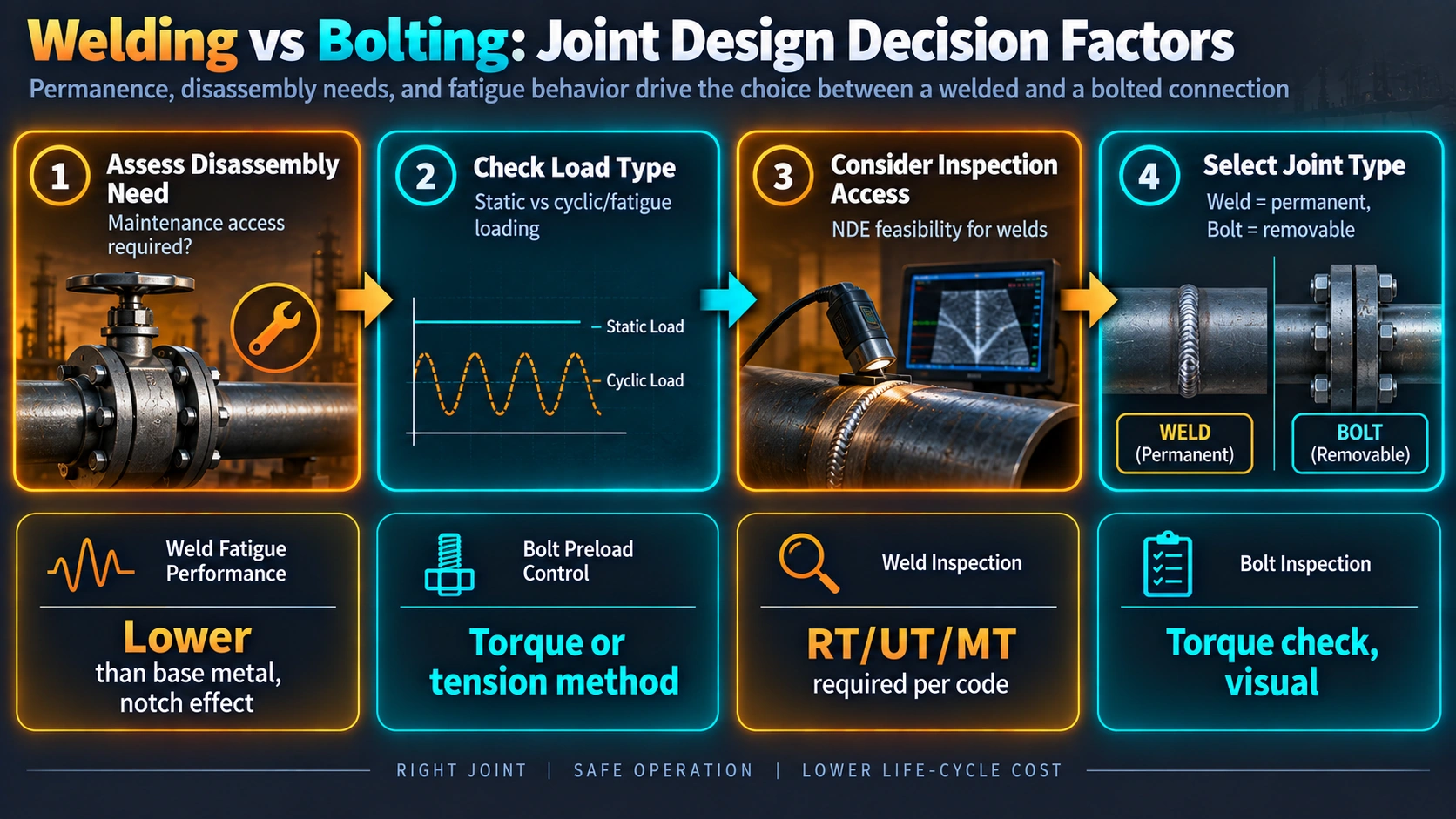
When an inspector, engineer, or customer asks why you chose welding or bolting on a given joint, you need a defensible answer. Run the joint through these four questions in order, and the method usually selects itself before you reach the end.
Question 1: Will this joint ever need to be opened?
If yes — for any reason, at any point in the structure’s life — the joint must be bolted or otherwise mechanically releasable. This is not a preference; it is a functional requirement. Welding a connection that needs to be accessed for inspection or maintenance turns a routine maintenance task into a cutting, re-welding, and re-inspection event that costs orders of magnitude more time and money.
Question 2: What is the service environment and will it allow quality welding?
Field welding in exposed, uncontrolled environments is difficult to execute to the same standard as shop welding. Rain, wind, cold steel, lack of preheat equipment, and the absence of certified inspection all compound the risk. If the environment makes quality welding impractical, bolt the connection. The joint will be more reliable, not less.
Question 3: Does the joint require measured, verifiable clamping force?
Gasket compression on a pressure vessel flange, base plate anchor bolts on rotating machinery, and wind turbine flange bolts all require a specific preload that must be demonstrated by the installer and verified by inspection. Torque, turn-of-nut, and hydraulic tensioning all produce documented evidence of joint integrity. Welding cannot meet this requirement.
Question 4: Are the materials metallurgically weldable with available procedures?
Consult the carbon equivalent of the base metal and the available qualified WPS. If no viable welding procedure exists or the alloy combination produces unacceptable phase changes or brittle intermetallics, bolting with appropriate isolators is the only engineering option. The guidance in our article on sour service material selection shows how environment can further constrain the metallurgical options.
Joint Strength, Fatigue, and Failure Modes Compared
Static Strength Comparison
Under static tensile loading, a complete joint penetration groove weld matched to the base metal will fail in the base metal, not in the weld — meaning the joint is at least as strong as the parent material. A high-strength bolted connection (ASTM A325 or A490 bolts) develops very high shear capacity through the fasteners, but the net section through the bolt holes must be checked for tensile rupture, which always governs below the gross section capacity.
Fatigue Behaviour
Fatigue performance is where the comparison becomes more nuanced. Welds introduce geometric stress concentrations at the weld toe, where the weld profile meets the parent material surface. Fatigue cracks initiate at the weld toe under cyclic loading, and the fatigue life of a welded joint is significantly lower than that of the smooth, unnotched base metal. AWS D1.1 Chapter 2 provides fatigue categories (A through F) that quantify allowable stress ranges as a function of cycles.
Bolted connections have fatigue-sensitive locations at hole edges. However, a properly pre-tensioned slip-critical connection, where the clamping force keeps the faying surfaces in contact and prevents slip, behaves closer to a gapless joint under fatigue than a bearing-type connection where the bolt shank contacts the hole edge. This is one reason high-fatigue applications such as bridge connections and wind turbine flanges are almost always either high-strength bolted (where disassembly is needed) or specified with post-weld treatment (grinding, hammer peening, or HFMI) to improve the welded toe geometry.
Failure Modes to Watch
| Failure Mode | Welded Joints | Bolted Joints |
|---|---|---|
| Fatigue initiation site | Weld toe (geometric stress concentration) | Hole edge (stress concentration factor ~2.5 for drilled holes) |
| Brittle fracture risk | HAZ embrittlement; hydrogen cracking if preheat not controlled | Bolt thread root; hydrogen embrittlement in high-strength fasteners |
| Corrosion initiation | Weld spatter, undercut, crevice at weld root | Crevice under bolt head; moisture trapping at faying surface |
| Overload mode | Weld root or toe crack; base metal yielding | Bolt shear; plate bearing; net section tension rupture |
| Detection by inspection | UT, RT, PAUT, MT, PT on weld zone | Visual on head/nut; ultrasonic load-indicating bolts; DTI washers |
For critical welds in pressure service, our guides on ASME UG-84 Charpy impact testing requirements explain how toughness testing of the weld and HAZ is used to demonstrate freedom from brittle fracture risk, which is the primary failure mode for pressure equipment welds in low-temperature or cryogenic service.
Cost Comparison: Welding vs Bolting by Context
There is no single answer to “which is cheaper?” The cost comparison is highly context-dependent and must be evaluated for each project. The factors below define the cost landscape.
| Cost Factor | Welding | Bolting |
|---|---|---|
| Shop fabrication labour | Lower for standard connections — no drilling, no torquing, no inspection of fastener preload | Higher — drilling, countersinking, fastener installation, and torquing all add time |
| Field assembly labour | Higher — certified welder, preheat, gas supply, protection, inspection | Lower — faster, weather-tolerant, no special certification for most applications |
| Material cost | Filler wire/electrode + shielding gas; no flange plates or gussets required for simple connections | Fasteners + nut + washer + flange plates or end plates add material |
| Inspection cost | NDT (UT, RT, MT, PT) per code — adds 15–40% to weld cost on code work | Bolt preload verification (torque or DTI) — lower cost per connection than NDT |
| Rework cost | High — cut, grind, re-weld, re-inspect; often 3–5x the original weld cost | Low — replace fastener, re-torque; minutes vs days for equivalent weld rework |
| Maintenance cost (lifetime) | Permanent joints — no ongoing maintenance unless damage occurs | Periodic re-torquing, gasket replacement, corrosion inspection at flange faces |
The Hybrid Approach: Combining Welding and Bolting
The most sophisticated fabricated structures use both methods, each in its optimal location. Understanding the hybrid approach is what separates an engineer who knows the rules from one who applies them intelligently.
Steel Building Construction
Shop-fabricated columns and beams arrive on site with welded end plates and base plates. The connections between structural members are made with high-strength field bolts — typically ASTM A325 or A490 for structural steel in the USA. The weld provides the stiff, efficient connection to the structural member; the bolt provides the quick, weather-tolerant, adjustable field connection between members. The result is a structure that is faster and cheaper to erect than an all-field-weld design, while achieving the stiffness and load capacity that an all-bolted design could only match with significantly more material.
ASME Pressure Equipment
A pressure vessel built to ASME Section VIII Division 1 has a fully welded pressure boundary — shell longitudinal and circumferential seams, head-to-shell joints, and all nozzle welds — all subject to weld examination requirements in Part UW. The only bolted connections are at removable closures: manway covers, inspection ports, heat exchanger channel covers, and flanged nozzles connecting to removable equipment. Even these bolted joints have welded nozzles; the bolting is only at the flange-to-flange interface between the vessel nozzle and the mating piping or equipment flange.
Wind Turbine Towers
A modern onshore wind turbine tower consists of conical steel shell sections roll-formed and welded in the factory, with welded longitudinal and circumferential seams. The individual tower sections are connected at site using ring flanges — welded to each section end in the factory, bolted together at site with high-strength studs and hydraulic tensioners. The weld provides the continuous pressure-tight shell; the bolted flange provides the repeatable, verifiable, site-assembled connection between sections that can be inspected and re-torqued throughout the tower’s 25-year service life.
Recommended Technical References
The following books are standard references for engineers and inspectors working on welded and bolted connections in structural and pressure equipment applications.
Disclosure: WeldFabWorld participates in the Amazon Associates programme (StoreID: neha0fe8-21). If you purchase through these links, we may earn a small commission at no extra cost to you. This helps support free technical content on this site.
Frequently Asked Questions
Is a welded joint stronger than a bolted joint?
Not necessarily in all cases. A properly executed full-penetration groove weld can develop the full tensile strength of the base metal — meaning the joint matches or exceeds parent material strength and is at least as strong as either plate being joined. However, bolted connections designed to AISC specifications with high-strength fasteners (A325 or A490) and controlled preload carry very high shear and tensile loads with excellent reliability under both static and cyclic conditions.
The real comparison is joint efficiency under the specific load type. Welds excel in continuous shear and sealing applications. Bolted joints with correct preload perform exceptionally under fatigue and tension where serviceability and verifiability are required. Neither is universally superior — the governing code and the load case determine which delivers better performance in a specific application.
When should I bolt instead of weld a structural steel connection?
Bolt when the joint must be disassembled for maintenance, inspection, or future modification. Also prefer bolting for field connections exposed to wind, rain, or conditions that make quality welding difficult to control; for connections subject to high cyclic or fatigue loading where preload can be verified and re-verified (wind turbine flanges being a prime example); and wherever dissimilar metal combinations make fusion welding metallurgically problematic.
Structural steel construction standardly uses welded shop connections (column-to-base-plate, beam-to-column moment end-plates) and high-strength bolted field connections for erection speed and safety. This hybrid approach reflects the practical reality that field welding is significantly more expensive and quality-sensitive than shop welding.
What codes govern welded structural and pressure connections?
For structural steel in the USA, AWS D1.1/D1.1M Structural Welding Code – Steel is the primary governing document, specifying welder qualifications, WPS requirements, inspection methods, and acceptance criteria for statically and cyclically loaded structures. Pressure-containing welds fall under the ASME Boiler and Pressure Vessel Code — primarily Section VIII Division 1 for pressure vessels and B31.3 for process piping — with welder and procedure qualification under ASME Section IX.
Bolted structural connections in steel buildings are governed by AISC 360 (Specification for Structural Steel Buildings) and the RCSC Specification for Structural Joints Using High-Strength Bolts. Bolted pressure vessel flange connections fall under ASME B16.5 or B16.47 for piping flanges, and ASME PCC-1 provides the reference procedure for bolted joint assembly and integrity verification.
Can I combine welding and bolting on the same structure?
Yes — hybrid connections are common and often the most efficient engineering solution. A modern steel building frame uses shop welds for column-to-base-plate connections and beam-to-column moment end plates, then high-strength bolts for all field splice connections. In pressure equipment, the shell and heads are welded per ASME Section VIII, while flange pairs on nozzles are bolted with gaskets to allow disassembly for maintenance. Wind turbine towers use welded shell sections and bolted flange-to-flange connections at transport and erection joints.
Combining methods requires clear design intent: the drawings and specifications must unambiguously identify which joints are welded (with WPS reference and inspection category) and which are bolted (with fastener grade, preload requirement, and tightening method). Ambiguity in a hybrid design is a quality and safety issue.
How does the heat-affected zone affect a welded joint’s long-term reliability?
The heat-affected zone (HAZ) is the region of base metal that has been thermally altered by welding without melting. In carbon and low-alloy steels, rapid cooling through the HAZ can form hard, brittle martensite and may cause hydrogen-induced cracking (HIC) if hydrogen is present from the electrode, shielding gas, or moisture — which is why AWS D1.1 and ASME Section IX mandate preheat for steels above threshold carbon equivalents.
For high-alloy and creep-resistant steels the situation is more demanding. In austenitic stainless steels, HAZ sensitisation — chromium carbide precipitation that depletes the HAZ of corrosion resistance — is a well-documented concern addressed through low-carbon grades (e.g. 304L, 316L) or post-weld stabilisation treatments. In P91 chrome-moly steel, HAZ softening and Type IV cracking in the fine-grained HAZ region are critical long-term failure modes in high-temperature service. Our article on P91 welding requirements covers this in detail.
What is the difference between a slip-critical and bearing-type bolted connection?
In a bearing-type bolted connection, shear load is transferred by direct contact (bearing) between the bolt shank and the sides of the bolt hole after the joint plies slip relative to each other. The bolt holes are typically standard clearance (1.6 mm larger than bolt diameter for most sizes), so a small slip occurs before bearing resistance is engaged. This is acceptable for statically loaded connections where a minor initial slip has no consequence.
In a slip-critical connection, the joint is pre-tensioned to a specified minimum proof load using controlled installation methods (turn-of-nut, calibrated wrench, or DTI washers), creating sufficient frictional resistance between the faying surfaces that the joint does not slip into bearing under service loads. Slip-critical classification is mandatory wherever slip would impair function — moment frames under seismic load, bridge deck splices, and connections subject to load reversal. Both connection types are designed per the RCSC Specification for Structural Joints Using High-Strength Bolts, and AISC 360 provides the design method.
Is bolting cheaper than welding for structural work?
The cost comparison is highly context-dependent and must be evaluated project by project. In the shop, welding is typically faster and cheaper per connection than drilling, fitting, and torquing bolted connections for simple joint types. In the field, the equation usually reverses: field welding requires certified welders, correct preheat, wind protection, gas supply, and inspection, all of which add cost and schedule risk. High-strength field bolting is faster, less weather-sensitive, and requires fewer specialist trades.
Inspection costs also differ. Code-governed welds require NDT (UT, RT, MT, or PT depending on joint category) that can add 15–40% to the weld cost. Bolt preload verification by torque wrench, turn-of-nut, or DTI is cheaper per connection. Over the life of the structure, welded joints are lower maintenance (no re-torquing required), while bolted joints with gaskets require periodic inspection and gasket replacement at pipe flanges and equipment closures. Analyse both the capital and lifecycle cost for any major fabrication decision.
Why are pressure vessel shells welded rather than bolted?
ASME Section VIII Division 1 requires pressure vessel shells, heads, and nozzles to be welded because a continuous, fused joint is the only construction method that achieves both the structural efficiency (joint efficiency E up to 1.0) and the leak-tightness required at operating pressure. The Code’s shell thickness design equation (UG-27) is written for welded construction; a bolted shell joint would introduce net section losses from bolt holes, gasket compression requirements, and a potential leak path through the gasket that is incompatible with the Code’s design intent.
Bolted connections are permitted — and specifically required — at removable closures such as manway covers, blind flanges, and heat exchanger channel covers, where access for inspection, tube bundle removal, or catalyst change is needed. These bolted closures are designed to ASME flange standards with appropriate gasket types and controlled bolt-up procedures per ASME PCC-1. The division of responsibility is clear: the welded pressure boundary provides the permanent, leaktight containment; the bolted closures provide the access points needed for operation and inspection throughout the vessel’s service life.