Best Vernier Caliper for Precision Measurement — Engineers, Welders & Inspectors (2026)
In pressure vessel fabrication, piping construction, and weld inspection, dimensional accuracy is not a preference — it is a code requirement. Whether you are verifying root gap before fit-up, checking nozzle bore diameter against a drawing tolerance, or measuring weld groove land thickness, the instrument in your hand must deliver repeatable, traceable results. Selecting the best vernier caliper for precision measurement in the Indian market is harder than it appears: the range spans calibration-grade Mitutoyo instruments down to no-brand imports that cannot hold zero across a single working shift.
As we cover in our complete guide to reading a Vernier scale, measurement technique matters as much as instrument quality. But that assumes the caliper itself is accurate to begin with. This guide evaluates five vernier and digital calipers suited to welding engineers, CWI inspectors, fabrication supervisors, and QC professionals working in Indian shop and site conditions — covering analog vernier, digital, and extended-range options across multiple price bands.
Vernier Caliper Least Count & Reading Calculator
Use this calculator to determine the least count of your caliper, verify a reading, or calculate the final measurement from main scale and vernier scale divisions.
Quick Comparison: 5 Best Vernier Calipers for Welding & Inspection (India, 2026)
| Product | Type | Range | Resolution | Accuracy | Best For | Price Band | Buy |
|---|---|---|---|---|---|---|---|
| Mitutoyo 530-312 | Analog | 0–150 mm | 0.02 mm | ±0.03 mm | Calibration-traceable QC | ₹₹₹₹ | Amazon.in |
| Mitutoyo 500-196-30 | Digital | 0–150 mm | 0.01 mm | ±0.02 mm | Fast inspection & data logging | ₹₹₹₹₹ | Amazon.in |
| Insize 1112-150 | Digital | 0–150 mm | 0.01 mm | ±0.03 mm | Workshop & fabrication shop | ₹₹₹ | Amazon.in |
| Mitutoyo 500-181-30 | Digital | 0–150 mm | 0.01 mm | ±0.02 mm | Budget Mitutoyo digital option | ₹₹₹₹ | Amazon.in |
| Insize 1112-300 | Digital | 0–300 mm | 0.01 mm | ±0.04 mm | Large-bore nozzle & pipe OD | ₹₹₹ | Amazon.in |
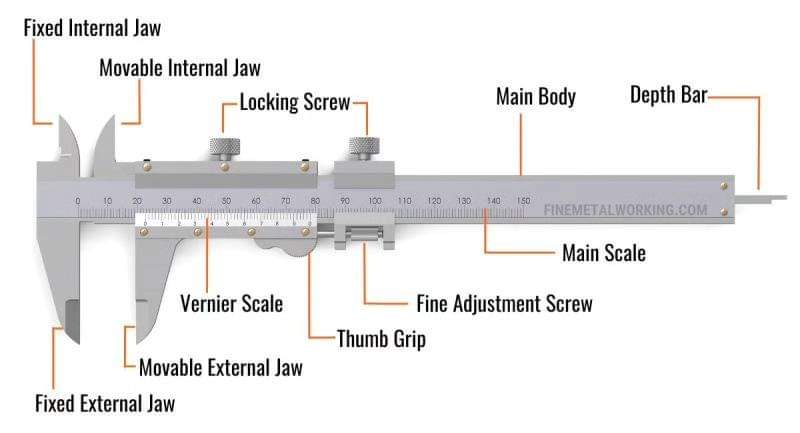
Vernier Caliper: Parts and Measurement Types
5 Best Vernier Calipers Reviewed
1. Mitutoyo 530-312 — Best Analog Vernier for ISO 9001 and ASME QC Work
For any fabrication shop operating under an ASME or ISO 9001-certified quality management system, the Mitutoyo 530-312 is the reference-grade analog vernier caliper. Mitutoyo’s manufacturing tolerances on jaw flatness, parallelism, and scale graduation are tighter than those of any other brand in the Indian market — and this shows in measurement repeatability over thousands of cycles.
This caliper satisfies ISO 9001 Clause 7.1.5 calibration requirements without immediate third-party recalibration on receipt. The 14-degree vernier face angle is a Mitutoyo-specific design that reduces parallax reading error — a significant advantage when taking rapid readings on a busy shop floor. The 50-division scale allows readings to 0.02 mm, which covers all standard weld joint dimensional checks: groove angle, root face, root gap, and component OD/ID verification as required during fit-up inspection.
Pros
- 14-degree face angle reduces parallax error
- Hardened stainless steel — resists shop-floor wear
- Dual metric/inch scale
- Consistent jaw parallelism across full range
- No battery dependency — works in all environments
Cons
- No digital readout — slower for high-volume recording
- Premium price versus mid-range alternatives
- Comes only in thin vinyl sleeve — no hard case
2. Mitutoyo 500-196-30 — Best Digital Caliper for Inspection Speed and Data Output
When inspection throughput matters — multi-point dimensional checks on a batch of nozzles, or rapid fit-up verification on a production line — a digital caliper eliminates parallax error and reading time entirely. The Mitutoyo 500-196-30 with AOS (Advanced Onsite Sensor) Absolute technology is the professional digital standard used across Indian oil and gas, power, and pressure vessel fabrication QC departments.
The ABS (Absolute) encoder retains its reference position even after power-off — critical for consistent measurement across a shift without re-zeroing. This is particularly valuable for inspectors working to a formal welding inspection checklist with multiple hold points spread over hours. The 0.01 mm resolution — twice that of a standard 50-division vernier — is useful when checking tight-tolerance groove land dimensions or verifying component dimensions against drawings with ±0.1 mm tolerances. The optional SPC data output port connects to statistical process control systems, satisfying ISO 9001 production monitoring requirements.
Pros
- ABS encoder — no re-zeroing after power-off
- 0.01 mm resolution — highest available in hand-held caliper
- SPC data output port for QC system integration
- Instant mm/inch switching
- ~3.5 year battery life (SR44)
Cons
- Battery dependency — failure risk in remote or offshore environments
- LCD difficult to read in direct outdoor sunlight
- Highest price point in this comparison
3. Insize 1112-150 — Best Budget Digital Caliper for Fabrication Workshop Use
Insize is a Taiwan-based precision instrument manufacturer with ISO 17025-accredited calibration facilities. Their 1112-150 digital caliper occupies the middle ground between premium Mitutoyo instruments and the low-end import market — offering hardened stainless steel construction, DIN 862 compliance, and reliable digital output at roughly half the cost of the Mitutoyo 500-196-30. For fabrication workshops and inspection departments operating under budgetary constraints, this is the most technically defensible mid-range choice.
DIN 862 compliance is a meaningful quality indicator — it means the instrument has been manufactured and tested against defined tolerance limits for jaw flatness, beam straightness, and scale accuracy. This is verifiable by third parties, unlike generic “high precision” marketing claims. For applications where a micrometer is needed for tighter tolerances, the Insize caliper handles the first-pass dimensional check. The foam-lined protective case included with the 1112-150 is a practical detail that budget calipers often omit.
Pros
- DIN 862 compliant — independently verifiable quality
- Hardened stainless steel with foam case
- 0.01 mm digital resolution
- mm/inch switchable — useful for ASME imperial drawings
- Strong value at mid-range price (~₹2,200–2,500)
Cons
- Accuracy ±0.03 mm — slightly looser than Mitutoyo’s ±0.02 mm
- No SPC/data output port
- Jaw movement less fluid than Mitutoyo
4. Mitutoyo 500-181-30 Digimatic — Best Entry-Level Mitutoyo Digital Caliper
The Mitutoyo 500-181-30 Digimatic is the entry point into Mitutoyo’s digital caliper range — offering the brand’s jaw quality and stainless construction at a lower price than the 500-196-30, without the ABS absolute encoder. For inspectors who do not need ABS (and are comfortable zeroing the caliper each session), this is the most cost-effective way to get Mitutoyo build quality in a digital format. It is particularly suited to welding engineers performing material checks and weld parameter verification who need fast digital reading without the full professional-grade price.
Pros
- Mitutoyo jaw quality and SS construction at lower price
- ±0.02 mm accuracy — matches the 500-196-30
- 0.01 mm LCD resolution
- Robust, reliable for regular workshop use
Cons
- No ABS encoder — must re-zero at each session
- No SPC data output port
- Limited stock availability on Amazon.in
5. Insize 1112-300 — Best 300mm Digital Caliper for Large Nozzle and Pipe OD Measurement
A 150 mm caliper covers approximately 90% of welding inspection dimensional tasks. But for pressure vessel nozzle bores above DN150, large pipe OD checks, or flange face diameter verification, a 300 mm range instrument is essential. The Insize 1112-300 fills this gap — the same DIN 862-compliant, hardened stainless steel construction as the 1112-150 but with double the range. This covers nozzle bore checks from DN50 through approximately DN250 without needing a pi tape or separate bore gauge — relevant for ASME Section VIII pressure vessel inspectors where nozzle reinforcement area calculations require accurate bore diameter measurement. Our pipe weight calculator frequently references the nominal vs actual OD distinction that makes accurate caliper measurement on large-bore components critical.
Pros
- 300 mm range covers large nozzles and pipe ODs
- DIN 862 compliant — verifiable quality standard
- Digital 0.01 mm display
- Extended jaws reach inside recessed features
Cons
- Accuracy ±0.04 mm — looser than 150 mm instruments
- Heavier and bulkier — fatigue in extended inspection sessions
- Not suitable as primary instrument for tight-tolerance work
Which Vernier Caliper Is Right for Your Application?
How to Choose a Vernier Caliper for Welding and Inspection Work
Selecting a vernier caliper for professional welding inspection or fabrication QC requires evaluating more than just the advertised accuracy. The instrument must survive shop conditions, support your calibration programme, and not introduce systematic errors into your dimensional records. Here are the criteria that matter in practice.
1. Resolution vs Accuracy — understanding the difference
Resolution (least count) is what the instrument can display: 0.02 mm for a standard 50-division vernier, 0.01 mm for digital models. Accuracy is the maximum error between the displayed reading and the true value. A digital caliper showing 0.01 mm resolution may carry ±0.03 mm accuracy — meaning it displays a value to 0.01 mm but that value could be wrong by up to 0.03 mm. For weld inspection tolerances of ±0.5 mm or better, any instrument in this guide is adequate. For tight-tolerance machined components, use Mitutoyo instruments with ±0.02 mm accuracy.
LC = MSD / N
Where: MSD = smallest main scale division (mm), N = number of vernier divisions
Example — 50 division vernier, 1mm main scale:
LC = 1 mm / 50 = 0.02 mm
Final Reading Formula:
Reading = MSR + (n x LC) – Zero Error
MSR = Main Scale Reading, n = coinciding vernier division
Example: MSR = 24mm, n = 14, LC = 0.02mm → Reading = 24 + (14 x 0.02) = 24.28 mm
2. Stainless steel is non-negotiable for shop use
Carbon steel calipers — even chrome-plated ones — corrode at the jaw faces and scale engravings in a fabrication environment. Hardened stainless steel resists the abrasive grit from grinding, cutting oils, humidity, and the metal dust common on shop floors. Any caliper used more than occasionally in an industrial environment should be hardened stainless throughout — beam, jaws, and depth bar.
3. Analog vernier vs digital — the professional trade-off
Digital calipers are faster, eliminate parallax errors, and support data output. For high-volume inspection they are the productivity choice. However, they have a hard failure mode: battery death. Analog vernier calipers function in any environment and have no electronics to fail. Many experienced inspectors carry one of each: a digital for workshop use and an analog for offshore or remote site work. Our vernier scale reading guide covers the technique for getting maximum accuracy from an analog instrument.
4. Range — match to your application
A 150 mm caliper covers 90% of welding inspection tasks. For large-bore nozzles, shell OD checks, or flange OD verification above DN150, a 300 mm instrument is required. Avoid using a 300 mm caliper as your primary instrument — longer beams are more susceptible to deflection and handling damage, and accuracy specifications are typically looser. Use it as a supplementary range instrument alongside your 150 mm primary.
5. Calibration traceability — ISO 9001 and ASME requirements
Under ISO 9001:2015 Clause 7.1.5 and ASME QC-1, all measurement instruments used in product inspection must be calibrated at defined intervals against standards traceable to national measurement institutes (NPL in India, NIST in the USA). Budget instruments that cannot be economically sent for third-party calibration create a compliance gap. This is why professional QC departments specify Mitutoyo — the calibration infrastructure supports the full instrument lifecycle at predictable cost.
| Vernier Type | Least Count | Battery | Best Environment | QC Suitability |
|---|---|---|---|---|
| 10-division analog | 0.1 mm | None | Field, rough use | Basic |
| 20-division analog | 0.05 mm | None | Workshop, field | Moderate |
| 50-division analog | 0.02 mm | None | All environments | Good |
| Digital (standard) | 0.01 mm | Yes | Workshop, lab | Good |
| Digital with ABS + SPC | 0.01 mm | Yes | ISO 9001 workshop | Excellent |
Vernier Caliper in Practice
Recommended Books: Metrology and Precision Measurement
Frequently Asked Questions
What is the least count of a standard vernier caliper used in weld inspection?
Can a vernier caliper measure weld reinforcement height?
What material should a vernier caliper be for welding shop use?
What is the difference between digital and vernier caliper for inspection work?
How often should a vernier caliper be calibrated in a QC environment?
Which vernier caliper brand is best in India for engineering and inspection use?
What range of vernier caliper is most useful for pressure vessel and piping inspection?
Our Verdict
For welding engineers and QC inspectors working under ISO 9001 or ASME quality programmes, the Mitutoyo 530-312 is the correct analog vernier — the 14-degree anti-parallax scale and hardened stainless construction justify the premium for any environment where electronics cannot be relied upon. For inspection departments that need digital speed and data output, the Mitutoyo 500-196-30 with ABS absolute encoder is the professional standard.
For fabrication workshops needing a reliable digital caliper without the full Mitutoyo price, the Insize 1112-150 is the most defensible mid-range choice, with DIN 862 compliance providing an independently verifiable quality benchmark. The Mitutoyo 500-181-30 bridges the gap for engineers who want Mitutoyo build quality in a digital format at a lower price than the ABS model. And for any job involving large-bore nozzle measurement or pipe OD verification above DN150, the Insize 1112-300 fills the range gap that a 150 mm instrument cannot reach.
For the complete technique on reading any of these instruments accurately, visit our vernier scale reading guide. For tighter-tolerance dimensional work, our micrometer guide covers the next step up in precision. Engineers performing dimensional inspection as part of a formal QC programme should also review our welding inspection checklist.