Elbow Weight Calculator With Complete guide
A pipe elbow is the most widely used piping fitting for changing the direction of a pipe run. Used in virtually every industrial facility — oil & gas, petrochemical, power generation, pharmaceuticals, and water treatment — elbows are specified in 90° and 45° turns, in long-radius (LR = 1.5D) and short-radius (SR = 1D) configurations. Accurately estimating elbow weight is essential for material take-offs (MTO), spool weight calculations, weld cladding consumable estimation, freight planning, and project cost control.
What is a Pipe Elbow?
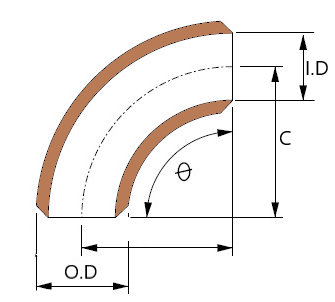
A pipe elbow (also called a pipe bend or elbow fitting) is a curved fitting used to change the direction of a piping system. Unlike a mitre cut on straight pipe, an elbow is a purpose-manufactured fitting with a smooth, consistent radius designed to minimise pressure drop and turbulence at direction changes. Elbows are manufactured to ASME B16.9 (factory-made wrought buttwelding fittings) for butt-welded connections, and to ASME B16.11 for socket-welded and threaded connections.
Understanding elbow weight is critical for:
- Weld cladding consumable estimation — when elbows are clad with corrosion-resistant overlay, the consumable quantity depends on the elbow’s outer surface area, which is related to its weight
- Price calculation — fittings are often bought and sold by weight (per kilogram) from distributors, making accurate weight essential for cost control
- Freight charges — shipping costs for piping fittings are typically weight-based, so accurate weight data prevents surprises at the logistics stage
- Spool weight and lift planning — pre-fabricated pipe spools with multiple elbows must have total weight calculated for crane and rigging selection
Long Radius vs Short Radius Elbows
The two standard elbow radius types defined in ASME B16.9 are the long radius (LR) and short radius (SR) elbow. The designation refers to the bend radius relative to the pipe nominal bore (nominal pipe size):
| Parameter | Long Radius (LR) | Short Radius (SR) |
|---|---|---|
| Bend Radius (R) | R = 1.5 × NPS (= 1.5D) | R = 1.0 × NPS (= 1D) |
| Centre-to-End (C) for 90° | C = 1.5 × NPS | C = 1.0 × NPS |
| Weight (relative) | Heavier (~50% more vs SR) | Lighter |
| Pressure Drop | Lower (smoother flow) | Higher (sharper turn) |
| Space Required | More axial length | Compact |
| Cost | Higher (more material) | Lower |
| Typical Application | Process piping, ASME B31.3, general service | Tight spaces, utility lines, rack piping |
| Standard Reference | ASME B16.9 | ASME B16.9 |
The Elbow Weight Formula — Explained
The standard industry formula for calculating the weight of a butt-welding pipe elbow (90° or other angles) is derived from the geometry of a section of a torus (a donut-shaped solid). The formula used widely in piping engineering is:
Unit: kg/piece · Valid for a 90° elbow at the base
Variable Definitions W = Weight (kg per piece)
S = Wall thickness (mm)
D = Outside diameter (mm)
R = Bending radius (mm) = 1.5D for LR, 1.0D for SR
For Angles Other Than 90° W_θ = W_90° × (θ / 90)
e.g. 45° elbow weight = W_90° × 0.5 · 60° elbow = W_90° × 0.667
Where Does the 0.0387 Factor Come From?
The constant 0.0387 encapsulates the geometry of the torus cross-section and unit conversions. Deriving it from first principles:
Cross-sectional area of pipe wall = π × (D − S) × S (thin-wall approximation)
Volume = Arc length × Cross-sectional area = (π/2) × R × π × (D−S) × S
Weight = Volume × Density ÷ 1,000³ (mm³ → m³, × 7850 kg/m³)
W = (π²/2) × S × (D−S) × R × 7850 / 1,000³
W = 4.935 × 10⁻⁸ × 7850 × S × (D−S) × R / 1 = 0.0387 × S × (D−S) × R / 1000
This confirms the standard constant assumes carbon steel density (7,850 kg/m³). For other materials, the calculator scales the result proportionally.
Worked Calculation Example
Using the original article’s example: 90° Long Radius Elbow, 6″ SCH 40, Carbon Steel (ASTM A234 WPB)
Angle: 90° · Material: Carbon Steel (7850 kg/m³)
Applying the Formula W = 0.0387 × S × (D − S) × R / 1000
W = 0.0387 × 7.11 × (168.3 − 7.11) × 252.45 / 1000
W = 0.0387 × 7.11 × 161.19 × 252.45 / 1000
W = 0.0387 × 289,138 / 1000
W = ≈ 11.19 kg/piece
This matches published manufacturer data (approx. 11 kg for a 6″ SCH40 90° LR BW elbow ✓)
Pipe Diameter & Thickness Reference Chart
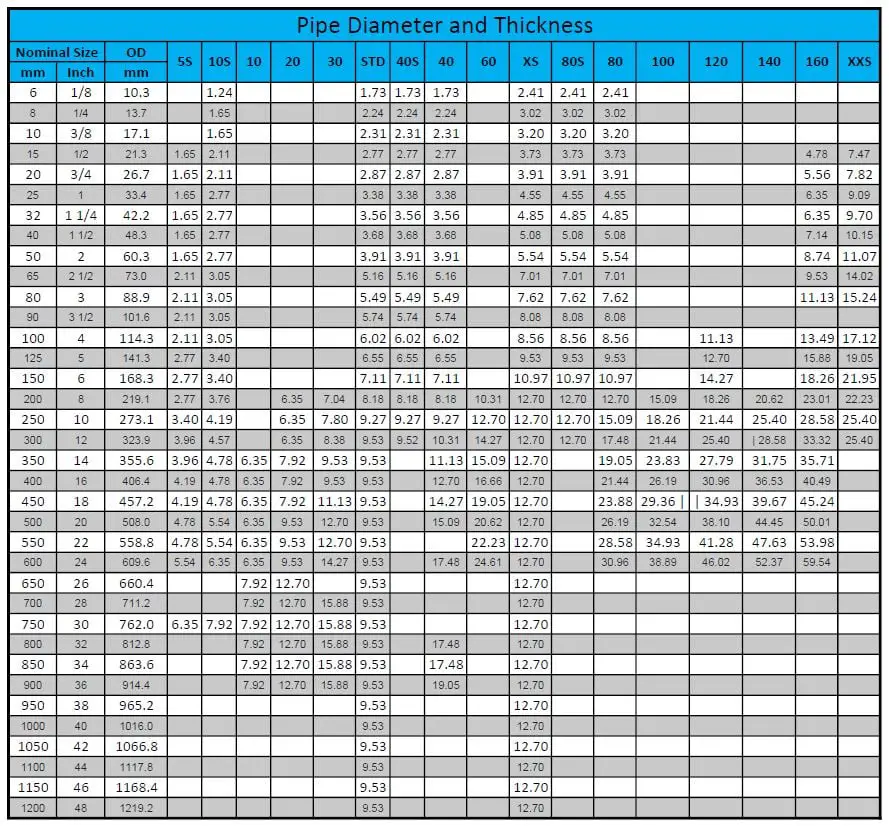
To use the elbow weight formula, you first need the pipe’s outside diameter (OD) and wall thickness (S) for the given NPS and schedule. The chart below provides standard dimensions from ASME B36.10 for the most common pipe sizes. Use these values directly in the calculator above for accurate results.
90° Elbow Weight Reference Charts
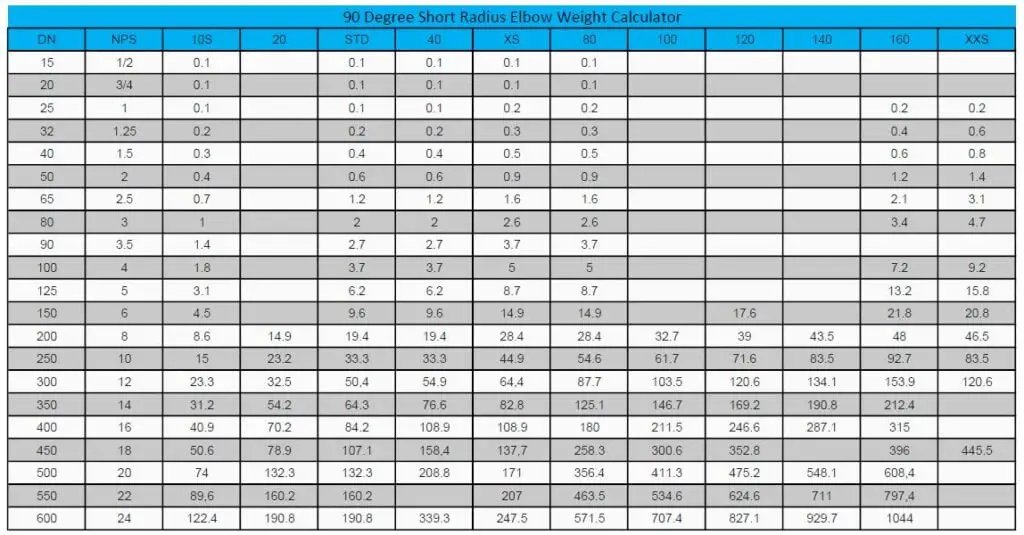
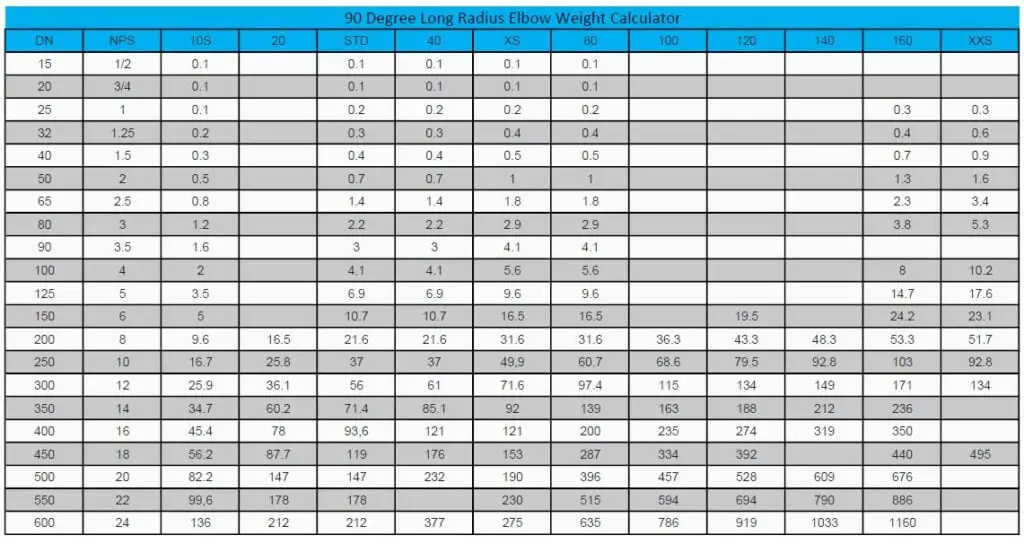
The following reference tables give pre-calculated weights for the most common 90° elbow sizes in carbon steel (density 7,850 kg/m³). These match the published manufacturer data charts reproduced below. For materials other than carbon steel, multiply by the density ratio (e.g., for stainless steel 304: multiply by 7980/7850 = 1.017).
Short Radius (SR) 90° Elbow Weight Chart — Carbon Steel
Long Radius (LR) 90° Elbow Weight Chart — Carbon Steel
90° Elbow Approximate Weights (Carbon Steel)
For quick reference without needing to read chart images, the table below provides calculated weights for standard 90° carbon steel elbows in both LR and SR configurations across common NPS sizes and SCH 40 / SCH 80 wall thicknesses:
| NPS | OD (mm) | SCH | T (mm) | 90° LR Weight (kg) | 90° SR Weight (kg) | 45° LR Weight (kg) |
|---|---|---|---|---|---|---|
| ½” | 21.3 | 40 | 2.77 | 0.06 | 0.04 | 0.03 |
| ½” | 21.3 | 80 | 3.73 | 0.07 | 0.05 | 0.04 |
| 1″ | 33.4 | 40 | 3.38 | 0.18 | 0.12 | 0.09 |
| 1″ | 33.4 | 80 | 4.55 | 0.23 | 0.15 | 0.12 |
| 2″ | 60.3 | 40 | 3.91 | 0.79 | 0.53 | 0.40 |
| 2″ | 60.3 | 80 | 5.54 | 1.07 | 0.71 | 0.54 |
| 3″ | 88.9 | 40 | 5.49 | 2.65 | 1.77 | 1.33 |
| 3″ | 88.9 | 80 | 7.62 | 3.56 | 2.37 | 1.78 |
| 4″ | 114.3 | 40 | 6.02 | 5.46 | 3.64 | 2.73 |
| 4″ | 114.3 | 80 | 8.56 | 7.57 | 5.05 | 3.79 |
| 6″ | 168.3 | 40 | 7.11 | 11.19 | 7.46 | 5.60 |
| 6″ | 168.3 | 80 | 10.97 | 16.66 | 11.11 | 8.33 |
| 8″ | 219.1 | 40 | 8.18 | 24.13 | 16.09 | 12.07 |
| 8″ | 219.1 | 80 | 12.70 | 36.36 | 24.24 | 18.18 |
| 10″ | 273.1 | 40 | 9.27 | 46.16 | 30.77 | 23.08 |
| 10″ | 273.1 | 80 | 12.70 | 62.20 | 41.47 | 31.10 |
| 12″ | 323.9 | 40 | 9.53 | 67.69 | 45.13 | 33.85 |
| 12″ | 323.9 | 80 | 12.70 | 89.10 | 59.40 | 44.55 |
| 16″ | 406.4 | 40 | 9.53 | 107.26 | 71.51 | 53.63 |
| 20″ | 508.0 | 40 | 9.53 | 168.13 | 112.09 | 84.07 |
| 24″ | 610.0 | 40 | 9.53 | 242.14 | 161.43 | 121.07 |
Weights calculated using W = 0.0387 × S × (D−S) × R / 1000 for carbon steel (7,850 kg/m³). LR: R=1.5D, SR: R=1D. 45° LR = 50% of 90° LR weight.
Why Elbow Weight Matters in Piping Engineering
Pipe elbows are the most numerous fitting type in most piping systems. A typical process plant may contain thousands of elbows across all pipe sizes, and their cumulative weight makes a significant contribution to structural load and project cost. Here is why accurate elbow weight calculation matters at each stage of a project:
1. Material Take-Off (MTO) and Procurement
Fittings suppliers quote elbows by unit price or by weight per tonne. Quantity surveyors generate a Material Take-Off (MTO) from the isometric drawings — counting every elbow by size, schedule, material, and type — and convert to total tonnage for budget estimation. A systematic error in elbow weight (such as consistently using SR weights for LR elbows) can misrepresent the MTO by 30–50% for the fittings component, leading to significant cost overruns.
2. Weld Cladding Consumable Estimation
When elbows are clad with a corrosion-resistant weld overlay (e.g., Inconel 625 or ER309L stainless over carbon steel elbows), the consumable quantity depends on the total surface area to be clad. Surface area correlates closely with weight — so knowing the elbow weight per piece allows the welding engineer to estimate consumable quantities even before detailed surface area calculations are performed, using a density-based back-calculation.
3. Spool Weight and Crane Lift Planning
Pre-fabricated pipe spools are lifted from the fabrication shop to the installation site using cranes. Every spool must have a documented weight calculation for the lift plan, covering all pipe sections, elbows, flanges, valves, and appurtenances. Accurate elbow weights are essential for this calculation. An undersized crane selection caused by underestimated fitting weights is a serious safety risk.
4. Freight and Logistics
Import duties, shipping charges, and storage handling fees for piping fittings are typically weight-based. Accurate weight data allows the project logistics team to optimise container loading, avoid overweight charges, and produce accurate freight cost estimates during the tender phase.
Elbow Materials — Common Grades & Standards
Pipe elbows are available in a wide range of materials to suit different process conditions. The material must be compatible with the connecting pipe specification and the applicable design code. The table below summarises the most common elbow materials in industrial piping:
| Material | Common ASTM Grade | Density (kg/m³) | Temperature Range | Typical Service |
|---|---|---|---|---|
| Carbon Steel | ASTM A234 WPB / WPC | 7,850 | −29°C to +425°C | General process, steam, water, oil |
| Low-Temp Carbon Steel | ASTM A420 WPL6 | 7,850 | Down to −46°C | Cryogenic, LNG, low-temp service |
| Alloy Steel (1¼ Cr-Mo) | ASTM A234 WP11 | 7,750 | Up to +540°C | High-temp power piping, boiler lines |
| Alloy Steel (2¼ Cr-Mo) | ASTM A234 WP22 | 7,750 | Up to +595°C | High-temp power and petrochemical |
| Stainless Steel 304/316L | ASTM A403 WP304L/316L | 7,980 | −196°C to +815°C | Corrosive service, food, pharma |
| Duplex SS (2205) | ASTM A815 UNS S31803 | 7,800 | −50°C to +300°C | Offshore, sour service, seawater |
| Nickel Alloy (Inconel 625) | ASTM B366 UNS N06625 | 8,440 | Up to +980°C | Severe corrosion, high-temp chemical |
Frequently Asked Questions
What is the formula for elbow weight calculation?
What is the difference between LR and SR elbows?
Does a 45° elbow weigh half as much as a 90° elbow?
What standard governs pipe elbow dimensions?
Why is the wall thickness of an elbow important in the formula?
How do I convert elbow weight from carbon steel to stainless steel?
What is the “C” dimension on an elbow?
More WeldFabWorld Calculators & Tools
Use these free tools alongside the elbow calculator for complete pipe spool weight estimation and welding project planning: