Thermal Expansion, Contraction and Weld Distortion: What Every Inspector Must Know
Weld distortion is one of the most common and costly problems in welded fabrication — and it is entirely predictable. Structures warp, plates bow, joints misalign, and dimensional tolerances are violated, all as a direct consequence of the non-uniform thermal cycle imposed by welding. Understanding the physical and metallurgical mechanisms behind thermal expansion and contraction allows the welding inspector to appreciate why dimensional control measures are specified, to verify that those measures are being properly implemented, and to assess deviations with technical authority rather than procedural habit.
This guide covers the full distortion cycle from first principles: the physics of thermal expansion, the mechanism of constrained contraction, the five principal distortion modes, the variables that govern their severity, and the suite of control measures available to the fabricator. A worked thermal expansion calculator is provided for quick quantitative assessment in the field or office. Practical inspector checklists and code references are integrated throughout.
The Mechanism of Thermal Expansion
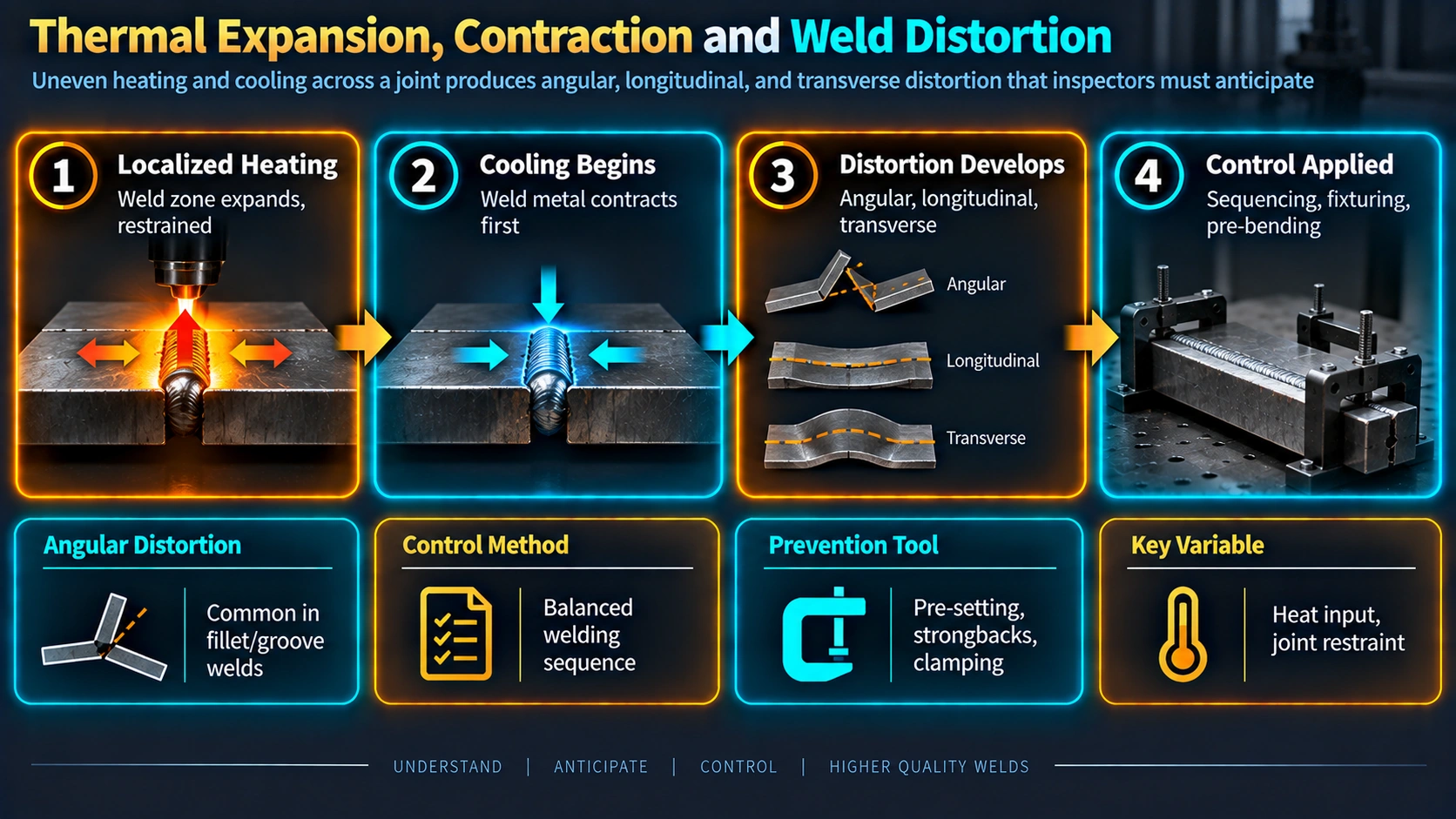
When heat is applied to a metal, the internal energy of its atoms increases, causing them to vibrate with greater amplitude about their equilibrium positions in the crystal lattice. This increased vibrational amplitude increases the average interatomic spacing — the average distance between neighbouring atoms — which manifests at the macroscopic scale as thermal expansion: the material gets physically larger in all dimensions.
Every metal and alloy has a characteristic coefficient of thermal expansion (CTE), commonly designated by the Greek letter alpha (α). The CTE expresses the fractional change in length per unit temperature rise, in units of m/(m.°C) or equivalently mm/(mm.°C) or simply 1/°C. The fundamental linear thermal expansion formula is:
Under uniform heating — as in a controlled furnace — the entire part expands uniformly in all directions. On uniform cooling, it contracts uniformly back to its original dimensions. No permanent distortion results from truly uniform, unconstrained heating and cooling. This is the critical distinction between furnace heat treatment and welding.
Thermal Expansion / Shrinkage Calculator
Calculate the thermal expansion or contraction of a weld zone, pipe span, or structural member. Useful for estimating shrinkage allowances and preheat effects.Why Welding Creates Non-Uniform Expansion
The welding arc is, by design, a localised heat source. It deposits intense thermal energy into a very small zone — typically a few millimetres wide — while the surrounding base metal may be at ambient temperature or, at most, at preheat temperature. This temperature gradient is at the root of every distortion and residual stress problem in welded fabrication.
The sequence of events in the weld zone can be understood as two linked phases:
Phase 1: The Expansion (Heating) Cycle
As the arc traverses the joint:
- The metal directly under the arc is heated rapidly to temperatures at or above the solidus (for the weld pool) or into the austenite range (for the HAZ)
- This hot metal attempts to expand, with a magnitude given by α × L × ΔT
- The surrounding cooler metal, which has expanded far less, physically restrains this expansion
- Because the hot metal is soft (yield strength of steel drops to below 50 MPa above 900°C, compared to 250–400 MPa at room temperature), it deforms plastically rather than pushing against the restraint elastically
- The hot metal is effectively upset — compressed and thickened — by the restraint of the surrounding cool metal
Phase 2: The Contraction (Cooling) Cycle
When the arc moves away or is extinguished:
- The previously hot, upset metal cools and attempts to contract by the same amount it expanded — but it is now shorter than the original base metal due to the plastic upsetting in Phase 1
- This contraction is resisted by the surrounding base metal, which has cooled and regained its full strength
- The result is that the weld zone is held in tension — it wants to be shorter but is being stretched by the base metal
- The adjacent base metal is placed in compression — being squeezed by the weld zone attempting to contract
- These locked-in stresses (residual stresses) cause the assembly to distort in the direction of the dominant tensile force
Contraction Phase and Residual Stress
The residual stress that remains in a weldment after it has cooled to ambient temperature is not a side effect of welding — it is an inevitable consequence of the constrained contraction mechanism. In the weld zone and CGHAZ, residual tensile stresses can approach or equal the yield strength of the material. In the adjacent base metal, balancing compressive stresses develop. These stresses are completely internal: the weldment is in equilibrium, but with a highly non-uniform stress distribution locked into its microstructure.
The Weld Shrinkage Rules of Thumb
For practical fabrication planning, empirical rules of thumb for weld shrinkage are widely used to allow for material to be pre-cut slightly longer or wider than the final dimension:
Types of Weld Distortion
Weld distortion manifests in five principal modes, each with different geometric characteristics, different root causes within the thermal expansion/contraction cycle, and different control and correction strategies. An inspector should be able to identify each type visually and understand what fabrication conditions produced it.
1. Transverse Shrinkage
Shortening perpendicular to the weld axis. The joint gap closes inward as the weld metal contracts transversely on cooling. Typically 1–4 mm per weld in structural steels depending on plate thickness and heat input. Must be allowed for in part sizing and fit-up.
2. Longitudinal Shrinkage
Shortening parallel to the weld axis. The weld bead is slightly shorter than the joint it filled after cooling. Less pronounced than transverse shrinkage but cumulative in long welds and assemblies with many joints.
3. Angular Distortion
Rotation of plates about the weld axis. Caused by differential contraction through the weld thickness: the top of the weld cools first (or is deposited last and contracts more) and pulls the plate edges upward. Particularly severe in multi-pass single-V or single-bevel joints where weld metal volume is asymmetric.
4. Longitudinal Bowing (Bending)
Curved deflection of the fabrication along its length. Occurs when welding is asymmetric about the neutral axis of the section — for example, welding a flange to one side of a web without balancing the other side. The weld metal contracting on one side introduces a bending moment that curves the section.
5. Buckling (Thin Plate Distortion)
Out-of-plane wavy or buckled distortion in thin plate panels. Occurs when the compressive residual stresses induced in the base metal adjacent to the weld exceed the local buckling resistance of the plate. More common in plate below 6–8 mm thickness and in high heat input processes. Also called “oil-canning” distortion.
6. Rotational Distortion
In-plane rotation of joint members relative to each other. Occurs because the weld at the start of the joint contracts before the weld at the end is deposited, causing the free end to close the root gap or open further as the joint is welded. Controlled by tacking at suitable intervals or using a welding sequence that works from the centre outward.
Factors That Influence the Degree of Distortion
The magnitude of all distortion types is governed by the same fundamental variable: the volume of metal heated, the temperature it reaches, and the degree to which its contraction is constrained. The following fabrication variables each directly affect one or more of these parameters.
| Factor | Effect on Distortion | Inspector Action | Severity |
|---|---|---|---|
| Heat input (kJ/mm) | Higher heat input = more thermal energy deposited = more expansion and contraction = more distortion | Verify heat input is within WPS limits; check amperage, voltage, and travel speed records | High impact |
| Number of weld passes | Each pass adds incremental shrinkage; cumulative effect increases with pass count | Verify weld pass sequence matches WPS; check for excess passes | High impact |
| Base metal thickness | Thin sections distort more easily (lower bending rigidity); thick sections provide more restraint but accumulate higher residual stress | Confirm dimensional tolerances appropriate for section thickness; extra vigilance on <8 mm plate | Medium impact |
| Joint type and geometry | Single-sided joints (single V, single bevel) distort more than double-sided; asymmetric weld volumes cause angular distortion | Check that joint prep matches drawing; verify double-sided joint access is maintained | High impact |
| Degree of joint restraint | Heavily restrained joints distort less but develop higher residual stresses; unrestrained joints distort more freely but at lower stress | Note jig/fixture use in fabrication records; consider stress implications of high restraint | Medium impact |
| Welding sequence | Unbalanced sequences accumulate distortion; balanced and backstep sequences reduce net distortion | Witness welding sequence against WPS; note deviations from specified sequence | High impact |
| Fit-up quality (root gap, mismatch) | Excessive root gap increases weld volume and therefore shrinkage; poor alignment magnifies angular effects | Measure and record fit-up dimensions (root gap, hi-lo, alignment) before welding begins | Medium impact |
| Preheat and interpass temperature | Preheat reduces the temperature differential between weld zone and base metal, reducing the constraint and slightly reducing distortion; high interpass temperature slows cooling and reduces distortion | Verify preheat and interpass temperature against WPS minimum/maximum limits | Moderate impact |
| Material CTE | Materials with higher CTE (austenitic SS: ~17 ×10⁻&sup6;/°C vs carbon steel: ~12 ×10⁻&sup6;/°C) expand and contract more per degree, increasing distortion potential | Apply extra vigilance on stainless steel, nickel alloy, and aluminium fabrications | Medium impact |
Thermal Expansion Data for Common Weld Materials
The coefficient of thermal expansion varies significantly across the alloy families commonly encountered in welded fabrication. These values are used directly in the thermal expansion calculator above and in the distortion estimation formulas.
| Material | ASME P-Number | CTE at 20–300°C (×10⁻&sup6; /°C) | CTE at 20–600°C (×10⁻&sup6; /°C) | Relative Distortion Risk vs C-Steel |
|---|---|---|---|---|
| Carbon steel (C-Mn, SA-516) | P1 | 12.0 | 13.5 | Baseline |
| C-0.5Mo steel | P3 | 12.5 | 13.8 | Similar |
| 1.25Cr-0.5Mo (P11) | P4 | 12.0 | 13.2 | Similar |
| 2.25Cr-1Mo (P22) | P5A | 11.7 | 13.0 | Slightly lower |
| 9Cr-1Mo-V (P91) | P5B Gr.2 | 10.8 | 12.0 | Lower |
| Austenitic SS 304/304L | P8 | 17.2 | 18.0 | 43% higher |
| Austenitic SS 316/316L | P8 | 16.5 | 17.5 | 38% higher |
| Duplex SS 2205 | P10H | 13.0 | 14.2 | 8% higher |
| Nickel alloy (Inconel 625) | P43 | 12.8 | 14.0 | Similar |
| Aluminium 6061 | P21 | 23.6 | 25.2 | 97% higher |
| Copper (commercially pure) | P31 | 17.0 | 18.0 | 42% higher |
Distortion Control Methods
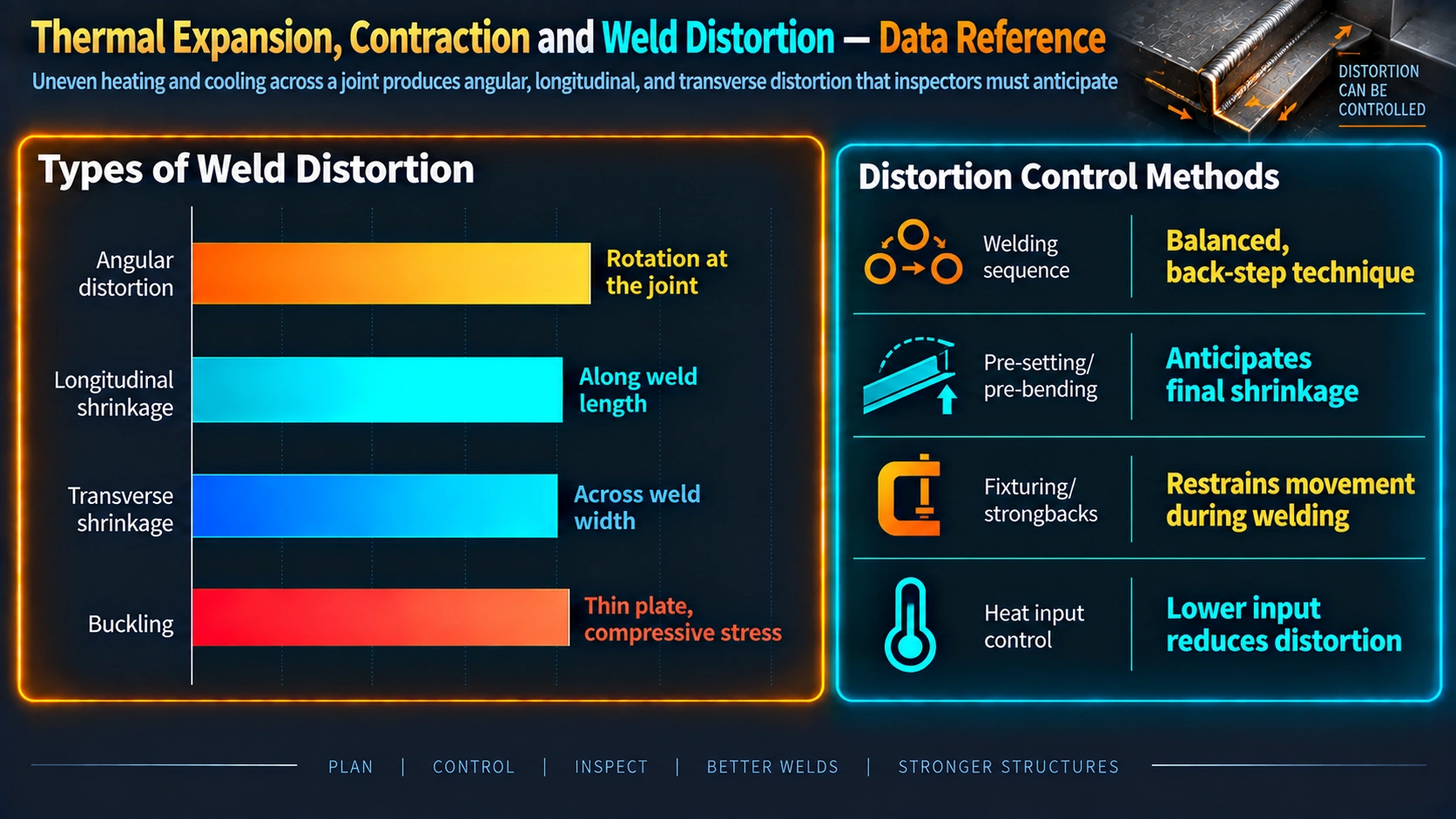
Distortion control is most effective when applied proactively — before and during welding — rather than reactively after distortion has occurred. The available control methods fall into three categories: design and planning measures, mechanical restraint, and thermal management.
Design and Planning Measures
- Minimise weld volume — Use the minimum groove angle and root gap that still permits full fusion. Smaller weld cross-sections produce less shrinkage. Consider double-sided joints to balance the thermal cycle about the neutral axis.
- Symmetric joint design — Double-V and double-bevel joints distribute weld volume symmetrically about the plate centreline, balancing the shrinkage forces and eliminating angular distortion.
- Minimise the number of weld passes — Each pass adds incremental shrinkage. Use the largest electrode or wire consistent with the heat input limit to reduce pass count.
- Pre-setting (pre-cambering) — Intentionally offsetting joint members before welding in the direction opposite to the expected distortion, so that when the weld cools, the joint moves toward its correct dimensional position. Essential for T-joints and single-bevel butt welds.
Mechanical Restraint
- Jigs and fixtures — Rigidly clamping the workpiece prevents free distortion during welding. The weld cools in the constrained shape, minimising geometric distortion. Note that this transfers the distortion into higher residual stresses; PWHT is usually required to relieve these after fixture release.
- Tack welds — Properly sized and spaced tack welds maintain fit-up and prevent joint closure during welding. Inspect tack weld quality (cracks, incomplete fusion) before permitting run-on welding, particularly in high-strength or cold-sensitive steels.
- Strong-backs and run-on/off tabs — Temporary structural attachments that increase the rigidity of the assembly. Must be removed in accordance with the drawing and code requirements after welding is complete.
Thermal Management
- Minimise heat input — Lower heat input directly reduces the volume and intensity of the thermal cycle. GTAW (TIG) and short-arc GMAW (MIG) processes typically offer better heat input control than SAW for distortion-sensitive work.
- Interpass temperature control — For austenitic stainless steels and thin plates, low maximum interpass temperatures (typically 150°C) reduce the cumulative heat build-up and help confine the thermal zone to each pass.
- Intermittent welding — Depositing short bead segments with cooling intervals reduces total heat input per unit time and allows partial stress relaxation between passes.
- Peening — Mechanical peening of intermediate weld passes plastically elongates the weld metal, counteracting the compressive upset during welding. Not permitted as a final pass treatment unless specifically approved by the applicable code and the responsible engineer. Verify that the WPS permits peening before witnessing it.
Welding Sequences and Their Effect on Distortion
The order in which weld passes — and weld joints in an assembly — are deposited has a significant effect on the cumulative distortion. The welding inspector must be familiar with the principal sequences to assess whether the correct approach is being followed.
| Sequence Type | Description | Best Application | Distortion Effect |
|---|---|---|---|
| Continuous (progressive) | Weld deposited from one end to the other in a single direction | Short welds, fully restrained joints, where rotational distortion is acceptable | Highest distortion |
| Backstep | Individual bead increments deposited in the direction opposite to overall weld progression | Long butt welds; welds where longitudinal shrinkage is a concern | Reduced longitudinal shrinkage |
| Balanced (alternating sides) | Equal amounts of weld deposited alternately on opposite sides of a double-sided joint or on both sides of a T-joint | Double-V butts; T-joints; column fabrication | Minimises angular distortion |
| Block sequence | Joint divided into short blocks, each completed in full before moving to the adjacent block | Repair welds; joints with high restraint where controlled heat distribution is needed | Moderate distortion control |
| Centre-to-end | Welding starts at the centre of the joint and progresses toward both ends simultaneously | Long butt welds in panels; plate girder flange welds | Reduces rotational distortion |
| Skip sequence | Short bead segments deposited at spaced intervals, then gaps filled in a second pass | Tack weld placement; first pass of thin plate assemblies | Distributes heat input |
Correcting Distortion After Welding
Despite best efforts at prevention, some degree of distortion may remain in a completed weldment. The acceptable magnitude of distortion is defined by the dimensional tolerances in the applicable engineering drawing or fabrication specification. When distortion exceeds these limits, correction is required. The two principal correction methods are:
Mechanical Straightening
Distorted components can be straightened by applying mechanical force — using presses, hydraulic jacks, or specialist straightening equipment — to bend the component back to its required shape. This is effective for simple bowing and angular distortion in structural sections but must be performed carefully to avoid introducing new cracking, particularly in already-welded joints or in materials sensitive to cold working (e.g., hardened steels, sensitised stainless steels).
Heat Straightening
Localised heating of specific zones on the convex side of a distorted member causes controlled thermal expansion and, on cooling, contraction in the desired direction. The most common technique is the vee heating method, in which a triangular pattern of heat (typically applied by oxy-gas torch) is applied to the outer surface of a bow or kink. Heat straightening is widely used for structural steel repair and in-service correction but requires experienced application to avoid introducing new distortion or metallurgical damage.
Inspector Checklist — Distortion Control During Fabrication
- Verify root gap, bevel angle, and alignment (hi-lo) are within drawing tolerance before welding begins
- Confirm tack weld size, spacing, and quality (check for cracks, underfill) are per WPS
- Verify preheat temperature is achieved and maintained at the correct distance from weld (typically 75 mm)
- Confirm welding sequence matches the WPS or approved fabrication procedure
- Monitor and record interpass temperature between passes; enforce maximum where specified (stainless steels, TMCP, duplex)
- Verify heat input calculations (voltage × current / travel speed) are within WPS limits at regular intervals
- Check dimensional compliance at intermediate stages (after root pass, after each side of a double-sided joint)
- Inspect strong-backs, run-ons, and attachments before removal; verify removal method (grinding) is as specified
- Measure final dimensions against drawing tolerances; document and flag any exceedances
- Confirm PWHT records (temperature, hold time, heat/cool rate, thermocouple placement) are complete before dimensional release of critical components
Role of the Welding Inspector
The welding inspector’s role in distortion management extends through the full fabrication cycle. It is not limited to measuring finished weldments against dimensional tolerances — by that stage, the opportunity for cost-effective control has largely passed.
Before welding, the inspector should verify that the WPS includes adequate distortion control measures (sequence, pre-setting, interpass temperature limits) and that the fabricator understands and is prepared to implement them. During welding, the inspector should monitor sequence compliance, heat input, interpass temperature, and dimensional progress at hold points defined in the Inspection and Test Plan (ITP). After welding, the inspector should verify that PWHT has been performed in compliance with the WPS and code requirements, and that final dimensional measurements are taken and documented before component release.
Understanding distortion mechanics also equips the inspector to assess the likely cause of any distortion that has occurred, to judge whether the distortion is within acceptable limits or requires correction, and to evaluate whether any proposed correction method is appropriate and code-compliant. These are not procedural judgements — they require the technical foundation that welding metallurgy provides.
The intersection of distortion management with mechanical testing is also significant: residual stresses from poor distortion control can influence hardness test results, bend test performance, and Charpy impact values, all of which are assessed in weld procedure qualification to ASME Section IX and equivalent standards.
Frequently Asked Questions
What causes weld distortion?
Weld distortion is caused by non-uniform thermal expansion and contraction during and after welding. The localised heat of the welding arc raises a small zone to near-melting temperatures while the surrounding base metal remains cool. The hot metal cannot expand freely and is plastically compressed (upset) by the surrounding cooler, stronger metal. On cooling, the upset zone cannot contract freely due to the same restraint, producing permanent dimensional change (distortion) and locked-in residual tensile stresses in the weld zone. The root mechanism is always the same: constrained differential thermal movement.
What are the main types of weld distortion?
The six principal types are: (1) transverse shrinkage — closing of the joint gap perpendicular to the weld; (2) longitudinal shrinkage — shortening parallel to the weld axis; (3) angular distortion — rotation of plates about the weld axis due to differential contraction through the thickness; (4) longitudinal bowing — curved deflection along the fabrication’s length due to asymmetric weld placement; (5) buckling — out-of-plane wavy distortion in thin plate due to compressive residual stresses; and (6) rotational distortion — in-plane rotation of joint members. Each type requires different control measures and different pre-setting compensations.
How does heat input affect weld distortion?
Heat input is directly proportional to the degree of distortion. Higher heat input means more thermal energy is deposited into the joint, creating greater peak temperatures, more volumetric expansion, and therefore more constrained contraction on cooling. Low heat input processes such as TIG/GTAW on thin sections produce less distortion than high heat input processes such as SAW for the same joint. Reducing heat input by reducing amperage, increasing travel speed, or reducing interpass temperature is one of the most effective and directly controllable distortion control measures available to the fabricator. Inspectors should verify that heat input records (voltage, amperage, travel speed) fall within WPS limits throughout welding.
What is the coefficient of thermal expansion and why does it matter in welding?
The coefficient of thermal expansion (CTE or α) is the fractional change in length of a material per unit temperature rise, in units of /°C. It determines how much a given length of material will expand when heated through a given temperature range, per the formula ΔL = α × L₀ × ΔT. In welding, materials with higher CTE — such as austenitic stainless steel (approximately 17 × 10⁻&sup6; /°C) — experience significantly more thermal expansion than carbon steel (approximately 12 × 10⁻&sup6; /°C) for the same heat input. This is why interpass temperature limits, low heat input processes, and careful sequencing are especially critical when welding stainless steels and aluminium alloys.
What is the backstep welding sequence and when is it used?
The backstep sequence is a welding technique in which individual bead increments are deposited in the direction opposite to the overall weld progression. Each increment ends where the previous one started, so although the overall weld advances from left to right, each individual segment is deposited right-to-left. This technique distributes the thermal input more uniformly along the weld length, reducing cumulative longitudinal shrinkage and rotational distortion. It is commonly used for long butt welds in structural fabrication, plate girder construction, and pipe spool assembly where dimensional control along the weld length is critical.
What is pre-setting and how does it control distortion?
Pre-setting (or pre-cambering) is the deliberate offsetting of joint members before welding to anticipate and compensate for expected distortion. The parts are positioned at an angle or camber opposite to the direction in which welding will cause them to move. When the weld contracts and rotates the joint, it moves toward the intended final shape rather than away from it. Pre-setting is most effective for T-joints and fillet-welded connections where angular distortion is predictable and repeatable. The required offset is determined by experience, trial welds on representative test pieces, or calculation. Inspectors should verify that the specified pre-set is achieved before welding begins, as it is difficult to confirm after the weld is deposited.
How does welding sequence affect distortion in a multi-pass weld?
In a multi-pass weld, each successive pass adds incremental shrinkage and residual stress. The sequence in which passes are deposited — and the sequence in which joints are welded in an assembly — can either accumulate distortion or balance it. Balanced welding (depositing equal amounts alternately on opposite sides of a double-V or double-bevel joint) minimises net angular distortion by counteracting the rotation produced by each side. Backstep and skip sequences reduce longitudinal shrinkage in long joints. Inspectors should verify that the WPS-specified sequence is being followed by observing weld deposit order and checking dimensional compliance at ITP hold points during fabrication.
Can postweld heat treatment correct weld distortion?
PWHT reduces residual stresses rather than correcting geometric distortion directly. By heating the weldment uniformly to the stress relief temperature and holding, residual stresses relax by slow plastic flow. This prevents further stress-driven distortion in service but does not restore a distorted component to its correct geometric shape. Geometric correction requires mechanical straightening or heat straightening. For pressure components, any straightening must be approved and code-compliant; subsequent PWHT after straightening helps stabilise the corrected shape. Inspectors should confirm that final dimensional measurements are made after PWHT (which can itself introduce small distortions if heating is non-uniform) and before component release.