TIG Welding (GTAW) – Complete Guide & Working Principle
Gas Tungsten Arc Welding (GTAW), also known as TIG welding, is a captivating combination of science and craftsmanship. It is considered one of the most precise and versatile methods in the welding industry, capable of producing flawless and superior welds in different materials. In this guide we will explore the fundamental principles, necessary equipment, essential skills, wide-ranging applications, as well as the pros and cons of GTAW welding.
Principles of GTAW Welding
GTAW welding creates an electric arc between a non-consumable tungsten electrode and the workpiece. A shielding gas — typically argon or helium — simultaneously protects the weld pool from atmospheric contamination. Because the electrode doesn’t melt during the process, the result is a pure and precise weld bead.
Precise control of arc length and shielding gas flow are the cornerstones of a stable, clean weld. This makes GTAW the preferred choice whenever metallurgical quality and visual appearance are paramount.
Equipment Used in GTAW Welding
⚡ Power Source
A GTAW machine provides the electrical current needed for welding and can operate on either AC or DC. Inverter-based machines offer superior parameter control and portability.
TIG welding requires a constant current (CC) power source. This prevents dangerously high currents when the electrode touches the workpiece — whether intentionally during arc start or accidentally during welding. Unlike MIG welding which uses a flat (constant voltage) source, the CC source protects the tungsten tip from fusing to the workpiece.
🔩 Tungsten Electrode
The non-consumable tungsten electrode creates the electric arc. It is sharpened to a fine point and selected based on the welding current type. Pure tungsten is used for AC welding (aluminium), while thoriated or ceriated tungsten is preferred for DC welding on steels and other metals.
Tungsten’s exceptional melting point of 3,422 °C — far above steel (1,371–1,540 °C) and aluminium (660 °C) — allows the electrode to endure intense heat while precisely directing the arc into the weld pool. As tungsten heats up, its electron emission improves, further stabilising the arc.
Grinding the tip to a precise point allows the welder to control arc shape and cone width, enabling customisation of heat concentration and penetration profile.
| ISO Classification | ISO Colour | AWS Classification | AWS Colour | Composition |
|---|---|---|---|---|
| WP | Green | EWP | Green | Pure Tungsten |
| WC20 | Gray | EWCe-2 | Orange | ~2% CeO₂ |
| WL10 | Black | EWLa-1 | Black | ~1% La₂O₃ |
| WL15 | Gold | EWLa-1.5 | Gold | ~1.5% La₂O₃ |
| WL20 | Sky-blue | EWLa-2 | Blue | ~2% La₂O₃ |
| WT10 | Yellow | EWTh-1 | Yellow | ~1% ThO₂ |
| WT20 | Red | EWTh-2 | Red | ~2% ThO₂ |
| WT30 | Violet | — | — | ~3% ThO₂ |
| WT40 | Orange | — | — | ~4% ThO₂ |
| WY20 | Blue | — | — | ~2% Y₂O₃ |
| WZ3 | Brown | EWZr-1 | Brown | ~0.3% ZrO₂ |
| WZ8 | White | — | — | ~0.8% ZrO₂ |
Colour coding for tungsten electrodes as per ISO and AWS classifications.
💨 Shielding Gas
True to its name — Tungsten Inert Gas — TIG welding requires an inert gas to shield both the tungsten electrode and molten metal from oxidation. Inert gases by definition do not chemically react with the materials being joined, maintaining a clean, stable arc environment.
The two most commonly used shielding gases are argon and helium. Argon satisfies requirements in approximately 99% of welding scenarios. However, helium–argon mixtures can enhance penetration and welding speed at the cost of some arc stability.
🔦 Welding Torch
GTAW torches are designed for both manual and automatic operation and incorporate cooling systems using either air or water. Manual torches feature a handle and an adjustable head angle to suit operator preference; automatic torches are equipped with mounting racks for fixture-based operation.
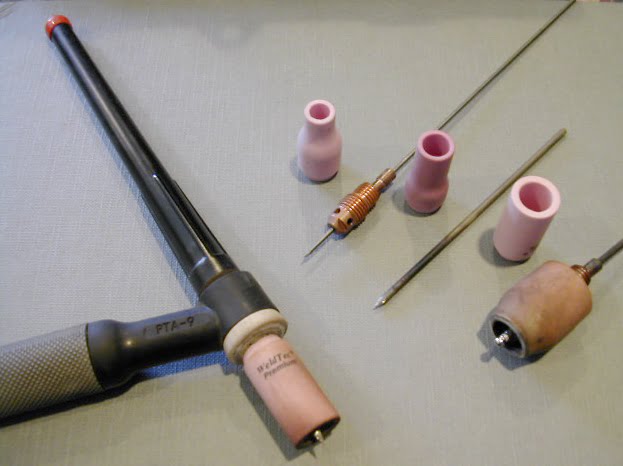
- Air-cooled torches — suitable for lower current applications, generally up to ~200 A.
- Water-cooled torches — required for high-current applications up to ~600 A; hoses carry both shielding gas and cooling water.
🥢 Filler Rod
GTAW can join metals both with and without filler metal. The arc fuses the base metals directly; however, filler rod is often added to reinforce joints and prevent cracking, especially on thicker materials.
Adding filler rod is one of the most demanding aspects of manual TIG welding. The welder must coordinate both hands — guiding the filler into the pool with one hand while manipulating the torch with the other — all while ensuring the filler never contacts the tungsten, as this causes electrode contamination and requires re-grinding.
Skills Required for GTAW Welding
GTAW demands a high level of skill and unwavering attention to detail. The key competencies required include:
- Arc Control: Maintaining a stable and consistent arc length for quality welds.
- Heat Control: Managing heat input to prevent distortion or burn-through, especially on thin materials.
- Weld Joint Preparation: Thorough cleaning and correct joint geometry (including bevelling) are essential for strong, reliable welds.
- Filler Rod Control: Precise, rhythmic dipping of the filler rod into the leading edge of the weld pool without contaminating the electrode.
Applications of GTAW Welding
GTAW is the method of choice whenever joint quality, cleanliness, and aesthetic appearance are critical. It is routinely selected for exotic and high-value alloys — stainless steel, aluminium, chromoly, nickel alloys, and magnesium — but also for mild steel when absolute quality is required.
Advantages & Disadvantages of TIG Welding
✅ Advantages
- High-quality, visually clean welds
- Suitable for a wide range of materials
- Ideal for thin section welding
- Minimal spatter and smoke
- No flux required
- All welding positions possible
- Maximum control over arc and heat input
- Excellent visibility of arc and weld pool
- Can weld with or without filler metal
❌ Disadvantages
- Requires significant skill and experience
- Slower process — lower productivity
- Small errors in travel speed, amperage, or tungsten prep significantly impair quality
- Higher initial equipment cost
- Not suitable outdoors — inert gas shielding disrupted by wind
- Lower deposition rate compared to MIG/SMAW
GTAW Welding — Frequently Asked Questions
What is GTAW welding?
What materials can be welded with GTAW?
Why is a constant current power source important in TIG welding?
How do I choose the right tungsten electrode?
Can GTAW be used for pipe root passes?
Can GTAW weld aluminium?
What safety precautions should I take?
Can GTAW be automated?
What are common joint configurations for GTAW?
What welding parameters should I set for GTAW?
🎓 GTAW Welding Quiz
Test your learning — 20 seconds per question · No plugin required
Answer all 10 questions on GTAW / TIG welding fundamentals.
You have 20 seconds per question. Time up? The correct answer is revealed automatically.