ASTM G48 Corrosion Testing of Stainless Steels and Nickel Alloys — Complete Technical Guide
ASTM G48 corrosion testing is the primary standard method used worldwide to evaluate the resistance of stainless steels and nickel alloys to pitting and crevice corrosion in aggressive chloride-containing environments. Published by ASTM International and regularly revised, it provides six distinct test methods — designated Methods A through F — each targeting a specific corrosion mode or material family. In industries such as offshore oil and gas, chemical processing, desalination, and marine engineering, where high-alloy stainless steels are exposed to seawater or chloride process streams, ASTM G48 qualification is frequently a mandatory element of both material procurement specifications and welding procedure qualification records.
Unlike many corrosion tests that apply to the bulk metal only, ASTM G48 testing is particularly critical for evaluating duplex and super-duplex stainless steel weldments, where the microstructural changes caused by welding — phase imbalance, intermetallic phase precipitation, and nitrogen redistribution — can substantially reduce localised corrosion resistance even when the weld appears visually sound. A material that passes G48 in the mill-annealed condition may fail after welding if the procedure is incorrect, making G48 an indispensable weld procedure qualification tool.
This guide covers the complete technical scope of ASTM G48: the corrosion mechanisms being tested, all six methods with their conditions and evaluation criteria, specimen preparation requirements, Critical Pitting Temperature (CPT) and Critical Crevice Temperature (CCT) determination, the relationship between PREN and G48 performance, and practical guidance for engineers qualifying materials and welds for chloride service.
What Is ASTM G48 and Why Is It Important?
ASTM G48, formally titled Standard Test Methods for Pitting and Crevice Corrosion Resistance of Stainless Steels and Related Alloys by Use of Ferric Chloride Solution, is the standard framework for chloride-induced localised corrosion testing. Ferric chloride (FeCl₃) is used as the test medium because it provides a strongly oxidising, high-chloride environment that accelerates the breakdown of the passive film on stainless steel surfaces under controlled conditions, allowing meaningful testing within practical laboratory time frames.
The standard is published by ASTM International and is used globally by material manufacturers, fabricators, engineering contractors, and end-user inspection teams. It is referenced in a wide range of material standards and project specifications for equipment destined for offshore, subsea, chemical plant, pharmaceutical, and desalination service. The test is applicable to both base metal in the mill-annealed condition and to welded specimens, making it one of the few corrosion tests that directly qualifies weld procedures for service in aggressive environments.
The Six ASTM G48 Methods
ASTM G48 contains six test methods, designated Methods A through F. The first two methods (A and B) are the original practices and use fixed test temperatures. Methods C through F are later additions that determine the critical temperature at which corrosion initiates, providing a more nuanced and material-differentiating result.
| Method | Corrosion Mode | Temperature Control | Duration | Evaluation | Primary Use |
|---|---|---|---|---|---|
| A | Pitting | Fixed (typically 22 °C or 50 °C) | 72 h | Mass loss + visual | General qualification |
| B | Crevice | Fixed (typically 22 °C or 35 °C) | 72 h | Mass loss + visual | Crevice qualification |
| C | Pitting | Step (5 °C increments) | 24 h/step | CPT (lowest pit temp) | Material ranking |
| D | Crevice | Step (5 °C increments) | 24 h/step | CCT (lowest crevice temp) | Crevice ranking |
| E | Pitting | Step (5 °C increments) | Per step | CPT by current | Research / precision |
| F | Crevice | Step (5 °C increments) | Per step | CCT by current | Research / precision |
ASTM G48 Test Procedure — Step by Step
While each method has specific variations, the core test procedure follows a consistent sequence. The most widely specified combination for weld procedure qualification is Method A (and/or Method B) at a fixed temperature defined by the material specification or project requirement. The following procedure applies to Methods A and B:
- Specimen cutting: Cut specimens from the material in the required dimensions — typically 25 mm × 50 mm for flat products. For weld qualification, specimens are cut to include the weld centreline, HAZ on both sides, and base metal on either side. Orientation with respect to rolling direction should be noted and reported.
- Specimen grinding: Grind the test face to 120-grit silicon carbide (SiC) paper. Maintain the same grinding direction throughout. Do not use water-cooled grinding if the material is susceptible to hydrogen embrittlement; use dry grinding or appropriate coolant. The final surface must be flat and free of deep scratches.
- Degreasing: Clean all surfaces with acetone or isopropanol to remove oils, grinding residue, and fingerprints. Handle specimens with clean gloves after this point to prevent re-contamination.
- Measurement and weighing: Measure and record specimen dimensions (to calculate surface area) and weigh to the nearest 0.001 g using an analytical balance. Surface area is used later to calculate mass loss rate.
- Crevice device attachment (Method B only): Attach PTFE crevice formers (multiple-crevice assemblies or rubber bands) to the specimen surface per the standard. Torque to the specified level to ensure consistent contact geometry. Record the number and type of crevice devices.
- Solution preparation: Prepare the test solution by dissolving FeCl₃·6H₂O in distilled water to produce a 6.0 ± 0.1% FeCl₃ solution by mass. Adjust pH if required by the specific method. Ensure the solution volume is sufficient to maintain the required specimen-to-solution ratio (minimum 8 mL per cm² of specimen surface area).
- Immersion and temperature control: Place specimens in glass or PTFE containers and submerge in the test solution at the prescribed temperature (±1 °C). Maintain the temperature throughout the test using a controlled water bath or oven. Avoid metallic containers, which can introduce galvanic effects.
- 72-hour exposure: Maintain immersion for 72 ± 0.5 hours without interruption. Do not agitate the solution. At test completion, remove specimens promptly.
- Post-test cleaning: Rinse with water, then clean corrosion products using a soft brush and water, followed by drying. Do not use acid cleaning, as this may dissolve metal and skew mass loss results.
- Final weighing and examination: Weigh the cleaned specimen to 0.001 g. Examine under magnification (10× minimum) for pits or crevice attack. Report mass loss in g/m², and describe the nature and distribution of any pits observed.
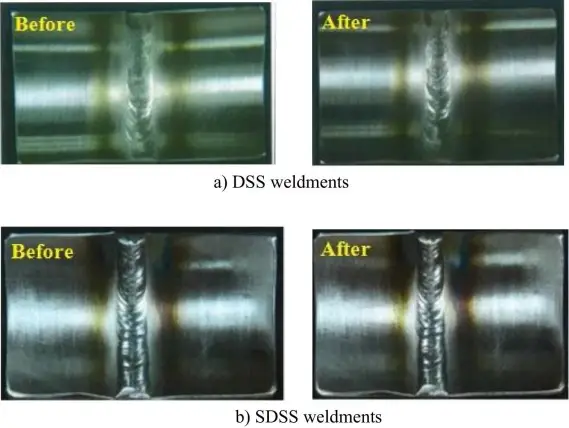
Critical Pitting Temperature and Critical Crevice Temperature
While Methods A and B provide a useful pass/fail result at a fixed temperature, Methods C through F allow determination of the Critical Pitting Temperature (CPT) and Critical Crevice Temperature (CCT) — single-number material parameters that describe the fundamental localised corrosion resistance of the alloy under the G48 test conditions. These parameters are far more informative for material selection and ranking than a simple pass/fail at one arbitrary temperature.
Critical Pitting Temperature (CPT)
The CPT is defined as the lowest temperature at which stable pitting initiates on the open surface of a specimen in 6% FeCl₃ solution. In Method C, the specimen is exposed at a starting temperature where no pitting is expected, and the temperature is increased in 5 °C steps after each 24-hour exposure period. At each step, the specimen surface is examined for pit initiation. The CPT is the lowest temperature at which pitting is confirmed (by observation of hemispherical pits, staining, or measurable mass loss exceeding the threshold).
| Material Grade | Nominal Composition | Typical CPT (°C) — Method C | Typical CCT (°C) — Method D | PREN |
|---|---|---|---|---|
| 316L | 18Cr-10Ni-2.5Mo | 15 – 25 | 0 – 10 | ~24 |
| Lean Duplex (2101) | 21Cr-1Ni-0.5Mo | 15 – 20 | 5 – 10 | ~26 |
| Standard Duplex (2205) | 22Cr-5Ni-3Mo-0.15N | 35 – 45 | 20 – 30 | ~35 |
| Super Duplex (2507) | 25Cr-7Ni-4Mo-0.28N | 50 – 65 | 35 – 45 | ~43 |
| Super Duplex Zeron 100 | 25Cr-7Ni-3.5Mo-0.7W | 55 – 70 | 40 – 50 | ~41 |
| 6Mo Austenitic (254 SMO) | 20Cr-18Ni-6Mo-0.2N | 75 – 90 | 55 – 65 | ~45 |
| Alloy 625 (UNS N06625) | 22Cr-9Mo-3.5Nb (Ni base) | > 85 | > 65 | >50 |
Note: CPT and CCT values are approximate and depend strongly on specimen surface condition, solution freshness, and laboratory technique. Values from different laboratories can vary by up to 5–10 °C for the same material. Always compare results only within the same laboratory using the same procedure.
Critical Crevice Temperature (CCT)
The CCT is determined identically to the CPT (via Methods D or F) but with crevice-forming devices attached. Because the crevice geometry restricts oxygen access and concentrates chlorides, crevice corrosion initiates at a lower temperature than open-surface pitting. As a rule of thumb, CCT is typically 10–20 °C lower than CPT for the same material. This means a material with a CPT of 50 °C may only have a CCT of 30–35 °C — a critical distinction for the design of bolted flanges, tube-to-tubesheet joints, and other creviced assemblies in chloride service.
PREN — Predicting G48 Performance Before Testing
The Pitting Resistance Equivalent Number (PREN) is a compositional index that correlates with a material’s resistance to pitting corrosion in chloride environments and therefore predicts, in a general sense, how well the material will perform in ASTM G48 testing. It is calculated from the chromium, molybdenum, and nitrogen contents of the alloy.
PREN Formula
While PREN is a useful screening tool, it has important limitations as a predictor of actual G48 performance:
- PREN is based on nominal composition; actual heat-to-heat variation affects corrosion resistance.
- PREN does not account for microstructural effects such as sigma phase, chi phase, or secondary austenite in duplex grades.
- For weld metal and HAZ specimens, the effective local PREN may differ significantly from the nominal alloy PREN due to dilution, nitrogen loss, and phase changes during the thermal cycle.
- Two alloys with the same PREN can have different CPT values depending on the balance of Cr, Mo, and N contributions.
| PREN Range | General Category | Typical G48 Method A Test Temp | Representative Grades |
|---|---|---|---|
| <25 | Moderate resistance | 22 °C | 316L, 317L, lean duplex |
| 25 – 35 | Good resistance | 22 – 40 °C | 2205 duplex, high-Mo austenitic |
| 35 – 45 | High resistance | 50 °C | Super-duplex (2507, Zeron 100), 6Mo |
| >45 | Very high resistance | 50 – 85 °C | Alloy 625, Alloy C-276, Alloy 22 |
ASTM G48 Testing of Duplex Stainless Steel Weldments
ASTM G48 occupies a uniquely important position in the qualification of duplex stainless steel weldments. The duplex microstructure — nominally 50% ferrite and 50% austenite — provides excellent corrosion resistance in the mill-annealed condition. However, the welding thermal cycle disrupts this balance and can introduce detrimental microstructural features that substantially reduce localised corrosion resistance in the HAZ and weld metal.
Weld Microstructural Changes That Affect G48 Performance
| Microstructural Change | Location in Weld | Effect on Corrosion | Cause |
|---|---|---|---|
| Elevated ferrite content (>65%) | HAZ (high-T region) | Reduced Cr and Mo in austenite; lower CPT/CCT | Austenite dissolution at peak HAZ temperatures |
| Sigma phase (σ) | HAZ at 700–950 °C | Severe CPT/CCT reduction | Cr and Mo precipitation from ferrite |
| Chi phase (χ) | HAZ at 600–900 °C | Moderate CPT/CCT reduction | Mo-rich intermetallic from ferrite decomposition |
| Secondary austenite (γ₂) | Weld metal | Lower N; reduced local PREN | Austenite re-precipitation during cooling |
| Cr-nitride precipitation | HAZ (rapid cooling) | Chromium depletion adjacent to nitrides | Nitrogen supersaturation in ferrite |
Because sigma and chi phases precipitate within seconds at peak temperatures in the sensitisation range (700–950 °C) for duplex grades, even a single-pass weld on 2205 or super-duplex material can fail ASTM G48 if heat input and interpass temperature are not tightly controlled. This is why the TIG (GTAW) process, with its lower and more controllable heat input, is the preferred welding process for duplex piping in corrosive service, often with heat input limited to 0.5–2.5 kJ/mm and interpass temperature limited to 100–150 °C maximum.
- Standard Duplex (2205): Method A or B at 22 °C; no pitting; mass loss ≤ 4.0 g/m²
- Super-Duplex (2507): Method A at 40 °C or 50 °C; no pitting; mass loss ≤ 4.0 g/m²
- Zeron 100: Method A at 40 °C; often also Method B at 35 °C
- Test specimens: base metal, HAZ, and weld metal (all three locations typically required)
Controlling Heat Input to Pass ASTM G48
The key welding parameter for G48 pass/fail on duplex grades is heat input. Maximum heat input limits are typically specified in the welding procedure specification (WPS) and are derived from the procedure qualification test results. Common guidance:
- Maximum heat input: 0.5–2.5 kJ/mm for standard duplex; 0.2–1.5 kJ/mm for super-duplex (varies by wall thickness and diameter)
- Interpass temperature: 100 °C maximum for super-duplex; 150 °C for standard duplex
- Backing gas for root pass: Pure argon or Ar + 2% N₂ to prevent nitrogen loss from the weld root
- Post-weld solution annealing: Where weld geometry permits, solution annealing at 1050–1100 °C followed by water quench restores the duplex microstructure and eliminates sigma phase, reliably producing passing G48 results
Interpreting ASTM G48 Test Results
Interpreting ASTM G48 results requires careful application of the acceptance criteria defined in the material specification or project standard. The standard itself does not define universal acceptance limits — it defines procedures. Acceptance criteria are therefore set by the purchasing specification, client standard, or referenced code.
Common Acceptance Criteria (Methods A and B)
| Criterion Type | Typical Limit | Notes |
|---|---|---|
| Mass loss | ≤ 4.0 g/m² or ≤ 1.0 g/m² (project specific) | Stricter limits for super-duplex and nickel alloys |
| Visual (pitting) | No pitting visible at 10× | Some specs allow pits only in weld cap / bead ripples |
| Visual (crevice) | No crevice attack at 10× | Method B; attack under device constitutes failure |
| CPT minimum | ≥ 40 °C for 2507; ≥ 35 °C for 2205 | Method C; must be confirmed for both BM and WM |
| CCT minimum | ≥ 25 °C for 2205; ≥ 35 °C for super-duplex | Method D; always verify for creviced applications |
ASTM G48 in the Context of Other Corrosion Standards
| Standard | Corrosion Mode Tested | Applicable Materials | Relationship to G48 |
|---|---|---|---|
| ASTM A262 | Intergranular attack (sensitisation) | Austenitic SS (304, 316, 321, 347) | Different mode; complement to G48 for austenitic grades |
| ASTM G28 | IGC of Ni-rich alloys | Alloys 625, 825, C-276 | Separate standard for Ni alloys; G48 addresses pitting |
| ASTM A923 | Detrimental phases in duplex SS | Duplex grades (2205, 2507) | Microstructure assessment; G48 is the corrosion performance confirmation |
| ISO 17782 | Pitting and crevice (FeCl₃) | Duplex and super-duplex | European equivalent; similar principles but different solution concentrations |
| NACE MR0175 / ISO 15156 | SSC / HIC in sour service | Carbon, low-alloy, and stainless steels | Different mechanism (H₂S); see sour service guide |
Recommended Reference Books
Disclosure: WeldFabWorld participates in the Amazon Associates programme (StoreID: neha0fe8-21). If you purchase through these links, we may earn a small commission at no extra cost to you. This helps support free technical content on this site.
Frequently Asked Questions
What is ASTM G48 and what does it measure?
ASTM G48 is a standard published by ASTM International that provides six test methods (A through F) for evaluating the resistance of stainless steels and related nickel alloys to pitting corrosion and crevice corrosion in ferric chloride (FeCl₃) solution. The standard is primarily used to qualify materials and weld procedures for service in aggressive chloride-containing environments, and it is especially important for duplex, super-duplex, and 6Mo austenitic stainless steel grades. Unlike impact or tensile tests, G48 directly measures localised corrosion performance — the failure mode most critical in offshore, chemical, and desalination service.
What is the difference between ASTM G48 Method A and Method B?
Method A evaluates pitting corrosion resistance by immersing specimens in 6% ferric chloride solution at a fixed temperature (typically 22 °C or 50 °C depending on material) for 72 hours, with no artificial crevice geometry. Method B evaluates crevice corrosion resistance using the same solution but with multiple-crevice PTFE or rubber devices attached to the specimen surface, creating localised oxygen-depleted zones that simulate real engineering crevices such as flanges and joints. Method A assesses the open surface pitting tendency while Method B is inherently more severe. For creviced assemblies in service, Method B results are the more relevant acceptance criterion.
What is the Critical Pitting Temperature (CPT) in ASTM G48?
The Critical Pitting Temperature (CPT) is the lowest temperature at which stable pitting initiates on the open surface of a specimen in 6% ferric chloride solution, determined by Methods C and E of ASTM G48. Testing begins at a low temperature with no pitting and increments upward at 5 °C steps until pitting is observed. The CPT is a material fingerprint — higher CPT values indicate superior pitting resistance. Super-duplex grades such as 2507 typically have CPT values above 50 °C in the mill-annealed condition, while lean duplex or standard austenitic grades may be below 25 °C. Welding can significantly reduce CPT in the HAZ if procedure variables are not controlled.
What is the Critical Crevice Temperature (CCT) in ASTM G48?
The Critical Crevice Temperature (CCT) is the lowest temperature at which crevice corrosion initiates under crevice-forming devices attached to the specimen surface, determined by Methods D and F of ASTM G48. The CCT is always lower than the CPT for the same material because the crevice geometry restricts oxygen access and creates a locally acidic, oxygen-depleted environment that initiates corrosion at a lower temperature than the open surface. For standard duplex 2205, the CCT is typically 10–20 °C below the CPT. CCT is the more conservative and more relevant parameter for design of creviced assemblies such as flanges, tube-to-tubesheet joints, and mechanical fittings in chloride service.
Why is ASTM G48 particularly important for duplex stainless steel welds?
Welding of duplex stainless steel creates a heat-affected zone (HAZ) where the ferrite-austenite balance is disrupted, intermetallic phases (sigma, chi) can form, and chromium and nitrogen distribution can become non-uniform. These microstructural changes can reduce the localised corrosion resistance of the HAZ to below that of the base metal even when the weld appears visually perfect. ASTM G48 testing of weld specimens directly reveals whether the as-welded microstructure meets the corrosion resistance requirement. A material that easily passes G48 in the mill-annealed condition may fail after welding if heat input is too high, interpass temperature is exceeded, or the backing gas provides insufficient nitrogen.
How do you prepare the specimen surface for ASTM G48 testing?
Specimen surface preparation has a major influence on G48 results and must be carefully controlled. The standard requires grinding the test surface to 120-grit SiC paper for Methods A and B. The surface must be flat, free of machining burrs, and degreased with acetone or isopropanol before testing. Handle specimens with clean gloves after cleaning to prevent fingerprint contamination, which can act as a crevice site. Scratches deeper than the grinding specification, surface contamination with iron particles (from grinding tools used on carbon steel), and residual machining stress can all produce artificially low CPT or CCT values. Edge conditions must also be controlled — edges are more susceptible than flat surfaces and should be lightly chamfered or ground to remove sharp burrs.
How does ASTM G48 relate to ASTM A262 for stainless steel corrosion testing?
ASTM G48 and ASTM A262 test for entirely different corrosion modes. ASTM A262 detects susceptibility to intergranular attack (IGA) caused by sensitisation — chromium carbide precipitation at grain boundaries — and applies primarily to austenitic grades (304, 316, 321, 347). ASTM G48 detects pitting and crevice corrosion initiated by chloride attack on the passive film, and is primarily used for duplex, super-duplex, and high-alloy austenitic grades. For complete corrosion qualification of an austenitic stainless steel weld procedure for a corrosive chemical process service, both tests may be required — A262 to confirm freedom from sensitisation and G48 to confirm pitting/crevice resistance. Passing one does not imply passing the other.
What PREN value is required to pass ASTM G48 testing?
ASTM G48 itself does not specify a minimum PREN — it measures actual corrosion performance through immersion or electrochemical testing. However, PREN is widely used as a compositional screening tool to predict G48 performance. Standard duplex (2205) with PREN around 35 typically passes Method A at 22 °C. Super-duplex grades (2507, Zeron 100) with PREN ≥ 40 are generally required for Method A at 50 °C or Method B testing. The WeldFabWorld PREN calculator helps you compute PREN for any alloy, but remember that PREN predicts bulk composition performance — it does not account for weld microstructure effects, which can only be confirmed by actual G48 testing of weld specimens.