How to Read a Material Test Certificate (MTC) — Part 2: PMI Cross-Check
Key Takeaways
- PMI (Positive Material Identification) is the independent field verification of a material’s chemistry against its MTC — it is the last defence against material mix-up before fabrication begins.
- XRF is portable and non-destructive but cannot reliably detect carbon; OES is more analytically complete and essential for L-grade stainless steels and P91 verification.
- Acceptance is based on whether the PMI result falls within the applicable ASTM/ASME specification range — not whether it exactly replicates the MTC number.
- API RP 578 is the primary industry reference document governing PMI programme requirements in the petroleum and natural gas sector.
- A PMI result outside the specification range is a non-conformance requiring quarantine, NCR, and formal disposition — never accept or reclassify without engineering approval.
- PMI verifies chemistry only — it cannot confirm mechanical properties, heat treatment condition, or toughness.
The first part of this guide covered how to read and interpret every field on a Material Test Certificate — from heat number and chemical composition through to EN 10204 certificate types and the step-by-step MTC verification procedure. Part 2 extends that knowledge into Positive Material Identification (PMI): the technique used to independently cross-check the chemistry stated on the MTC against the actual composition of the physical material in your hands. PMI is where document verification meets physical reality, and it is a mandatory control on most oil and gas, petrochemical, and power generation projects involving alloy steel or stainless steel materials.
Material mix-ups — wrong grade, wrong specification, wrong certificate — are more common in the supply chain than the industry likes to admit. Falsified MTCs have been found at every tier of the supply chain, from sub-standard mills exporting to legitimate manufacturers inadvertently receiving substituted material from distributors. In several documented high-profile failures, equipment constructed from incorrect material operated for years before a rupture or leak exposed the substitution. PMI closes this gap. This guide explains how PMI works, when and how to apply it, what the results mean, and how to handle the full range of outcomes — including the non-conformances that are discovered.
Whether you are a QA/QC engineer setting up a goods-receipt inspection procedure, a CWI preparing for incoming material verification, or an engineer reviewing a project Inspection and Test Plan (ITP), this guide gives you a complete, practical understanding of the MTC PMI cross-check workflow from start to finish.
Contents
- What is Positive Material Identification (PMI)?
- XRF vs OES — Choosing the Right Technique
- Step-by-Step PMI Cross-Check Procedure
- Reading and Evaluating PMI Results
- PMI Acceptance Criteria and Tolerances
- Non-Conformance: What to Do When PMI Fails
- PMI Coverage Requirements by Project Type
- Code and Standard Requirements for PMI
- PMI of Welding Consumables
- In-Service and Post-Weld PMI
- Recommended References
- Frequently Asked Questions
What is Positive Material Identification (PMI)?
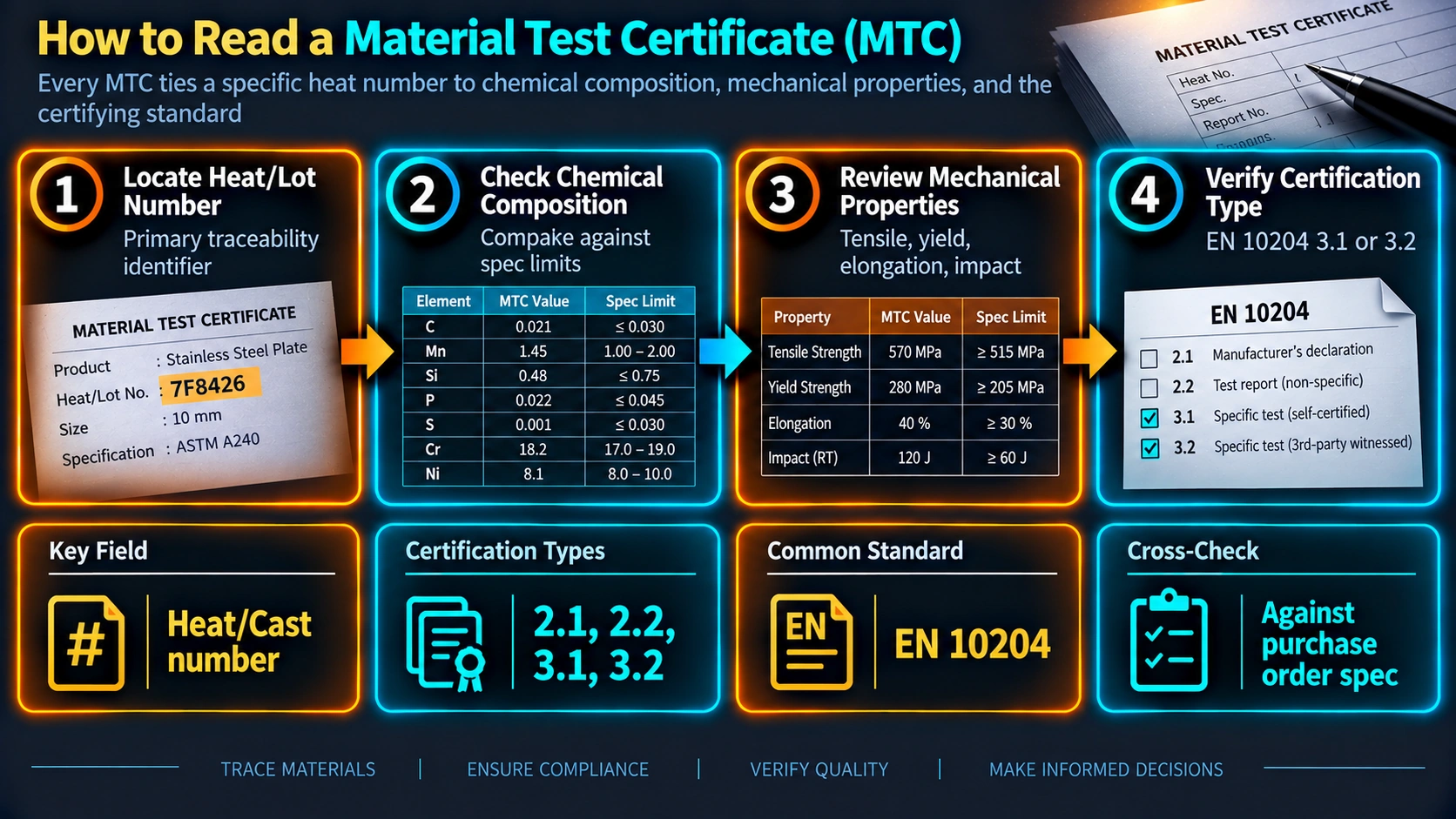
Positive Material Identification is the non-destructive or minimally destructive in-field technique of analysing the chemical composition of a metallic material to confirm that it matches what is stated on its documentation — specifically the Material Test Certificate. PMI is performed using portable or laboratory-based spectrometric instruments and produces an elemental analysis that can be compared directly against the certified values on the MTC and against the compositional requirements of the applicable material specification.
The term “positive” in PMI reflects the principle that identification must be confirmed by measurement — not assumed from markings, packaging, colour, or documentation alone. Heat number markings can be incorrect. MTCs can be mislabelled or, in the most serious cases, fraudulently prepared for non-compliant material. Physical appearance provides no reliable indication of alloy chemistry. Only a spectrometric measurement confirms what the material actually is.
PMI is governed primarily by API RP 578 — Material Verification Programme for New and Existing Alloy Piping Systems, which defines the scope, techniques, coverage requirements, and documentation procedures for PMI programmes in the petroleum and natural gas industries. It is the reference document that project specifications cite when mandating PMI, and it defines the minimum requirements that a PMI plan must satisfy.
XRF vs OES — Choosing the Right Technique
Two analytical techniques are used for PMI in the fabrication and plant maintenance industries. Each has distinct capabilities, limitations, and appropriate applications. Understanding the difference is essential to specifying the correct technique for a given PMI programme.
When to Use XRF
XRF is the standard tool for goods-receipt PMI in most fabrication environments. It is fast, non-destructive, and capable of distinguishing between all common alloy grades based on their heavy element composition (Cr, Ni, Mo). It is the correct choice for routine grade screening of stainless steel, duplex, nickel alloy, and chrome-moly pipe, fittings, and flanges where the primary goal is to confirm the correct grade is present. It is also the required technique for in-service PMI on installed components where OES’s burn mark would be unacceptable.
When OES is Required
OES must be specified — either as the primary technique or as a follow-up to XRF — in the following situations:
- L-grade stainless steels (304L, 316L): XRF cannot reliably distinguish 304 from 304L or 316 from 316L because the difference is the carbon content (max 0.030% for L-grades). OES is the only in-field technique that can confirm carbon in this range with adequate precision.
- P91 / Grade 91 alloy steel: The vanadium (V) and niobium (Nb) microalloying additions that define P91 are present at very low concentrations. OES is required to confirm these at the concentrations specified in ASTM A335/SA-335.
- Duplex stainless nitrogen content: Nitrogen is a critical austenite-stabilising element in duplex stainless steels, directly affecting the ferrite/austenite balance. XRF cannot accurately measure nitrogen.
- When XRF produces an ambiguous result: If an XRF reading does not clearly match a single grade, OES is used to resolve the ambiguity.
Step-by-Step PMI Cross-Check Procedure
The following procedure applies to incoming goods-receipt PMI of piping components, plates, fittings, and flanges. It should be documented in the project Inspection and Test Plan (ITP) and carried out by a qualified PMI technician using a calibrated instrument.
Before Testing
- Review the PMI plan: Confirm the coverage percentage required by the project specification — typically 100% for alloy components, spot-check (10%) for carbon steel. Identify which grades require OES supplementation.
- Instrument calibration: Verify that the XRF or OES instrument has current calibration certification from an accredited laboratory. Most portable XRF units require annual calibration. Daily performance checks using certified reference standards are required before commencing PMI testing. Record the calibration status in the PMI report.
- Prepare the MTC package: Collect the MTCs for all incoming materials. Cross-reference heat numbers against the delivery documentation and purchase order. Identify the expected composition range for each grade from the applicable ASTM/ASME specification. This forms the acceptance reference against which PMI readings will be compared.
During Testing
- Surface preparation: For XRF, clean the test area with a wire brush or light abrasive to remove scale, paint, coating, or surface contamination. For OES, grind the area to bare metal. The instrument reads only what is on the surface — contamination will produce false readings.
- Mark the test location: Identify and mark the PMI test spot on each component. For pipe, use the pipe body away from end-prep weld bevels. For fittings, test on the fitting body. For plates, test on the plate surface clear of flame-cut edges (the heat-affected cut edge may give anomalous readings).
- Take multiple readings: Take a minimum of 3 readings per piece at slightly different locations. The average of three readings reduces the effect of surface heterogeneity and instrument noise. If readings are inconsistent with each other, grind and re-test.
- Record every result: Record the instrument reading, piece identification (heat number, piece number), test location, date, technician name, and instrument serial number and calibration date. This becomes part of the permanent PMI record.
- Compare against specification range: Compare the average reading for each element against the minimum and maximum values specified in the ASTM/ASME specification for that grade. This is the primary acceptance criterion — not comparison against the MTC value.
After Testing
- Mark tested components: Apply a PMI-PASS marking (typically a paint mark or metal tag, as specified by the project) to all accepted components to confirm they have been tested and passed.
- Complete the PMI report: Issue a formal PMI Inspection Report documenting all readings, acceptance/rejection status, instrument details, and technician sign-off. Attach the report to the MTC for permanent retention.
- Handle non-conformances: Any component that fails PMI must be immediately quarantined, marked with a HOLD or REJECT tag, and a Non-Conformance Report (NCR) raised. See the non-conformance section below.
Reading and Evaluating PMI Results
Modern portable XRF instruments display results as a list of detected elements with their concentrations in weight percent (wt%). OES instruments produce a similar output. The printout will also typically identify the alloy grade the reading most closely matches, based on the instrument’s internal grade library. This auto-identification feature is useful but should not be relied upon as the sole acceptance criterion — the individual element values must be checked against the specification.
PMI Result Interpretation Example — TP316L Stainless Pipe
Reading an OES Result for P91 Grade
The P91 material requirements guide on WeldFabWorld covers the full verification procedure for this critical chrome-moly alloy, including the specific PMI requirements that apply on power plant and pressure vessel projects.
PMI Acceptance Criteria and Tolerances
PMI acceptance is based on one primary criterion: does the PMI result place the material within the compositional range specified by the applicable ASTM/ASME material specification? The comparison is against the specification range, not against the specific MTC value. This distinction is important and is often misunderstood.
| Scenario | MTC Value | PMI Reading | Spec Range | Decision | Reason |
|---|---|---|---|---|---|
| Cr in TP316L | 17.2% | 16.8% | 16.0–18.0% | PASS | Both MTC and PMI within spec. XRF variability is acceptable. |
| Cr in TP316L | 17.2% | 13.5% | 16.0–18.0% | FAIL | PMI result outside spec range. Significant deviation — likely wrong material. |
| Mo in TP316L | 2.14% | 1.85% | 2.00–3.00% | INVESTIGATE | PMI result below spec minimum. Could be instrument error or borderline material. Repeat with OES. |
| Cr in P91 | 8.72% | 8.65% | 8.00–9.50% | PASS | Both within spec. Minor XRF reading difference is within instrument accuracy. |
| Cr in P91 | 8.72% | 1.1% | 8.00–9.50% | FAIL | PMI indicates carbon steel, not P91. Critical material mix-up. Quarantine immediately. |
| C in TP316L (OES) | 0.018% | 0.038% | ≤ 0.030% | FAIL | Carbon exceeds L-grade maximum. Material may be TP316 not TP316L. NCR required. |
Non-Conformance: What to Do When PMI Fails
A PMI failure — where the reading falls outside the specified composition range — must be handled through a formal Non-Conformance process. The steps are defined and should not be deviated from under any circumstances, including schedule pressure or supplier insistence that the material is correct.
Immediate Actions
- Quarantine the material: Segregate the suspect piece(s) from the general material stock. Apply a visible HOLD tag. Prevent the material from being issued to fabrication under any circumstances.
- Raise an NCR: Complete a Non-Conformance Report documenting the heat number, piece identification, the PMI results, the MTC values, the specification requirement, and the nature of the discrepancy.
- Expand testing: Conduct PMI on additional pieces from the same heat and lot to determine whether the non-conformance is isolated to one piece or affects the entire lot.
- Notify the supplier: Issue a formal notification to the material supplier and — if your quality system requires it — to the project client or TPI.
Investigation and Disposition
The root cause investigation must determine whether the non-conformance is due to: (a) an instrument error, (b) a surface contamination artefact, (c) a heat number marking error, (d) a wrong MTC supplied for the material, or (e) a genuine material substitution. The disposition options, in order of preference, are:
| Disposition Option | Condition | Authority Required |
|---|---|---|
| Repeat testing with OES | XRF result borderline; OES may clarify | QA/QC Engineer |
| Send to accredited laboratory for chemical analysis | PMI result disputed; definitive test needed | QA/QC Manager + Client |
| Correct MTC obtained from supplier | Wrong MTC supplied; material is correct grade | QA/QC Manager + TPI |
| Reject and return to supplier | Material confirmed as wrong grade or non-compliant | QA/QC Manager |
| Use As-Is (concession) | Only if material meets requirements for the actual service — requires engineering review | Engineering + Client approval |
PMI Coverage Requirements by Project Type
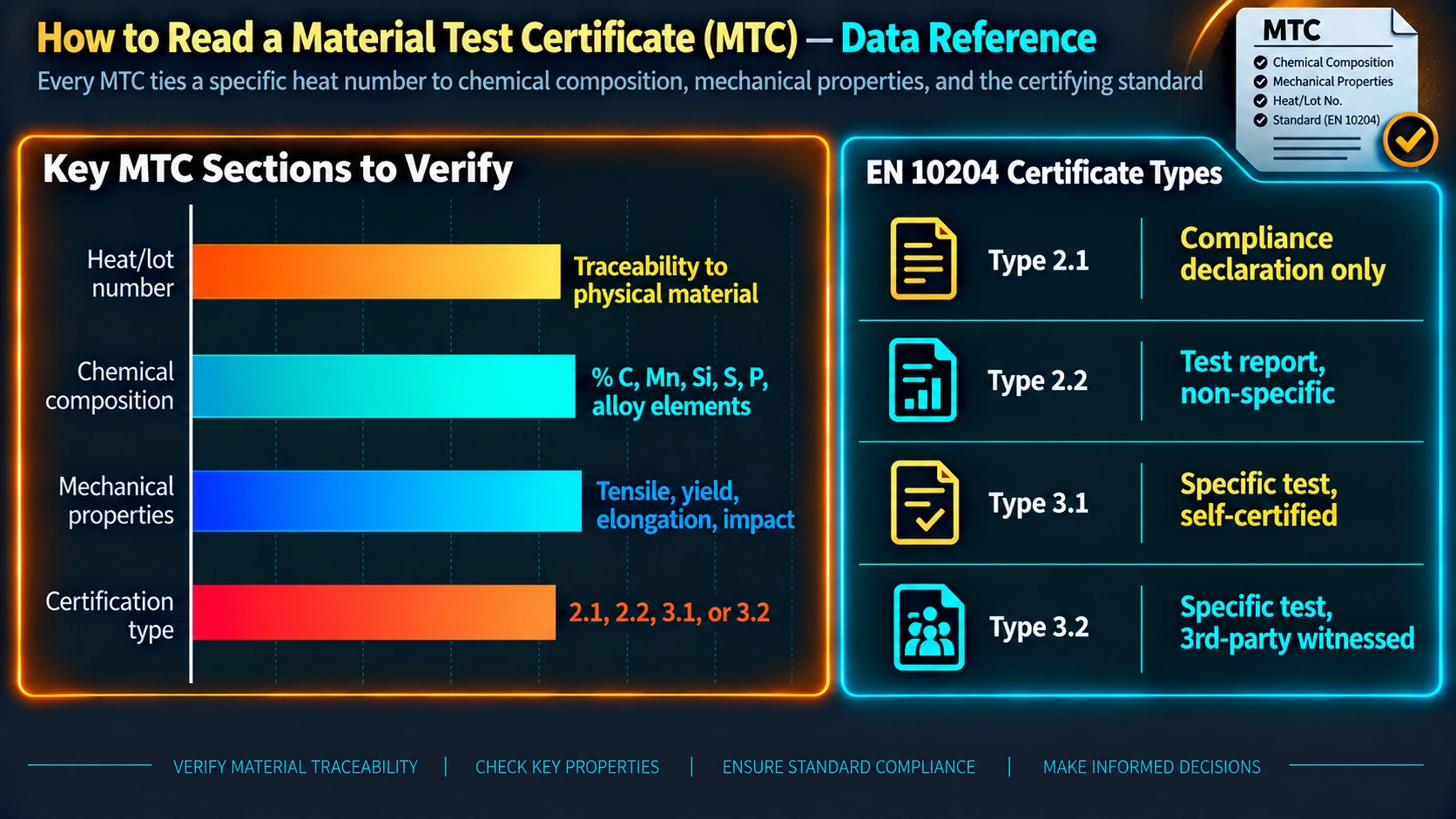
API RP 578 provides guidance on PMI coverage, and project specifications build on this to define the specific percentage and scope of testing required. The following table summarises typical coverage requirements across different project types and material categories.
| Material Type | Service Category | Typical Coverage | Technique |
|---|---|---|---|
| Austenitic SS (304, 316, 321) | General process service | 100% of alloy components | XRF + OES for C confirmation (L-grades) |
| Duplex / Super Duplex SS | Corrosive, chloride, seawater | 100% | XRF + OES (N verification) |
| Chrome-Moly (P11, P22, P91) | High-temperature service | 100% | OES (V, Nb confirmation for P91) |
| Nickel alloys (Inconel, Hastelloy) | Severe corrosive / high-temp | 100% | XRF |
| Carbon steel | Non-critical systems | 10% spot check | XRF (confirm not alloy steel) |
| Carbon steel | Sour service (H2S) | 100% hardness check; PMI on alloy if specified | XRF or portable Brinell |
| All materials | Nuclear / offshore critical | 100% — base + weld | XRF + OES |
Note that the coverage percentages above are guidance values. The project PMI plan, which must be submitted and approved before fabrication starts, specifies the exact coverage. On some projects, particularly those following major operator engineering standards such as ExxonMobil GP 18-10-01 or Shell DEP 77.251.00, PMI coverage requirements are more stringent than the API RP 578 baseline.
Code and Standard Requirements for PMI
PMI is not required by ASME BPVC or ASME B31.3 as a universal mandatory requirement. These codes rely primarily on the MTC and heat traceability. However, PMI becomes a contractual and often regulatory requirement when the following documents are invoked:
| Standard / Code | PMI Requirement | Scope |
|---|---|---|
| API RP 578 | Primary PMI guidance document | Petroleum and natural gas piping systems — alloy materials |
| NACE SP0472 | PMI recommended for NACE-compliant sour service materials | H2S environments — verify carbon steel hardness + grade |
| ISO 10474 / EN 10204 (3.2) | PMI often specified as a supplementary requirement | Pressure equipment — independent verification of chemistry |
| ASME BPVC Section V Article 15 | Not mandated — referenced as informational for OES/XRF techniques | Procedure guidance for in-plant PMI testing |
| Operator Engineering Standards | Mandatory PMI programmes of varying scope | Project-specific — ExxonMobil, Shell, Saudi Aramco, TotalEnergies, etc. |
PMI of Welding Consumables
PMI of welding consumables — electrodes, wire, flux-cored wire — is less common than base material PMI, but is specified on critical projects, particularly in the nuclear power, offshore, and specialty chemical sectors. The objective is to verify that the filler material will produce a weld deposit of the specified composition.
PMI of consumables is typically not performed on the electrode or wire itself because the flux coating, flux core, or wire surface condition may not be representative of the deposited weld metal composition. Instead, PMI is performed on a weld pad — a test weld deposit produced under controlled conditions on a clean carbon steel backing plate. The OES reading of the weld pad composition confirms what the consumable will actually deposit.
Consumable PMI Application Example
For GTAW/TIG welding of stainless steel in corrosive service, ensuring the filler metal is genuinely the L-grade is critical to preventing sensitisation and weld decay in service.
In-Service and Post-Weld PMI
PMI is not limited to goods receipt. In-service PMI is performed on existing plant and piping systems for several purposes:
- Pre-repair verification: Before any welding repair or modification, confirm the grade of the existing material to select the correct filler material and preheat requirements.
- Alloy verification on tie-ins: Before welding a new spool into an existing line, PMI confirms the base material of the existing pipe at the cut-back so that the correct weld procedure is applied.
- Inspection of suspect historical material: On older plant where original documentation may be incomplete or lost, in-service PMI provides at least partial material verification.
- Post-weld verification: Confirming that the weld deposit composition is consistent with the specified filler material, particularly for critical alloy welds.
For duplex stainless steel welds, post-weld PMI is sometimes used to screen for gross composition deviations — for example, to verify that a weld made with the correct filler has a chemistry consistent with the specified alloy. However, ferrite content measurement (Ferrite Number by magnetic measurement) is the more appropriate post-weld check for duplex materials, as it directly measures the phase balance rather than the overall chemistry.
Recommended References
Disclosure: WeldFabWorld participates in the Amazon Associates programme (StoreID: neha0fe8-21). If you purchase through these links, we may earn a small commission at no extra cost to you. This helps support free technical content on this site.