Hastelloy Welding: Process Selection, Consumables, and Precautions
Hastelloy is the trade name for a family of nickel-molybdenum and nickel-chromium-molybdenum superalloys developed by Haynes International. These alloys are specified in chemical processing plants, pharmaceutical reactors, flue gas desulphurisation (FGD) systems, nuclear waste handling, and offshore oil and gas equipment precisely because they resist corrosive environments that rapidly degrade carbon steel, stainless steel, and even titanium. Hastelloy C-276, for instance, is one of the most widely used materials of construction for vessels and piping handling wet chlorine, chlorinated solvents, hydrofluoric acid, and reducing acids.
Welding Hastelloy is not inherently difficult — the alloys are not prone to hydrogen-assisted cold cracking and generally do not require preheat — but they demand strict procedural discipline. Contamination with low-melting-point elements, excessive heat input, inadequate shielding, and incorrect filler metal selection are the four failure modes that account for the majority of defective Hastelloy welds encountered in the field. This guide addresses each of these systematically, covering all common grades, processes, consumable specifications, parameter ranges, and the inspection requirements applicable under ASME and AWS codes.
- Hastelloy does not require preheat under normal conditions; elevated preheat promotes sensitisation.
- Contamination with sulphur, zinc, lead, or copper causes hot cracking — surface cleanliness is non-negotiable.
- GTAW with pure argon is the preferred process; back-purging is mandatory for pipe root passes.
- Maximum interpass temperature is typically 177°C (350°F) to limit carbide and sigma-phase precipitation.
- Standard PWHT (stress relief) must not be applied; solution anneal at 1100–1180°C + water quench is the correct treatment when required.
- All wire brushes, grinding wheels, and handling tools must be dedicated to nickel alloys — no shared use with carbon or stainless steel.
1. Hastelloy Grades — Composition and Corrosion Properties
The Hastelloy family encompasses more than a dozen commercial grades. For pressure equipment and piping in the chemical process industry, four grades account for the vast majority of fabricated components. Understanding the composition and intended service of each grade is essential before selecting consumables and designing a welding procedure.
1.1 Hastelloy C-276 (UNS N10276)
C-276 is the workhorse of the Hastelloy family. Its composition of nominally 57% Ni, 15.5% Cr, 16% Mo, 3.75% W, and 5% Fe delivers outstanding resistance to both oxidising and reducing environments, pitting, crevice corrosion, and stress-corrosion cracking. C-276 is the standard choice for chemical reactors, heat exchangers, and piping handling sulphuric acid, hydrochloric acid, phosphoric acid, wet chlorine gas, and mixed acid systems. It is also widely used in FGD scrubbers, pharmaceutical manufacturing, and pollution control equipment.
1.2 Hastelloy C-22 (UNS N06022)
C-22 has higher chromium (22%) and lower molybdenum (13%) than C-276, plus a small tungsten addition, giving it superior resistance to pitting and crevice corrosion in oxidising chloride environments. It was specifically developed to address the localised corrosion susceptibility of C-276 in certain highly oxidising conditions. C-22 is the alloy of choice for nuclear waste handling canisters (the Yucca Mountain repository specifications are written around C-22), pharmaceutical API synthesis vessels, and bleaching equipment in pulp and paper mills.
1.3 Hastelloy B-2 (UNS N10665)
B-2 is a nickel-molybdenum alloy with ~69% Ni, 28% Mo, and minimal chromium. The very high molybdenum content gives it exceptional resistance to hydrochloric acid at all concentrations and temperatures, as well as to sulphuric, phosphoric, and acetic acids in their reducing forms. It has essentially no resistance to oxidising environments or oxidising acid mixtures (even small amounts of ferric or cupric ions dramatically accelerate corrosion). B-2 has particular welding challenges discussed in Section 2.4.
1.4 Hastelloy X (UNS N06002)
Hastelloy X contains ~47% Ni, 22% Cr, 9% Mo, and 18% Fe. It was designed primarily for high-temperature applications (up to ~1200°C) where oxidation resistance and strength at elevated temperature are required: gas turbine combustion chambers, petrochemical furnace components, and industrial furnace muffles. Unlike the C-series alloys, X is not optimised for aqueous corrosion resistance; its higher iron content makes it less resistant to reducing acids.
| Grade | UNS | Ni (%) | Cr (%) | Mo (%) | W (%) | Fe (%) | Primary service |
|---|---|---|---|---|---|---|---|
| C-276 | N10276 | ~57 | 15.5 | 16 | 3.75 | 5 max | Broad corrosion resistance; chemical plant universal grade |
| C-22 | N06022 | ~56 | 22 | 13 | 3 | 3 max | Oxidising chloride environments; nuclear waste; pharma |
| B-2 | N10665 | ~69 | 1 max | 28 | — | 2 max | Reducing acids; HCl at all concentrations |
| X | N06002 | ~47 | 22 | 9 | 0.6 | 18 | High-temperature oxidation; furnace components; gas turbines |
2. Weldability of Hastelloy Alloys
Hastelloy alloys are generally considered to have good weldability relative to many other nickel superalloys. They are not age-hardenable in the way that Waspaloy or IN-718 are, and they do not suffer from hydrogen-assisted cold cracking. However, three metallurgical challenges are specific to these alloys and must be managed during welding procedure development.
2.1 Hot cracking (solidification and liquation cracking)
Hastelloy alloys solidify over a wide temperature range, and the weld pool is susceptible to solidification cracking if low-melting-point impurities (sulphur, phosphorus, silicon, boron) segregate to the solidification front. The high alloy content produces a sluggish, viscous weld pool that does not degas or reject impurities as effectively as carbon steel. Liquation cracking in the HAZ — where grain boundary films melt at temperatures below the solidus — is also possible if the base material or filler contains elevated sulphur or if contamination is introduced before welding.
The metallurgical remedy is compositional: Hastelloy filler metals are produced with very low sulphur, phosphorus, and silicon contents. The fabrication remedy is rigorous cleanliness, addressed in Section 6.
2.2 Sensitisation and secondary phase precipitation
When Hastelloy C-series alloys are held in the temperature range approximately 600–1000°C, chromium- and molybdenum-rich carbides (M6C, M23C6) and intermetallic phases (sigma, mu, P-phase) precipitate at grain boundaries. This depletes the adjacent matrix of Cr and Mo, reducing corrosion resistance in the sensitised zone. The HAZ of a Hastelloy weld necessarily passes through this sensitisation range on both heating and cooling. The goal of welding procedure development is to minimise the time spent in this range — achieved through heat input control, interpass temperature limits, and rapid cooling.
2.3 Grain coarsening in the HAZ
Hastelloy alloys have a face-centred cubic (FCC) austenitic structure with no solid-state phase transformation. Unlike steel, there is no transformation-based mechanism for grain refinement on cooling. Grains therefore grow monotonically during the weld thermal cycle in proportion to peak temperature and time at temperature. Coarse-grained HAZ microstructures reduce toughness and increase susceptibility to liquation cracking in subsequent passes. Heat input limits minimise the grain-coarsened zone width.
2.4 Special considerations for Hastelloy B-2
B-2 presents additional challenges that set it apart from the C-series. Its very high molybdenum content makes it particularly prone to segregation of molybdenum-rich phases during solidification, producing a heterogeneous as-welded microstructure. B-2 welds are also susceptible to ordered B2 phase formation if cooled slowly through ~700–900°C, causing severe embrittlement. Rapid cooling after welding is therefore essential. The interpass temperature limit for B-2 is lower than for C-series (generally 93°C / 200°F maximum). Solution annealing of finished B-2 weldments is strongly recommended.
Hastelloy does not transform from austenite to ferrite or martensite on cooling. There is therefore no grain refinement through transformation — every pass deposits a coarser grain structure into the HAZ. This makes interpass temperature control doubly important: it limits both sensitisation phase precipitation and cumulative HAZ grain coarsening.
3. Welding Process Selection
Several fusion welding processes are used for Hastelloy fabrication. The selection depends on component size, thickness, position, joint geometry, and the quality requirements of the applicable code. Each process has distinct advantages and limitations for nickel alloy work.
For most chemical plant Hastelloy fabrication — vessels, heat exchangers, and piping up to 50mm wall — the standard approach is GTAW root with GTAW or GMAW (pulsed) fill and cap. Manual GTAW throughout is standard for critical pressure-retaining joints when qualified to ASME Section IX or EN ISO 15614-1.
4. Filler Metals and Consumable Specifications
Hastelloy filler metals are covered by AWS A5.14 (bare wire, GTAW/GMAW) and AWS A5.11 (covered electrodes, SMAW). Selecting the correct filler metal involves matching the base metal composition, the service environment, and in some cases applying a deliberate overmatching strategy for particularly aggressive corrosive service.
4.1 AWS A5.14 bare wire specifications
| AWS Classification | UNS | Matches Hastelloy Grade | Key Composition (nominal) | Typical Application |
|---|---|---|---|---|
| ERNiCrMo-4 | N10276 | C-276 | Ni-15.5Cr-16Mo-3.75W | Primary filler for C-276 and C-series alloys; most widely used Hastelloy wire |
| ERNiCrMo-10 | N06022 | C-22 | Ni-22Cr-13Mo-3W | Filler for C-22; also used as overmatch filler on C-276 for maximum corrosion resistance in weld metal |
| ERNiMo-7 | N10665 | B-2 | Ni-28Mo | Filler for Hastelloy B-2 in reducing acid service |
| ERNiCrMo-2 | N06002 | Hastelloy X | Ni-22Cr-9Mo-18Fe | Filler for Hastelloy X high-temperature applications |
| ERNiCrMo-3 | N06625 | Inconel 625 (dissimilar) | Ni-22Cr-9Mo-3.5Nb | Widely used for dissimilar joints between Hastelloy and stainless or carbon steel |
4.2 AWS A5.11 covered electrode specifications (SMAW)
| AWS Classification | UNS | Matches | Notes |
|---|---|---|---|
| ENiCrMo-4 | W86276 | C-276 | Low-hydrogen, lime-fluoride flux; condition at 260–315°C for 1 h before use |
| ENiCrMo-10 | W86022 | C-22 | Used for C-22 and as overmatch on C-276; same conditioning requirements |
| ENiMo-7 | W80665 | B-2 | Condition at 200–260°C; very sensitive to moisture pickup — use immediately after conditioning |
4.3 Electrode conditioning and storage
Hastelloy SMAW electrodes are supplied in hermetically sealed containers. Once opened, they must be stored in a heated oven at 120–150°C and conditioned (rebaked) at 260–315°C for 1 hour before use. Electrodes exposed to ambient air for more than 4 hours should be reconditioned or discarded. Moisture absorbed by the flux coating introduces hydrogen into the weld pool, increasing the risk of porosity and potentially contributing to embrittlement in stress-corrosion-cracking-sensitive environments.
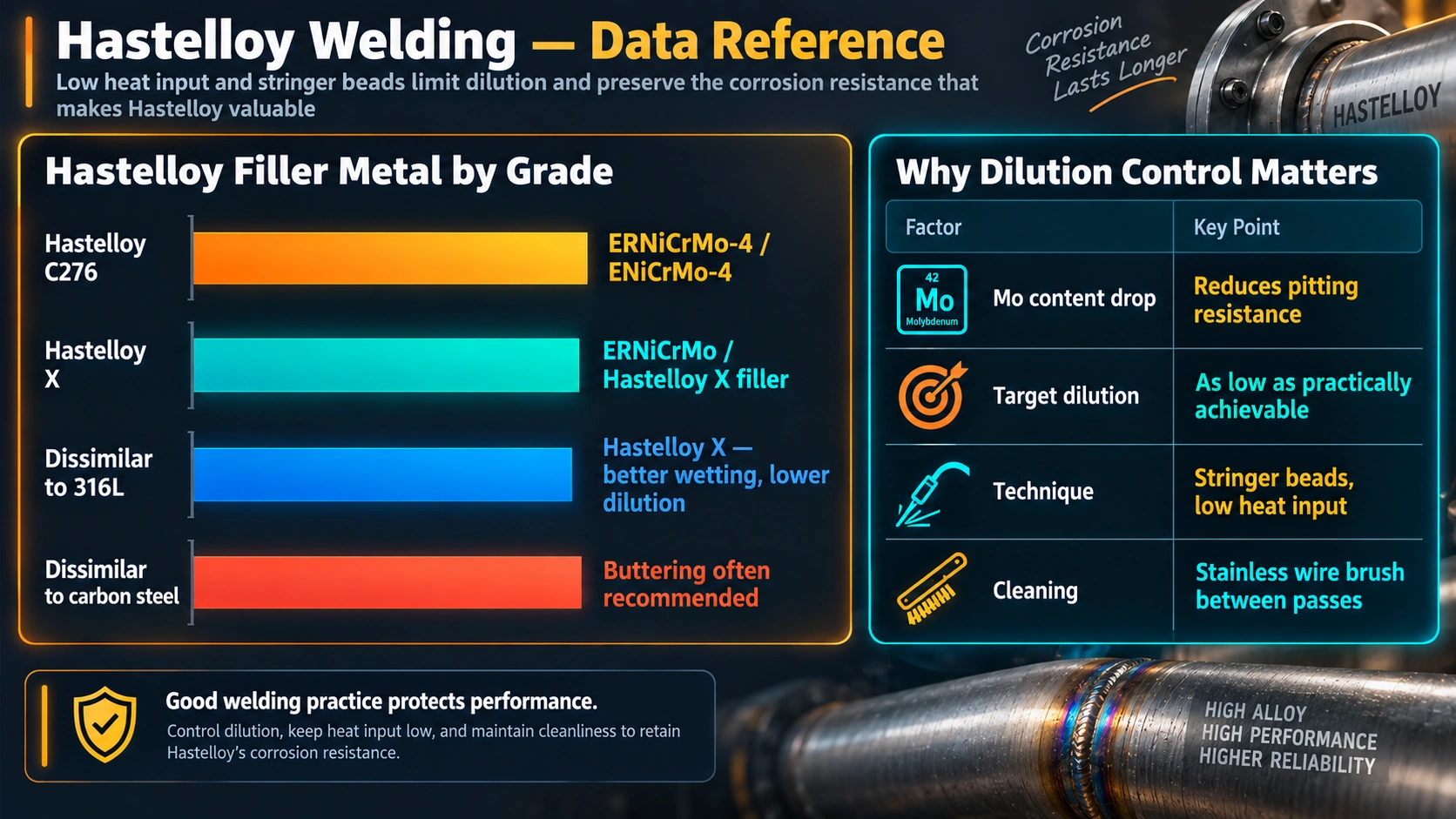
As a general rule, select the filler metal that matches the base metal composition. Where two C-series grades are being welded together and the service environment is highly aggressive, the higher-alloyed filler (ERNiCrMo-10 / C-22 filler) may be specified as an overmatching deposit. The weld metal is always the zone with the greatest metallurgical variability due to dilution, and using the most corrosion-resistant available filler reduces the probability of the weld metal being the preferential corrosion site.
5. Welding Parameters and Joint Preparation
5.1 Joint design
Hastelloy weld pools are significantly more viscous than carbon or stainless steel pools due to the high alloy content. This reduces fluidity and makes it harder to wet out the fusion faces, increasing the risk of lack of fusion at the groove walls. Joint angles are therefore typically wider than for equivalent steel joints: included angles of 60–70° for V-grooves (versus 60° for steel) and 75–80° for GTAW multi-pass butt joints in pipe. Root openings of 2.5–3.5 mm are standard for backed butt welds; root faces are kept narrow (0.5–1.5 mm) to ensure complete root fusion with the low heat input GTAW root pass.
5.2 Typical GTAW parameters
| Parameter | Thin section (<6mm) | Medium section (6–25mm) | Heavy section (>25mm) |
|---|---|---|---|
| Current type | DCEN | DCEN | DCEN |
| Amperage | 60–120 A | 90–160 A | 120–200 A |
| Voltage | 10–13 V | 11–14 V | 12–15 V |
| Travel speed | 150–250 mm/min | 100–200 mm/min | 80–150 mm/min |
| Heat input | 0.3–0.9 kJ/mm | 0.6–1.5 kJ/mm | 1.0–2.5 kJ/mm |
| Shielding gas | Ar (99.999%) | Ar or Ar-25%He | Ar-25%He or Ar-50%He |
| Shield flow rate | 8–12 L/min | 10–15 L/min | 12–18 L/min |
| Back-purge gas | Ar (mandatory for pipe) | Ar (mandatory for pipe) | Ar (mandatory for pipe) |
| Max interpass temp. | 177°C | 177°C | 177°C (93°C for B-2) |
5.3 Electrode (tungsten) selection for GTAW
Thoriated tungsten (EWTh-2, 2% ThO2) or ceriated tungsten (EWCe-2, 2% CeO2) electrodes are used for GTAW of Hastelloy on DCEN. Electrode diameter is selected based on current range: 1.6mm for <100A, 2.4mm for 100–200A, 3.2mm for >200A. The electrode tip should be prepared to a sharp taper (30–45° included angle) with a small flat tip (approximately 0.5–1mm diameter). Electrodes contaminated by contact with the filler wire or weld pool must be re-ground immediately using a grinding wheel dedicated to nickel alloys.
5.4 Bead technique
String beads (stringer beads) are strongly preferred over weaving for Hastelloy. Wide weave beads increase the heat input per unit length and extend the time the HAZ spends in the sensitisation temperature range. Maximum bead width should be limited to approximately 3× the electrode or wire diameter. Each bead should be deposited relatively fast to keep heat input low, and the torch should be moved with a steady, consistent travel speed rather than the slow oscillation used in structural steel work.
6. Critical Precautions
6.1 Surface cleanliness — the most important precaution
Contamination of Hastelloy joint surfaces with low-melting-point elements is the single most common cause of weld cracking in the field. The following contaminants are particularly dangerous:
- Sulphur — present in cutting oils, marker inks, some forming lubricants, and rubber gaskets. Forms low-melting Ni-S eutectic (Ni3S2, m.p. 645°C) which liquates at grain boundaries during welding.
- Lead — from paint, solder, storage straps, and some thread compounds. Ni-Pb eutectic at 326°C.
- Zinc — from galvanised steel clamps, scaffolding fittings, zinc-rich primers. Ni-Zn eutectic at ~380°C.
- Phosphorus — from some drawing lubricants and phosphate conversion coatings. Raises solidification cracking susceptibility.
- Copper — from copper-jawed tooling, copper backing strips, and some marking materials.
The required pre-weld cleaning procedure is:
- Degrease all joint surfaces and adjacent metal (at least 50mm each side of the joint) with a clean, lint-free cloth and an approved solvent (acetone or isopropyl alcohol). Use fresh solvent and clean cloths — do not recycle contaminated solvent.
- Wire brush with a stainless steel brush that is dedicated exclusively to nickel alloys. Wire brushes used on carbon steel or stainless steel introduce iron contamination.
- Inspect for any residual paint markings, adhesive labels, or protective coatings. Remove completely before welding.
- Weld immediately after cleaning. If more than 2 hours elapse, reclean.
- Ensure galvanised or zinc-coated items (including temporary supports, clamps, and fixtures) do not contact Hastelloy weld areas during or after heating.
6.2 Back-purging for pipe and vessel work
Hastelloy weld roots exposed to the atmosphere during GTAW develop heavy oxidation (“sugaring”) that severely damages corrosion resistance by depleting chromium at the weld surface. Back-purging with high-purity argon (99.999%) during root pass welding is mandatory for all pipe and vessel root passes. The back-purge system must maintain a positive argon flow throughout root welding, and the purge gas must be allowed to fully displace atmospheric oxygen before the arc is struck. The residual oxygen level inside the purge cavity should be <100 ppm, ideally <20 ppm, before welding begins. Oxygen monitors (weld purge monitors) are used to verify this in critical applications.
6.3 Heat input control
Maximum heat input should be specified in the WPS and must not be exceeded in production. For Hastelloy C-series alloys, maximum heat input limits typically fall in the range 1.5–2.5 kJ/mm for wall thicknesses above 10mm, with tighter limits of 0.5–1.5 kJ/mm for thin sections (<6mm). The heat input formula:
where k = 0.6 for GTAW, 0.8 for GMAW, 0.8 for SMAW. Welding engineers should specify and document actual voltage, current (measured at the arc, not the power source display), and travel speed for each pass during PQR.
6.4 Interpass temperature
The 177°C (350°F) maximum interpass temperature limit is non-negotiable for Hastelloy C-series in corrosion service. Temperature must be measured by contact pyrometer or calibrated thermocouple immediately adjacent to the joint, not by estimated time between passes. If the interpass temperature is exceeded, the weld must cool before the next pass is deposited. For Hastelloy B-2, reduce the maximum interpass temperature to 93°C (200°F).
6.5 Avoiding arc strikes outside the weld groove
Stray arc strikes on Hastelloy base metal create localised hardened, sensitised zones that are potential initiation sites for stress-corrosion cracking. All arc strikes outside the fusion zone must be reported, and the affected area must be examined by PT (dye penetrant testing). If cracking is found, the affected material must be cut out and replaced. WPS documentation and welder qualification records should specifically prohibit arc strikes outside the weld preparation.
6.6 Grinding and mechanical preparation
All grinding discs, cutting discs, and abrasive media used on Hastelloy must be iron-free and chloride-free, and dedicated to nickel alloy use. Alumina (Al2O3) grinding wheels are preferred. Silicon carbide can be used but carbide contamination of the surface is possible. Zirconia abrasives are acceptable. Interpass cleaning between passes should be done with a dedicated stainless steel wire brush or by light grinding; remove all slag (for SMAW), spatter, and discolouration before depositing the next pass.
7. Post-Weld Heat Treatment
PWHT requirements for Hastelloy diverge significantly from the approach used for carbon and low-alloy steels, and misapplication of standard steel PWHT procedures to Hastelloy weldments is a serious fabrication error.
7.1 Standard stress-relief PWHT — do not apply
The temperature range used for standard carbon steel stress-relief PWHT (600–720°C) falls directly within the sensitisation range for Hastelloy C-series alloys. Holding Hastelloy weldments at these temperatures — even for short periods — will cause extensive carbide and intermetallic precipitation at grain boundaries, severely degrading corrosion resistance throughout the weld and HAZ. This is not recoverable without a subsequent solution anneal. Standard PWHT must never be applied to Hastelloy welds.
7.2 Solution annealing — the correct treatment
Where post-weld thermal treatment is required to dissolve sensitisation products, reduce residual stresses, or restore full corrosion resistance, solution annealing is the correct approach. Parameters by grade:
| Grade | Solution anneal temperature | Soak time | Cooling method | Effect |
|---|---|---|---|---|
| C-276 | 1121–1177°C (2050–2150°F) | 15–30 min per 25mm thickness | Water quench or rapid air cool | Dissolves carbides and sigma/mu phase; restores full corrosion resistance |
| C-22 | 1121–1177°C | 15–30 min per 25mm | Water quench | As above; also relieves residual stress |
| B-2 | 1066–1121°C (1950–2050°F) | 15–30 min per 25mm | Water quench | Dissolves Mo-rich phases; critical for B-2 due to embrittlement risk |
| X | 1177°C (2150°F) | 20–30 min per 25mm | Rapid air cool or water quench | Homogenises microstructure; restores high-temperature oxidation resistance |
Solution annealing must be performed in a furnace with accurate temperature control and uniform atmosphere. The heating and cooling must be sufficiently rapid to avoid extended residence in the sensitisation range on both heating and cooling. For large fabrications where water quenching is impractical, forced-air cooling using compressed air jets must achieve a cooling rate of at least 55°C/min through the range 1000–550°C.
For most code-qualified Hastelloy weldments fabricated with controlled heat input, proper interpass temperature limits, and qualified procedures, solution annealing is not mandatory by ASME Section VIII or B31.3. It becomes necessary when: (a) corrosion testing per ASTM G28 or A262 reveals sensitisation in the as-welded condition; (b) the service environment is highly aggressive and the owner specification requires a fully annealed condition; or (c) fabrication errors (exceeded interpass temperature, excessive heat input) are suspected. Always consult the corrosion engineer and client specification before deciding whether to anneal.
8. Dissimilar Metal Welding
In chemical plant fabrication, Hastelloy components frequently connect to adjacent piping and structures fabricated from carbon steel, 300-series stainless steel, or other nickel alloys. Dissimilar metal joints require careful filler metal selection and WPS development.
8.1 Hastelloy to austenitic stainless steel (304, 316, 321, 347)
ERNiCrMo-4 (C-276 composition) or ERNiCrMo-3 (Alloy 625 composition) are the standard filler metals for Hastelloy-to-austenitic stainless joints. Both provide a compositional bridge that accommodates the dilution from both base metals and produces a weld deposit with adequate corrosion resistance in most environments. ERNiCrMo-3 (Alloy 625) is often preferred in mixed service where the stainless steel side is the primary structural alloy and the Hastelloy is the corrosion-resistant liner.
8.2 Hastelloy to carbon or low-alloy steel
Direct welding of Hastelloy to carbon steel using Hastelloy filler is technically possible but problematic due to the large difference in thermal expansion coefficient (αHastelloy ≈ 11.2 × 10⁻⁶/°C; αC-steel ≈ 12 × 10−6/°C) and the potential for carbon migration from the steel into the nickel alloy weld zone at service temperatures. The standard approach is to apply a nickel alloy butter layer (ENiCrMo-4 or ENiCrFe-3 / Inconel 182) to the prepared carbon steel face, PWHT the buttered assembly if required for the carbon steel component, and then complete the joint to Hastelloy using ERNiCrMo-4 with no further PWHT.
8.3 Hastelloy to duplex or super-duplex stainless steel
ERNiCrMo-10 (C-22 filler) or ERNiCrMo-4 are used depending on the duplex grade and service environment. Super-duplex (2507) to Hastelloy C-276 joints are sometimes specified in subsea and offshore applications. These joints require careful procedure qualification because the high nitrogen content of the duplex base metal can diffuse into the Hastelloy weld deposit, affecting its corrosion resistance. Interpass temperature limits must satisfy the Hastelloy requirement (≤177°C) and not the higher interpass temperatures sometimes applied to duplex welding.
9. Inspection and Testing Requirements
9.1 Visual inspection
All completed Hastelloy welds must be visually inspected per the applicable code. Pay particular attention to: weld surface discolouration (golden-brown or blue tint is acceptable; black or grey heavy oxidation indicates inadequate shielding); arc strikes outside the weld groove; surface porosity; crater cracks; and underfill. Any discolouration darker than light straw colour on the root side indicates inadequate back-purging and must be investigated — the affected run should be removed and re-welded with improved purge gas coverage.
9.2 Liquid penetrant testing (PT)
PT is the primary surface NDT method for Hastelloy weld examination. Water-washable or solvent-removable penetrant systems are used. All Hastelloy welds in pressure equipment service should receive 100% PT of the final weld surface and all interpass surfaces after each pass (particularly after root and first fill passes). PT is more sensitive than MT for the surface-breaking cracks relevant to Hastelloy (hot cracks, liquation cracks), and MT is not applicable to the paramagnetic Hastelloy alloys. PT developer must be removed completely before service exposure in corrosive environments.
9.3 Radiographic testing (RT) and ultrasonic testing (UT)
RT is widely used for butt welds in Hastelloy piping and vessels per ASME Section V and VIII Div. 1. The high alloy content of Hastelloy produces a weld with good radiographic contrast. PAUT (phased array UT) is increasingly specified as a supplement or replacement for RT in heavy-wall vessels where RT geometry or access is limiting. For PAUT of Hastelloy, note that the alloy’s coarser grain structure in the weld and HAZ produces higher acoustic backscatter than carbon steel — calibration blocks from the same grade of Hastelloy must be used for reference reflector sensitivity setting.
9.4 Corrosion testing
For critical chemical plant applications, corrosion testing of weld procedure qualification test coupons is specified in addition to mechanical tests. The most commonly referenced methods are:
- ASTM G28 Method A (boiling ferric sulphate-50% sulphuric acid test) — primarily applicable to C-series Hastelloy alloys to detect HAZ sensitisation by grain boundary attack.
- ASTM G28 Method B (boiling 23% sulphuric acid-1.2% HCl-1% FeCl3-1% CuCl2) — broader corrosion attack test applicable to both C-series and B-series alloys.
- ASTM A262 Practice E (boiling copper-copper sulphate-16% sulphuric acid) — sometimes specified for Hastelloy alloys that are used in environments similar to sensitised austenitic stainless applications.
9.5 Hardness testing
Vickers hardness surveys (HV10) are performed across the weld cross-section as part of PQR. Hastelloy C-276 in the as-welded condition typically exhibits hardness in the range 170–260 HV. There is no mandatory maximum hardness limit for Hastelloy under ASME IX or EN ISO 15614-1 for most applications, but values exceeding 300 HV should be investigated as they may indicate contamination, excessive work hardening, or unexpected phase formation. For sour service applications (ISO 15156), the 250 HV maximum limit applies across the entire HAZ.
10. Applicable Codes and Standards
| Standard | Relevance |
|---|---|
| ASME Section IX | Weld procedure and welder qualification for pressure equipment. P-Number for nickel alloys: P-41 (Ni), P-42 (Ni-Cu), P-43 (Ni-Cr-Fe), P-44 (Ni-Cr-Mo), P-45 (Ni-Cr-Co-Mo). Hastelloy C-276 falls under P-44. |
| ASME Section VIII Div. 1 & 2 | Pressure vessel design; UHA rules for high-alloy materials including Hastelloy. Impact test requirements for cryogenic service; PWHT rules (Section VIII specifically exempts nickel alloys from mandatory PWHT in most cases). |
| ASME B31.3 | Process piping code; Hastelloy pipe welds classified under Category D (normal fluid service) or Category M (materials in severe cyclic or high-hazard service). Examination requirements scale with category and severity. |
| AWS A5.14 | Specification for nickel and nickel-alloy bare welding electrodes and rods; covers ERNiCrMo-4, ERNiCrMo-10, ERNiMo-7, and related filler metals. |
| AWS A5.11 | Specification for nickel and nickel-alloy welding electrodes (SMAW); covers ENiCrMo-4, ENiCrMo-10, ENiMo-7. |
| EN ISO 15614-1 | Weld procedure qualification for steels and nickel alloys (European standard); covers Hastelloy procedure testing, hardness survey, and corrosion test requirements. |
| ASTM B575 | Material specification for low-carbon nickel-molybdenum-chromium and related alloy plate, sheet, and strip — covers C-276, C-22, B-2 in wrought product form. |
| ASTM B619 / B622 | Hastelloy welded pipe (B619) and seamless pipe and tube (B622) specifications; reference the applicable heat treatment and test requirements. |
| ASTM G28 | Standard test methods for detecting susceptibility to intergranular corrosion in wrought and cast nickel-chromium-molybdenum alloys. |
| ISO 15156 / NACE MR0175 | Materials for use in H2S-containing environments; applicable when Hastelloy is used in sour service; imposes 250 HV10 maximum hardness in HAZ. |
11. Recommended Reading
Disclosure: WeldFabWorld participates in the Amazon Associates programme (StoreID: neha0fe8-21). If you purchase through these links, we may earn a small commission at no extra cost to you. This helps support free technical content on this site.
12. Frequently Asked Questions
What welding process is best for Hastelloy?
GTAW (TIG welding) is the preferred process for Hastelloy due to its precise heat input control, inert shielding, and ability to produce high-quality, low-heat-input welds that minimise HAZ sensitisation and grain coarsening. GMAW (pulsed) and SMAW are used for larger fabrications and out-of-position work, but require careful parameter control. SAW is not recommended for Hastelloy due to flux contamination risk and high heat input.
What filler metal is used for welding Hastelloy C-276?
The standard filler metal for Hastelloy C-276 is ERNiCrMo-4 (AWS A5.14), which matches the C-276 composition (Ni-Cr-Mo-W). For SMAW, ENiCrMo-4 electrodes are used. An overmatching approach with ERNiCrMo-10 (Hastelloy C-22 filler) is sometimes specified for critical joints to provide additional corrosion resistance in the weld deposit, since weld metal is often the most corrosion-vulnerable zone due to segregation during solidification.
Does Hastelloy require preheat before welding?
Hastelloy alloys generally do not require preheat when the base metal is at ambient temperature and free from moisture. Elevated preheat is counterproductive for most Hastelloy grades because slow cooling promotes carbide precipitation and sensitisation in the HAZ. The metal should be clean, dry, and at room temperature. If welding in cold conditions (below 10°C), warming to 15–20°C is sufficient to prevent moisture condensation on the joint surface.
Can Hastelloy be welded to stainless steel?
Yes. Hastelloy can be welded to austenitic stainless steels (304, 316, 321, 347) and to carbon steel. For Hastelloy-to-stainless joints, ERNiCrMo-4 or ERNiCrMo-3 filler metals are typically specified to bridge the compositional gap and resist dilution effects. For Hastelloy-to-carbon steel dissimilar joints, a nickel alloy butter layer or ERNiCrMo-4 is used, with a fully qualified WPS per the applicable code.
What is sensitisation in Hastelloy and how is it prevented?
Sensitisation in Hastelloy refers to the precipitation of chromium-rich carbides or intermetallic phases (sigma, mu phase) at grain boundaries during exposure to 600–1000°C, depleting the matrix of Cr and Mo and reducing corrosion resistance. Prevention strategies include: minimising heat input and interpass temperature to reduce time in the sensitisation range; using low-carbon grades; applying string bead technique; and performing solution annealing (1100–1180°C, water quench) when required.
Is PWHT required for Hastelloy welds?
Standard stress-relief PWHT is not required and must not be applied to Hastelloy welds — the 600–720°C PWHT range for carbon steels falls within Hastelloy’s sensitisation zone and will severely degrade corrosion resistance. Where thermal treatment is required, a full solution anneal at 1100–1180°C followed by rapid water quenching is the correct procedure. For most code-compliant Hastelloy fabrications using proper heat input controls, no post-weld thermal treatment is necessary.
Why must Hastelloy be kept free from contamination before welding?
Hastelloy is highly susceptible to hot cracking caused by low-melting-point contaminants. Sulphur, lead, zinc, phosphorus, and copper form liquid eutectic films at grain boundaries during welding, causing solidification and liquation cracking. Even trace amounts from lubricants, cutting fluids, marker inks, zinc-coated contact surfaces, or galvanised fixtures can cause irreversible damage. All joint surfaces must be solvent-cleaned and wire-brushed with stainless steel brushes dedicated exclusively to nickel alloys immediately before welding.
What shielding gas is recommended for GTAW of Hastelloy?
Pure argon (99.999% purity) is the standard shielding gas for GTAW of Hastelloy. Argon-helium mixtures (Ar-25%He or Ar-50%He) are used on thicker sections to increase arc energy and improve weld pool fluidity. Argon-hydrogen mixtures and CO2 additions are not used for nickel alloys. Back-purging with pure argon is mandatory for root passes in pipes and vessels to prevent oxidation of the weld root. The back-purge oxygen level should be <100 ppm before striking the arc.