Weld Repair Procedure: ASME Code Requirements for Fabrication and In-Service Repairs
A weld repair is not simply a matter of grinding out a defect and rewelding. Under ASME codes, every repair to a pressure-retaining weld is a controlled engineering activity with defined procedural requirements, documented authority chains, and mandatory verification steps. Cutting corners on any part of the process — removing less than the full extent of the defect, using an unqualified WPS, skipping PWHT, or omitting post-repair NDE — can leave a component in a worse condition than before the repair attempt, potentially with a camouflaged flaw that passes a visual examination but fails in service.
This guide consolidates the weld repair requirements from the four ASME codes most relevant to pressure equipment fabrication and maintenance: Section VIII Divisions 1 and 2 (pressure vessels), Section IX (welding qualifications), B31.3 (process piping), and PCC-2 / NBIC Part 3 (in-service repair). It is structured as a practical reference for welding inspectors, welding engineers, and QC managers who need a single consolidated document covering the full repair cycle from defect identification through to final documentation.
- All repair welds require a qualified WPS per ASME Section IX — the same rules apply as for original fabrication welds.
- The Authorised Inspector (AI) must be notified before repair welding begins on pressure-retaining components.
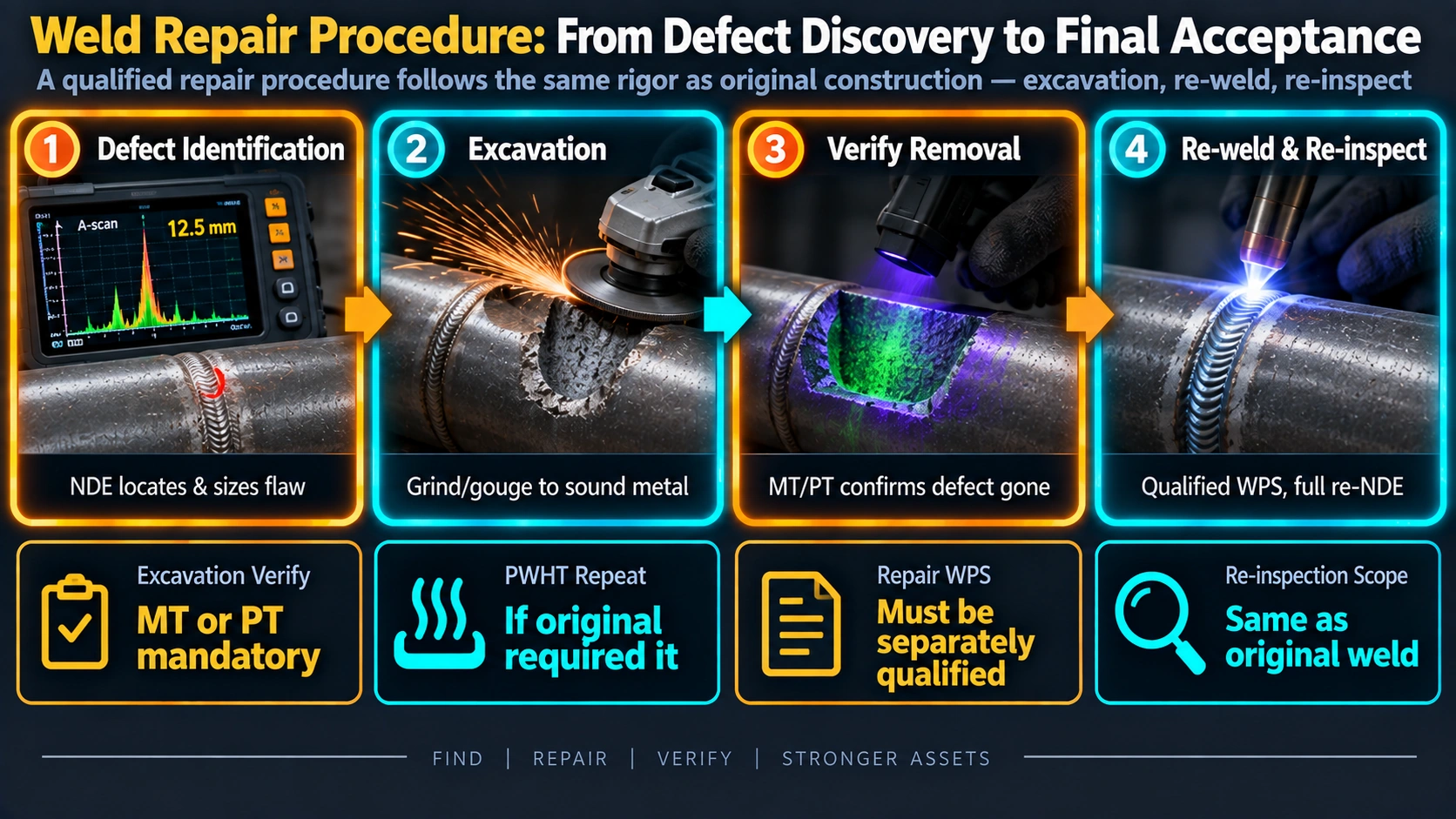
- Defect removal must be verified by NDE (MT or PT) before repair welding commences.
- Post-repair NDE must equal or exceed the examination requirements applied to the original weld.
- PWHT requirements from the original fabrication carry over to the repair unless a specific exemption or temper-bead procedure applies.
- In-service repairs require an ‘R’ Stamp Certificate holder (NBIC) and submission of Form R-1 to the Jurisdiction.
- All repair records must be retained for the life of the equipment — typically as part of the Manufacturer’s Data Report (MDR) or Repair Report.
1. Overview — What Constitutes a Weld Repair Under ASME
Under ASME codes, a weld repair is any operation that removes unacceptable weld metal or base metal affected by welding and deposits replacement weld metal to restore the joint to a condition that meets code acceptance criteria. This is a broader definition than many practitioners assume. It includes:
- Excavation and rewelding of a weld containing cracks, porosity, slag inclusions, lack of fusion, or other rejectable discontinuities found by NDE during original fabrication.
- Weld overlay or build-up to restore wall thickness lost to corrosion, erosion, or mechanical damage on a previously accepted pressure-retaining component.
- Repair of a crack or leaking joint discovered during in-service inspection, hydrostatic testing, or after a service incident.
- Removal and replacement of an unacceptable weld seam (cut-out and reweld).
- Seal welding of a previously mechanical-sealed joint where leakage has occurred.
Importantly, adding a cosmetic weld bead to improve weld surface appearance — without excavating to the defect — does not constitute a repair and will not remove the underlying discontinuity. This “cap-over” practice is a code violation and may mask a rejectable flaw that would otherwise be detectable by surface NDE.
Depositing weld metal over a surface crack or porosity without prior excavation and NDE verification of the cavity is explicitly prohibited under ASME Section VIII UW-38(d) and ASME B31.3. Surface NDE (PT or MT) performed after such a cosmetic pass will show a clean surface while the unrepaired defect remains sub-surface. Inspectors must reject any repair where excavation depth and cavity NDE cannot be demonstrated by documented records.
1.1 Regulatory authority — who must approve a repair
The authority chain for approving weld repairs differs between new construction and in-service scenarios:
New construction (original fabrication): The manufacturer’s written Quality Control (QC) System — required for ASME Code stamp holders — must describe the repair control process. The Authorised Inspector (AI) from the Authorised Inspection Agency (AIA) must be notified of all unacceptable NDE indications and must concur with the proposed repair method before work begins. The AI is not required to physically witness every repair weld but must review the repair documentation and be satisfied that the repair meets code requirements before the component proceeds to final inspection.
In-service repairs: Repairs to existing stamped equipment in service fall under the National Board Inspection Code (NBIC) Part 3 and must be performed by an organisation holding an ASME ‘R’ Certificate of Authorisation. The owner, the Authorised Inspector, and the Jurisdiction (state/local authority) must all be notified per the applicable jurisdiction requirements. Form R-1 (Report of Repair) is completed and submitted to the Jurisdiction and the National Board after completion.
2. Classification of Weld Repair Types
ASME codes do not use a single universal classification for repair types, but three broad categories describe the range of repair scenarios encountered in practice, each with different procedural implications.
2.1 Minor weld repairs (weld metal only)
The most common category: a weld discontinuity (porosity cluster, slag line, lack of fusion indication) is found by NDE, excavated, verified clean by PT or MT, and rewelded. The repair weld is confined entirely within the original weld cross-section. No base metal is involved. PWHT requirements are the same as for the original weld. Post-repair NDE uses the same methods and acceptance criteria as the original examination. This type of repair can usually be completed within the original WPS and does not require a new procedure qualification if the essential variables are unchanged.
2.2 Major weld repairs (involving base metal)
The excavation extends into the base metal — for example, when a toe crack extends into the parent plate, or when a weld is found to have gross lack of fusion that necessitates removal of a significant portion of the weld and adjacent base metal. Base metal involvement changes the P-Number grouping considerations for the repair WPS and may affect the PWHT requirement. Mechanical property testing of the repaired region may be required if the base metal heat-affected zone has been significantly altered by multiple thermal cycles.
2.3 Complete weld removal and replacement
In cases where a weld seam is found to contain pervasive, deep, or extensively distributed defects — particularly in high-pressure service or fracture-critical applications — the most technically sound solution is complete removal of the weld by machining or arc gouging, followed by a fresh joint preparation and rewelding. This is treated as a new weld for code purposes, with full production weld NDE requirements applied to the replacement weld. This approach avoids the complexity of PWHT exemptions for partial repairs in thick-section vessels and gives the inspector confidence that no residual defects remain from the original weld.
| Repair type | Excavation extent | New WPS needed? | PWHT required? | Post-repair NDE |
|---|---|---|---|---|
| Minor (weld metal) | Within original weld cross-section | No — if existing WPS covers variables | Same as original weld | Same as original NDE minimum |
| Major (base metal involved) | Into base metal; >25% weld removed | Possibly — review essential variables | Same as original; exemptions may apply | Same as original; additional hardness survey recommended |
| Complete removal & replacement | Full weld removed; fresh joint prep | Existing production WPS typically applicable | Full PWHT per original weld requirements | Full production NDE requirements apply |
3. WPS and Welder Qualification Requirements
ASME Section IX governs welding procedure and welder qualification for all ASME-coded pressure equipment, without distinction between production welding and repair welding. The qualification rules are identical: a repair weld is performed under a WPS supported by a PQR with test results demonstrating that the procedure produces welds with the required mechanical properties.
3.1 Using an existing production WPS for repairs
In most cases, the welding engineer can use the existing qualified production WPS for the repair weld, provided that the repair does not involve essential variable changes that would take the repair outside the WPS qualification range. The following checks must be made before approving an existing WPS for repair use:
- P-Number: The base metal P-Number of the repair area must fall within the WPS-qualified base metal range.
- F-Number and A-Number: The filler metal must match the qualified F and A numbers.
- Heat input range: The repair weld heat input must fall within the qualified range. Repair welds in restricted-access cavities often use lower current and slower travel speeds — verify that the procedure covers this range.
- PWHT: If the original WPS was qualified with PWHT and the repair will receive PWHT, this is satisfied. If the repair cannot receive PWHT (see Section 6), a procedure qualified without PWHT is required.
- Position: The repair position may differ from original production welding (e.g., overhead repair in a vessel that was originally welded in flat position). Verify that the WPS covers the required position.
- Preheat: Repair welds in thick sections or after prior thermal cycles may require a different preheat than the production WPS specifies. If preheat is increased beyond the WPS limit for non-qualified welding, a supplementary PQR may be required.
3.2 Qualifying a new WPS specifically for repair
A new WPS and supporting PQR are required when the repair involves essential variable changes that take it outside all existing qualified procedures — for example, repair of a crack in a P-5B (Cr-Mo) vessel using a lower-hydrogen process not previously qualified, or repair without PWHT on a vessel that was originally constructed with mandatory PWHT. Qualifying a new repair WPS follows exactly the same Section IX process as qualifying any other WPS: test assembly, mechanical testing (tensile, bend, impact if required), and documentation of the PQR.
3.3 Welder and welding operator qualification
Welders performing repairs must be qualified for the process, position, and filler metal type of the repair weld per ASME Section IX QW-300 series. A welder qualified for production welding is not automatically qualified for all repair scenarios — if the repair requires a different position, process, or filler metal outside their current qualification range, a new welder qualification test is required. Welder qualification records (WQR or WPQ) must be traceable to each repair weld through the repair record documentation.
Fabricators and repair organisations holding ASME Code stamps should maintain a repair WPS library that specifically addresses common repair scenarios: repairs without PWHT using temper-bead technique; repairs with butter layers for dissimilar material situations; and low-heat-input GTAW procedures for tight-cavity repairs. Having these WPSs pre-qualified avoids delays when repairs are needed under production schedule pressure.
4. Defect Removal — Excavation Methods and NDE Verification
Complete removal of the defect is the non-negotiable first step of any weld repair. Partial removal — grinding down until the indication disappears from the immediate surface — is not acceptable for cracks, lack of fusion, or other planar discontinuities. The excavation must remove all defective material and extend into demonstrably sound metal.
4.1 Excavation methods
Grinding: Suitable for shallow surface defects (porosity, surface slag, surface-breaking cracks). Angle grinders with abrasive discs remove material progressively while allowing visual monitoring. The cavity profile should be dressed to a smooth, tapered shape with a minimum 4:1 length-to-depth ratio to avoid stress concentration at the base of the excavation.
Arc air gouging (CAC-A): The most common method for removing significant depths of weld metal in carbon and low-alloy steel. A carbon electrode with compressed air blast removes molten metal rapidly. Produces a carburised surface layer (~0.5–1mm) that must be removed by grinding before repair welding — failure to do so increases the risk of cracking in the repair weld due to elevated carbon at the fusion interface. Not suitable for stainless steel or nickel alloys without careful subsequent grinding.
Mechanical gouging (chipping, routing): Used where arc gouging is impractical (tight spaces, in-service environments with flammable vapours). Slower but produces no carburised surface. Required for repair of stainless steel pressure vessels in food, pharmaceutical, or cryogenic service where contamination from the carbon electrode is unacceptable.
Plasma gouging: Produces a cleaner cut than arc air gouging with less carburisation, suitable for stainless and nickel alloys. Higher equipment cost but preferred for thin-section or austenitic alloy repairs.
4.2 NDE verification of the excavated cavity
Before repair welding begins, the excavated cavity must be examined by MT or PT to confirm that the defect has been completely removed. This is a mandatory hold point — not a recommended practice. The code basis is ASME Section VIII UW-38(a) for pressure vessels and ASME B31.3 345.2.3 for piping.
- MT (magnetic particle testing): Used for ferromagnetic materials (carbon steel, low-alloy steel, ferritic stainless steel). Wet fluorescent MT is the most sensitive method for crack detection at the base of the excavation. After arc air gouging, MT must be applied after the grinding step to avoid false indications from the magnetic field distortion caused by the carburised surface layer.
- PT (liquid penetrant testing): Used for non-magnetic materials (austenitic stainless, nickel alloys, aluminium) and as an alternative to MT for ferromagnetic materials. Visible dye PT is the minimum; fluorescent PT provides higher sensitivity and is preferred for crack removal verification.
- Cavity geometry: Before beginning PT or MT, visually verify that the cavity profile is smooth, without sharp corners or undercuts at the edges. Sharp corners concentrate stress in the repair weld root and may mask crack indications during NDE.
This point in the repair sequence is a mandatory HOLD point in the QC system. The cavity NDE record must be signed off by the responsible Inspector before any weld metal is deposited. Inspectors should be present to witness the PT or MT examination personally — reviewing a photograph of the cavity after the fact is not an adequate substitute for witnessed NDE at the hold point.
5. Repair Welding — Parameters, Technique, and Controls
5.1 Joint geometry and access
Repair excavations rarely have the ideal geometry of a production weld joint. Cavities are often asymmetric, narrow, and deep, with limited torch access. These conditions make lack of fusion the primary repair weld quality risk. The welding engineer must assess the cavity geometry before specifying repair welding parameters and may need to widen or reshape the cavity to ensure adequate electrode or wire access and fusion at the cavity walls.
Minimum recommended cavity geometry for successful repair welding: width at least 1.5× the electrode diameter plus the required manipulation room; minimum wall angle of 10–15° from vertical on each side to allow torch access to the fusion faces; smooth radius at the cavity base of at least 3mm to avoid notch effects. Cavities that cannot meet these geometry requirements should be widened before repair welding begins, even if this removes additional sound material.
5.2 Preheat for repair welds
Preheat requirements for repair welds are governed by the same code provisions (ASME Section VIII UCS-56 tables; AWS D1.1 Table 4.5; EN ISO 13916 for European codes) as for production welds, with the additional consideration that repair welds are typically deposited into material that has already experienced one or more thermal cycles. Repeated heating and cooling raises the residual hydrogen content of the surrounding material and may have created hardened microstructures in the original HAZ. As a minimum, apply the preheat required by the WPS for the relevant P-Number and thickness. For crack repairs, additional preheat — typically 25–50°C above the production minimum — is advisable as a precaution against HACC in the repair weld root.
P-No. 4 (1.25Cr-0.5Mo): Min. preheat = 150°C (300°F) regardless of thickness
P-No. 5A (2.25Cr-1Mo): Min. preheat = 200°C (400°F) — PWHT mandatory after repair
5.3 Bead sequencing and heat input control
Repair welds in pressure-retaining joints are held to the same heat input limits as production welds — typically specified in the WPS as a maximum kJ/mm value. In thick-section repairs, heat input control is particularly important because successive passes reheat the previous HAZ repeatedly, and cumulative thermal exposure can degrade toughness if interpass temperature or heat input limits are exceeded.
For repairs in sections thicker than 25mm, a temper-bead sequencing approach (even if formal temper-bead PWHT exemption is not being claimed) is good practice: each bead is deposited to overlap the previous bead’s HAZ by approximately 50%, providing thermal refinement of the coarse-grained HAZ. Butter layers are used on the cavity walls in dissimilar material repairs to prevent dilution effects.
5.4 Interpass cleaning and inspection
Between each pass, the repair weld must be cleaned of slag (SMAW), spatter, and surface oxides by grinding or wire brushing. Each pass must be visually inspected before depositing the next. Any surface cracks, porosity, or unfused edges visible between passes must be reported to the Inspector, who must decide whether the interpass condition is acceptable or whether additional excavation is required before proceeding.
6. Post-Weld Heat Treatment for Repairs
PWHT requirements for repair welds are derived from the same code tables that govern PWHT for production welds, with additional complexity arising from situations where the repair cannot practically receive the same PWHT as the original joint.
6.1 When PWHT is mandatory for repairs
ASME Section VIII UCS-56 mandates PWHT for P-Number 1 carbon steel welds above specific thickness thresholds (typically >38mm for P-1 Group 1 materials), and for all welds in P-4, P-5, P-6, P-7, P-8 (when impact tested), and P-15 materials. These mandatory requirements apply equally to repair welds as to production welds. There are no blanket exemptions for repair welds from mandatory PWHT in ASME Section VIII — each case must be evaluated against the applicable UCS/UHA/UNF/UHT paragraph for the material and thickness involved.
For ASME B31.3 process piping, PWHT requirements are stated in Table 331.1.1 by P-Number and wall thickness. Repair welds in P-4 (Cr-Mo) and P-5 piping, for example, require PWHT regardless of wall thickness under the standard process fluid service category.
6.2 PWHT of in-situ repairs — practical challenges
Local PWHT of a repair area is technically and practically complex. Furnace PWHT of large assembled vessels or piping systems in service is rarely feasible. Local PWHT using electrical resistance heating blankets (most common), induction heating, or gas ring burners must achieve the minimum holding temperature uniformly across the repair area and a surrounding zone at least as large as the minimum specified by the applicable code (typically the greater of 1× the weld width or 25mm on each side of the weld fusion line, and extending through the full wall thickness).
Thermocouple placement must be controlled and documented: a minimum of one thermocouple per 900mm of weld length, with additional thermocouples at the edge of the heated band to verify that the temperature gradient does not cause thermal shock. ASME Section VIII UW-40 and B31.3 331.1.3 specify the maximum heating and cooling rates that apply during local PWHT.
| P-Number | Material group | PWHT temp. range | Min. hold time | Repair PWHT mandatory? |
|---|---|---|---|---|
| P-1 | C and C-Mn steels | 593–649°C (1100–1200°F) | 1 h/25mm, min. 15 min | Yes — when t > 38mm (Div. 1) or per WPS for thinner sections |
| P-3 | Alloy steels (0.5Mo, Mn-Mo) | 593–649°C | 1 h/25mm, min. 30 min | Yes — all thicknesses for certain product forms |
| P-4 | 1.25Cr-0.5Mo steels | 677–732°C (1250–1350°F) | 1 h/25mm, min. 1 h | Yes — mandatory regardless of thickness under B31.3 |
| P-5A | 2.25Cr-1Mo steels | 677–760°C (1250–1400°F) | 1 h/25mm, min. 1 h | Yes — mandatory |
| P-5B | 5Cr-0.5Mo, 9Cr-1Mo (Gr. 91) | 730–790°C (P-91: 760–790°C) | 1 h/25mm, min. 2 h for P-91 | Yes — mandatory; P-91 requires careful PWHT control |
| P-8 | Austenitic stainless steels | Solution anneal if required | Per material spec. | Not mandatory in most cases; solution anneal for sensitisation-sensitive service |
7. Temper-Bead Welding — Avoiding PWHT on Repairs
Temper-bead welding (also called controlled deposition welding or controlled thermal severity welding) is the most widely used technique for performing code-compliant repairs on pressure equipment when furnace or local PWHT is impractical. It is particularly common for in-service repairs to large vessels, piping systems, and rotating equipment where cooling to the required PWHT temperature, then reheating, then rehydrostatic testing would be prohibitively disruptive.
7.1 Metallurgical principle
As discussed in the context of grain growth, the HAZ of any fusion weld contains a coarse-grained zone (CGHAZ) immediately adjacent to the fusion line where austenite grain growth has occurred and where hard, potentially brittle transformation products may form on cooling. In production welding, PWHT tempers these hard microstructures and reduces residual stress. Temper-bead welding achieves a similar microstructural improvement without PWHT by using a precisely controlled bead placement pattern in which each new bead reheats the previous bead’s CGHAZ into the fine-grained austenite temperature range (Ac3 to ~1100°C), causing grain refinement and partial tempering of the coarse prior-austenite microstructure.
7.2 ASME Code Cases for temper-bead repairs
ASME has issued several Code Cases that formally authorise temper-bead welding as an alternative to PWHT for specific material groups and situations:
| Code Case | Applicable Code | Scope | Material P-Numbers |
|---|---|---|---|
| CC 2434 | ASME Section VIII Div. 1 & 2 | Temper-bead repair welding without PWHT — new construction or in-service | P-1, P-3, P-4, P-5A, P-5B (Gr. 1 & 2) |
| CC 2142 | ASME Section VIII Div. 1 | Half-bead and controlled deposition repair technique | P-1, P-3, P-4, P-5A |
| CC 2843 | ASME Section VIII Div. 1 | Temper-bead repair of P-15E (Grade 91 Cr-Mo-V) | P-15E (9Cr-1Mo-V) |
| IWA-4600 | ASME Section XI | Weld repair of nuclear components without PWHT using temper-bead technique | P-1, P-3, P-4, P-5 |
7.3 Qualification requirements for temper-bead procedures
A temper-bead WPS requires a dedicated PQR demonstrating that the procedure produces HAZ hardness values and Charpy impact toughness equivalent to those of a PWHT’d weld. The qualification test assembly must replicate the repair geometry as closely as possible. Post-qualification hardness surveys (HV10 across the HAZ) typically demonstrate that the peak hardness in the as-welded temper-bead HAZ is within the ASME-permitted hardness limit (typically ≤248 HV10 for P-1 steels under most process codes). Charpy impact tests on sub-sized specimens from the HAZ at the design minimum temperature must meet the minimum absorbed energy requirements specified by the code for the material group.
7.4 Limitations of temper-bead welding
Temper-bead welding does not fully replicate the residual stress reduction achieved by PWHT. Residual tensile stresses in the repair weld remain at or near the material yield stress until PWHT is applied. This is a consideration in environments susceptible to stress-corrosion cracking (SCC) — temper-bead repairs in SCC-sensitive service (wet H2S, caustic, amine) should be evaluated by a corrosion engineer, and the owner may specify full PWHT as the only acceptable option regardless of code allowances for temper-bead.
8. Post-Repair NDE Requirements
Post-repair NDE is the final technical verification step before a repaired weld is accepted for return to service or continuation of fabrication. The fundamental rule across all ASME codes is that the post-repair examination must be at least as stringent as the examination required for the original weld. In some cases — where the repair has involved base metal, crack removal, or repeated thermal cycles — additional examination methods may be specified by the AI or the engineering authority.
8.1 Minimum NDE after repair — by code
| Code | Minimum post-repair NDE | Additional NDE |
|---|---|---|
| ASME Sec. VIII Div. 1 | VT of completed weld; RT or UT if original weld required radiography (UW-51/52) | PT or MT of final weld surface if original required surface examination; AI may require additional |
| ASME Sec. VIII Div. 2 | Full NDE per original weld category; PAUT increasingly specified for Div. 2 repairs | Hardness survey across repair HAZ recommended; TOFD for critical joints |
| ASME B31.3 | Re-examine repaired area to original examination category (Normal/Severe Cyclic/Category M/Category D) | Additional examination per 341.3.4 if original defect cause unresolved; engineering review |
| NBIC Part 3 | VT minimum; RT or UT for all full-penetration repairs in pressure-retaining components | Jurisdictional requirements may add hardness testing; AI discretion |
| ASME Section XI | VT, PT or MT, UT per IWA-4520 and applicable ISI program requirements | Pre-service inspection of repaired area per Table IWB-2500-1 category |
8.2 Timing of post-repair NDE
For repairs involving crack removal in hardenable steels, PT and MT must not be performed immediately after welding. Delayed cracking (hydrogen-assisted cold cracking) can initiate up to 48 hours after weld completion in higher-carbon and Cr-Mo steels. ASME B31.3 and many owner specifications therefore require a minimum 48-hour delay before post-repair PT or MT on P-4, P-5, and P-6 materials when no PWHT has been applied. RT and UT may be performed at any time after weld cooling but should not replace the mandatory surface examination at the 48-hour hold.
8.3 Acceptance criteria
Acceptance criteria for post-repair NDE are identical to those applied to the original weld. For ASME Section VIII Div. 1 full radiography, this means UW-51(b) acceptance criteria for RT and UW-52 acceptance criteria for spot RT. There is no relaxation of acceptance criteria for repair welds. If the post-repair NDE reveals further unacceptable indications, the repair cycle begins again: notification to AI, additional excavation with NDE verification of the cavity, re-welding, PWHT if required, and post-repair NDE.
9. In-Service Repairs — NBIC, PCC-2, and API 510/570
Repairs to pressure equipment already in service involve a regulatory and technical framework that overlays the original construction code requirements. The primary additional considerations are fitness-for-service assessment, regulatory notification, and the involvement of a certified repair organisation.
9.1 NBIC Part 3 — National Board Inspection Code
The NBIC Part 3 is the primary code governing repairs and alterations to pressure-retaining items in the United States. It requires that:
- The repair organisation holds an ASME ‘R’ Certificate of Authorisation.
- A repair plan is prepared and approved by the Owner and the Authorised Inspector prior to commencement of work.
- Repair welding is performed using procedures and welders qualified per ASME Section IX.
- Form R-1 (Report of Repair) is completed by the repair organisation and countersigned by the AI; a copy is submitted to the Jurisdiction and the National Board.
- A pressure test equivalent to the original code test (hydrostatic or pneumatic) is performed after the repair, unless a written exemption is approved by the Jurisdiction and AI.
9.2 ASME PCC-2 — Repair of Pressure Equipment and Piping
ASME PCC-2 provides engineering guidance for repair methods beyond conventional welded repairs, including weld overlay and cladding, hot tapping, composite sleeve repairs, and bolted clamps. For weld-based repairs, PCC-2 Article 2.1 covers weld repair of pressure equipment and references ASME Section IX and the original construction code for procedure and qualification requirements. PCC-2 is particularly useful for fitness-for-service decisions when the extent of corrosion or damage is such that a direct weld repair is not feasible.
9.3 API 510 (Pressure Vessel Inspection Code) and API 570 (Piping Inspection Code)
API 510 and API 570 govern the inspection, rating, repair, and alteration of in-service pressure vessels and piping respectively. Both codes require that repairs be performed to the original construction code standard (typically ASME Section VIII or B31.3) and that the repair be reviewed and approved by a pressure vessel or piping inspector certified per API 510/570. Key provisions relevant to weld repairs include: fitness-for-service assessment per API 579-1/ASME FFS-1 before deciding whether repair is necessary; classification of repairs versus alterations (the distinction affects regulatory notification requirements); and risk-based inspection (RBI) considerations for scheduling post-repair inspection intervals.
Under NBIC Part 3 and API 510/570, a repair restores a pressure-retaining item to its original design condition. An alteration changes the design conditions, geometry, or materials. The distinction matters because alterations require re-rating calculations, a new MAWP assessment, and more extensive regulatory notification. Adding a nozzle, changing the shell thickness by installing a patch plate, or modifying the support structure are typically alterations. Re-welding a failed seam to its original geometry is a repair. When in doubt, consult the Jurisdiction and the AI before beginning work.
10. Documentation Requirements
Documentation is the paper record that proves a repair was performed correctly — it is the inspector’s primary tool for demonstrating code compliance and the owner’s evidence that the equipment is fit for continued service. Inadequate documentation is itself a code non-compliance, regardless of the technical quality of the repair weld.
10.1 Required documentation for fabrication repairs (new construction)
| Document | Content | Retained by |
|---|---|---|
| Non-Conformance Report (NCR) | Defect description, location, size, NDE method, probable cause, proposed repair method, engineering disposition | Manufacturer — part of QC records |
| Repair WPS | Referenced WPS number and revision; confirmation that essential variables are within qualified range; any special requirements for the repair | Manufacturer and AI file |
| Welder Qualification Records (WQR/WPQ) | Qualification status of each welder who performed repair welding; process, position, material group, filler metal type | Manufacturer — must be current and traceable |
| Pre-repair NDE (cavity NDE) | PT or MT report confirming complete defect removal; method, examiner certification, date, result | Manufacturer — mandatory hold point record |
| PWHT record | Thermocouple locations, time-temperature chart, heating and cooling rates, hold temperature and duration, furnace or heating equipment ID | Manufacturer — original chart plus report |
| Post-repair NDE reports | RT film or digital images with interpretation report; UT scan data; PT/MT reports; acceptance/rejection statement per applicable criteria | Manufacturer and AI file |
| AI endorsement | AI signature/stamp on NCR closure, repair records, and final Manufacturer’s Data Report (MDR) | Manufacturer and National Board (for MDR) |
10.2 Required documentation for in-service repairs (NBIC)
In addition to the manufacturing repair documentation above, in-service repairs require:
- Form R-1 (Report of Repair): Completed by the ‘R’ Certificate holder; signed by the AI; submitted to Jurisdiction and National Board. Describes the item repaired, the repair method, the materials and procedures used, and the result of the post-repair inspection and pressure test.
- Fitness-for-Service (FFS) assessment: Required when the repair involves a flaw that has been evaluated but not fully removed, or when the decision to repair (versus replace) was based on remaining life calculations. Performed per API 579-1/ASME FFS-1 and retained as part of the equipment file.
- Pressure test record: Hydrostatic or pneumatic test report documenting test pressure, medium, duration, temperature, and result.
- Updated equipment inspection record: The equipment’s inspection history file (API 510 or API 570 file) must be updated to reflect the repair, the nature of the defect found, the probable cause, and any changes to the inspection interval or remaining life calculation resulting from the repair.
10.3 Record retention
ASME Section VIII and the NBIC require that all records associated with the original fabrication — including the Manufacturer’s Data Report and all supporting documentation — be retained for the life of the equipment. In-service repair records (Form R-1 and supporting documents) must similarly be retained by the owner for the life of the equipment. Electronic records are acceptable provided that they are backed up, access-controlled, and reproducible in legible printed form on demand. Inspectors reviewing a vessel’s service history should expect to find complete documentation for every repair performed since original fabrication — missing repair records are a significant compliance concern.
11. ASME Code Reference Summary
| Code / Standard | Applicable Repair Clauses | Key Requirements |
|---|---|---|
| ASME Section IX | QW-200 (WPS), QW-300 (Welder Qual.) | All repair welds require qualified WPS and qualified welders; same rules as production welding; essential variable changes require new PQR |
| ASME Sec. VIII Div. 1 | UW-38 (repair of defects); UW-40 (PWHT); UW-51/52 (NDE acceptance) | AI notification mandatory; NDE verification of excavation; post-repair NDE to original standard; PWHT per UCS-56 applies to repairs |
| ASME Sec. VIII Div. 2 | 7.2.7 (repair); 7.8 (PWHT); 7.5 (NDE) | All repair welds require documented procedure; Div. 2 has stricter NDE requirements; full PWHT unless specific engineering exemption |
| ASME B31.3 | 328.6 (repair); 331 (PWHT); 341.3 (NDE acceptance) | Repairs by excavation and welding; same WPS and welder requirements as original; post-repair NDE to original examination category; 48-hour delay for P-4/P-5 MT/PT |
| NBIC Part 3 | Part 3 Sections 1–5 (repair); R-1 Form | ‘R’ Certificate required; AI and Jurisdiction notification; Form R-1 submission; pressure test after repair unless exempted |
| ASME PCC-2 | Article 2.1 (weld repair); multiple articles for non-weld repairs | Engineering guidance for repair methods; references Section IX and original construction code for qualifications |
| API 579-1 / ASME FFS-1 | All parts — fitness-for-service assessment | Used to evaluate whether repair is required, to determine acceptable flaw size remaining post-repair, and to set post-repair inspection intervals |
| ASME Code Cases 2142, 2434, 2843 | Temper-bead repair welding | Alternative to PWHT for P-1 through P-5 steels; specific qualification test requirements; hardness and impact test limits apply |
12. Recommended Reading
Disclosure: WeldFabWorld participates in the Amazon Associates programme (StoreID: neha0fe8-21). If you purchase through these links, we may earn a small commission at no extra cost to you. This helps support free technical content on this site.
13. Frequently Asked Questions
Does a weld repair under ASME Section VIII require a separate qualified WPS?
Yes. ASME Section VIII Div. 1 (UW-38) and Div. 2 (7.2.7) require that all repair welds be performed under a qualified WPS supported by a PQR per ASME Section IX. An existing production WPS may be used if the essential variables — P-Number, F-Number, heat input range, PWHT, and position — are within the qualified range. If the repair involves different variables, a new WPS must be qualified.
What NDE is required after a weld repair under ASME codes?
Post-repair NDE must equal or exceed the examination requirements applied to the original weld. At minimum, visual examination is required for all repairs. For pressure-retaining welds requiring RT or UT under Section VIII, the post-repair area must receive the same volumetric examination. PT or MT is required for surface examination categories. ASME B31.3 requires re-examination to the original examination category. The AI may specify additional methods if the nature of the original defect warrants it.
Can a weld repair be made without PWHT if the original weld received PWHT?
This is a critical decision. If PWHT was mandatory for the original weld, the repair weld must also receive PWHT unless a specific exemption applies — such as the repair meeting thickness exemption criteria under a WPS qualified without PWHT, or temper-bead welding technique being applied per ASME Code Case 2434 or Section XI procedures. The AI must concur in all cases, and repairs in SCC-sensitive environments should be reviewed by a corrosion engineer regardless of code allowances.
What is the difference between a repair under ASME Section VIII and Section XI?
ASME Section VIII governs repairs during original fabrication or prior to initial service. ASME Section XI governs repairs to nuclear power plant components in service. For non-nuclear in-service pressure equipment repairs, ASME PCC-2 and the National Board Inspection Code (NBIC Part 3) govern the repair process, with the original construction code used as the technical basis. In-service repairs require an additional fitness-for-service assessment and may require regulatory notification and Form R-1 submission.
How deep must a defect be excavated before repair welding?
The defect must be completely removed — excavation continues until NDE (PT or MT) confirms the cavity is entirely defect-free. For cracks, excavation extends at least 6mm beyond the visually apparent crack tip in all directions, followed by MT or PT to confirm full removal. For porosity or slag, sound metal extends 10–15mm beyond the visible indication on each side. The cavity must also be dressed to a smooth 4:1 length-to-depth profile to avoid stress concentration in the repair weld.
Who can authorise a weld repair on an ASME-stamped pressure vessel?
For new construction repairs, the manufacturer’s QC System and the Authorised Inspector (AI) from the Authorised Inspection Agency govern the repair process. The AI must be notified of all unacceptable NDE indications and must concur with the repair plan. For in-service repairs, the National Board Inspection Code requires repairs to be performed by an organisation holding an ‘R’ Certificate of Authorisation, with notification to the Jurisdiction Inspector in most cases.
What is temper-bead welding and when is it used for repairs?
Temper-bead welding uses strategically placed overlapping weld beads so that the FGHAZ of each new bead thermally refines and tempers the CGHAZ of the previous bead, replicating the microstructural improvement of PWHT without a furnace cycle. It is used when PWHT is impractical — in-service repairs to large vessels, field repairs, or repairs where furnace access is unavailable. It is qualified under ASME Code Cases 2142, 2434, and 2843 for P-1 through P-5 steels, and under ASME Section XI IWA-4600 for nuclear components.
What documentation is required for a completed weld repair under ASME?
Required documentation includes: the repair WPS referencing the supporting PQR; the NCR describing the defect location, size, and probable cause; pre-repair cavity NDE records confirming defect removal; welder qualification records for all welders involved; PWHT time-temperature charts if applicable; post-repair NDE reports (RT film, UT data, PT/MT reports); and the AI’s endorsement. For in-service repairs under NBIC, Form R-1 is completed, countersigned by the AI, and submitted to the Jurisdiction and National Board. All records must be retained for the life of the equipment.