Practical Guide to Preventing Porosity in Aluminium Welds
Porosity in aluminium welding is one of the most frequently encountered and persistent weld defects in the fabrication industry. Unlike carbon steel, where porosity is often managed through flux or deoxidant additions to the filler, aluminium offers almost no self-healing mechanism against gas entrapment. Once hydrogen enters the molten pool, the race is on before the weld solidifies and traps it permanently. Understanding why porosity forms — and precisely what controls its severity — is essential for any welder, welding engineer, or QA professional working with aluminium alloys in aerospace, pressure vessel, structural, or marine fabrication.
This guide covers the complete picture: the metallurgical mechanism behind hydrogen-induced porosity, every significant hydrogen source, evidence-based cleaning and preparation procedures, shielding gas best practice, process parameter effects, and a practical prevention checklist you can apply on the shop floor today. Applicable welding processes include TIG/GTAW and MIG/GMAW — the two dominant processes for aluminium fabrication.
Why Porosity Forms in Aluminium Welds
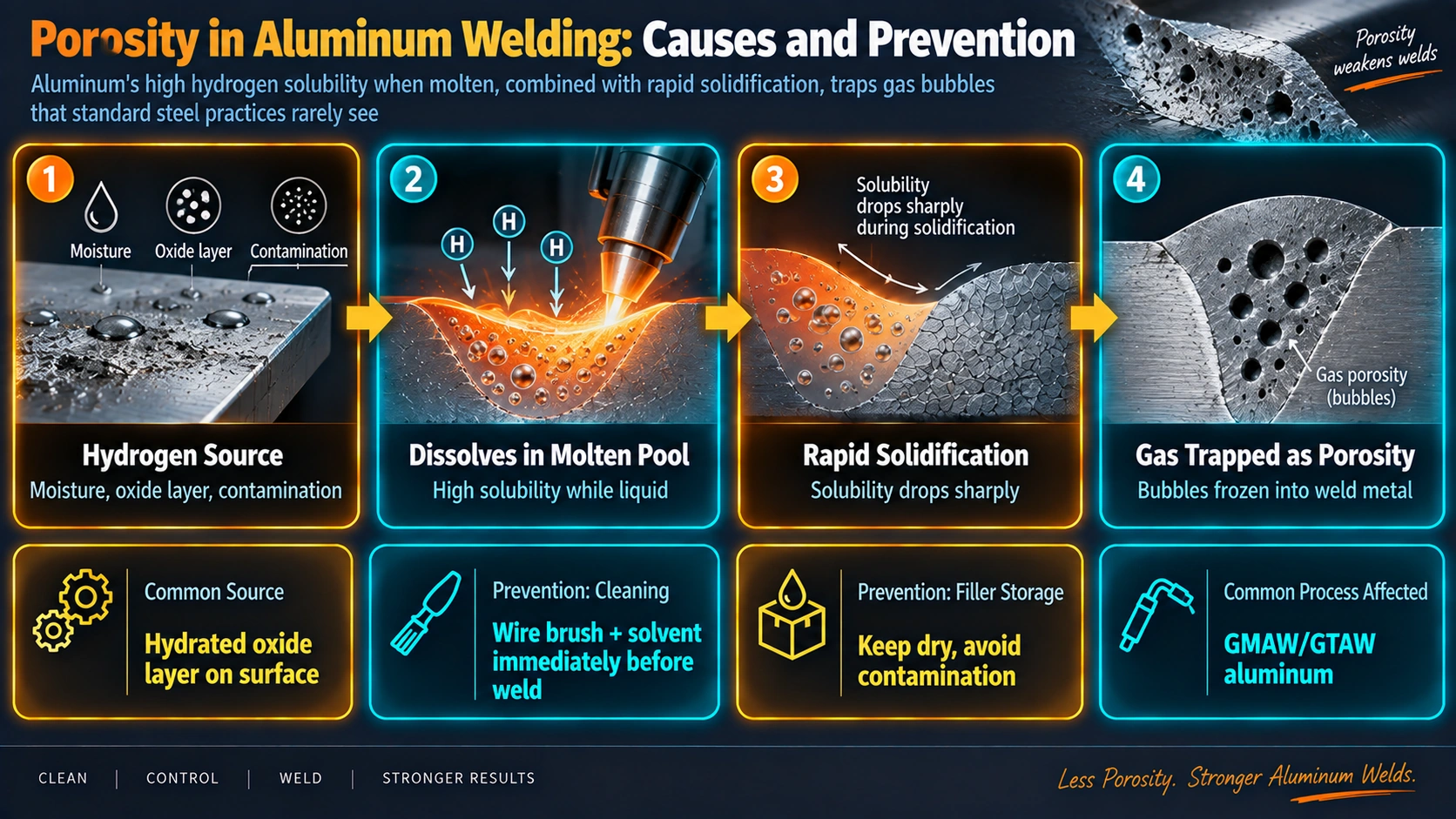
Porosity in aluminium is almost exclusively caused by hydrogen. To understand why this is such a problem with aluminium specifically — more so than with steel — you need to look at one critical material property: the dramatic change in hydrogen solubility at the melting point.
At welding temperatures, molten aluminium can hold a relatively large quantity of dissolved hydrogen. The instant the weld pool begins to solidify, the solubility drops by approximately 20 times. The rejected hydrogen must either diffuse out of the solidifying metal or become permanently trapped as a gas pore. Because aluminium solidifies quickly and thermal conductivity is high, there is often insufficient time for hydrogen to escape, resulting in subsurface spherical pores — the characteristic signature of hydrogen porosity in aluminium welds.
These pores are typically spherical, ranging from fractions of a millimetre to several millimetres in diameter. They may appear individually scattered (distributed porosity), in clusters (grouped porosity), or aligned along the weld centreline or fusion boundary, depending on the welding parameters and the severity of contamination.
Hydrogen Sources in Aluminium Welding
Controlling porosity requires identifying and eliminating every hydrogen source in your welding setup. There are six principal pathways through which hydrogen enters the weld pool in aluminium fabrication.
1. Hydrated Surface Oxide
All aluminium surfaces exposed to air develop an amorphous aluminium oxide (Al2O3) film within seconds. This oxide is hygroscopic and readily absorbs moisture from humid air, particularly at temperatures below the dew point or in coastal environments. When the hydrated oxide enters the arc plasma, thermal decomposition releases atomic hydrogen directly into the weld pool. This is arguably the single most significant hydrogen source in shop-floor aluminium welding.
2. Hydrocarbon Contamination
Oils, greases, cutting fluids, rolling lubricants, fingerprints, and adhesive residues on parent material or filler wire surfaces decompose in the arc to release hydrogen and carbon species. Even trace amounts are sufficient to cause porosity in aluminium, which has zero tolerance for hydrocarbon contamination compared to carbon steel, where flux or deoxidants can partially compensate.
3. Filler Wire Contamination
Aluminium filler wire — whether ER4043, ER5356, ER5183, or other alloys — must be stored in dry, clean conditions. Wire left on an open spool absorbs surface moisture and oils over time. Drawing lubricants used during wire manufacture can also be a hydrocarbon source if not adequately removed. Spool covers and dehumidified wire storage cabinets are standard good practice in production environments.
4. Moisture in Shielding Gas
Commercially supplied argon and helium for aluminium welding typically carry a moisture specification of 10 ppm or less (dew point −60°C or lower). However, moisture can be introduced after the cylinder through leaking or porous hose connections, condensation inside gas lines in cold environments, or incorrectly specified hose materials that allow moisture diffusion. Neoprene and rubber hoses are inferior to stainless steel or PTFE-lined hoses for aluminium shielding gas applications.
5. Atmospheric Humidity
In humid or coastal environments, ambient moisture can disrupt the shielding gas envelope, particularly at longer arc lengths, high torch travel speeds, or when airflow disturbs the shielding envelope. The risk is highest when welding outdoors or in workshops without humidity control. Increasing shielding gas flow rate (within limits to avoid turbulence) and reducing arc length are immediate mitigating measures.
6. Dissolved Hydrogen in the Base Metal
Cast aluminium products and some heavily worked wrought products can contain residual dissolved hydrogen from the casting or forming process. In these cases, porosity originates within the solidifying pool before any surface contamination is involved. For critical cast aluminium weldments, degassing treatment of the base material prior to welding is sometimes specified.
The Aluminium Oxide Layer — Special Considerations
The aluminium oxide film deserves expanded discussion because it is simultaneously a surface protection mechanism and a welding problem. Key properties that make it problematic for welding are:
| Property | Value / Characteristic | Impact on Welding |
|---|---|---|
| Melting Point | 2,072°C (Al2O3) | Does not melt with base metal (Al melts at 660°C); persists as film over the pool |
| Density vs. Al | 3.98 g/cm³ vs. 2.70 g/cm³ | Denser than molten Al; sinks into pool causing oxide inclusions |
| Moisture absorption | Hygroscopic; absorbs H2O rapidly | Primary hydrogen source at the fusion boundary |
| Thickness | 2–10 nm (natural); 25–100+ nm (anodised) | Thicker oxide = more absorbed moisture |
| Reformation rate | Seconds to minutes in air | Welding must start promptly after mechanical cleaning |
In TIG welding, AC current overcomes the oxide problem through cathodic cleaning. During the electrode-positive half-cycle, electrons emitted from the oxide-covered workpiece surface provide the energy to mechanically disrupt and remove the oxide film in a bright, clean band around the weld bead. This is visible as the characteristic “cleaning zone” or “etching band” in an aluminium TIG weld. The width and brightness of this zone indicate the effectiveness of oxide removal and therefore the level of porosity protection provided by the AC balance setting.
Pre-Weld Cleaning Procedures
Systematic pre-weld cleaning is the most impactful single action for preventing porosity in aluminium welding. A two-stage process is required: chemical degreasing followed by mechanical oxide removal.
Stage 1 — Chemical Degreasing
All joint surfaces and the adjacent base material to at least 50–75 mm on each side of the weld joint must be degreased. Use a clean, lint-free cloth or paper towel soaked in acetone, isopropyl alcohol (IPA, minimum 99% purity), or a dedicated aluminium degreaser. Apply in one direction — do not scrub back and forth, as this can redistribute contamination. Allow the solvent to evaporate fully before the next stage.
Stage 2 — Mechanical Oxide Removal
After degreasing, the hydrated oxide layer must be mechanically removed. The standard method is stainless steel wire brushing. Critical requirements for this operation are:
- Use a stainless steel wire brush — never carbon steel, as iron contamination introduces additional problems including galvanic corrosion and arc instability.
- The brush must be dedicated solely to aluminium. Cross-contamination from carbon steel or stainless steel brushing transfers oxides and iron particles.
- Brush in one direction only, parallel to the weld joint direction. Circular brushing can fold oxide back into the surface.
- Apply moderate pressure — the objective is to remove the oxide layer, not cold-work the surface. Excessive pressure can embed abrasive particles.
- Weld within 2–4 hours of brushing in a normal workshop environment. In humid conditions, this window shortens to 1 hour or less.
Alternative Chemical Cleaning Methods
For high-volume production or critical applications, chemical etching is used instead of or in addition to brushing. Sodium hydroxide (NaOH) solution (5–10%) dissolves the oxide film efficiently and provides a clean, activated surface. This must be followed by a dilute nitric acid (HNO3) or chromic acid rinse to neutralise the alkali and inhibit rapid oxide reformation, then a thorough water rinse and rapid drying. These methods come with significant chemical handling, waste disposal, and safety requirements and are more suited to automated production lines than one-off fabrication.
Filler Wire Cleaning
Filler wire for TIG welding should be wiped with an acetone-soaked cloth immediately before use and handled only with clean nitrile gloves. Never use carbon steel cleaning tools on filler wire. For MIG welding, the wire spool should be stored in a sealed, dehumidified container; a new spool end should be discarded (25–50 mm) before commencing welding if the spool has been open and exposed for more than a day.
Handling After Cleaning
After cleaning, never touch joint surfaces with bare hands. Skin oils are highly effective at introducing hydrocarbons and are invisible. Use clean nitrile or cotton gloves. Store cleaned components elevated off the floor on clean wooden blocks or rubber pads, away from cutting or grinding operations that generate metal powder and oil mist.
Shielding Gas — Selection, Purity, and Delivery
For both TIG and MIG welding of aluminium, pure argon (Ar, 99.998% minimum) is the standard choice. Argon provides the required inert atmosphere, supports stable arc behaviour, and enables the cathodic cleaning mechanism in AC TIG. Its properties also suit the DCEP polarity required for aluminium MIG welding.
Gas Mixtures
Helium additions to argon (typically Ar/25%He through to Ar/75%He) increase the arc energy density, improving penetration and increasing travel speed — particularly useful for thick-section aluminium where heat input must be maintained without excessive voltage. However, helium additions also increase cost significantly and can destabilise the AC arc in TIG welding. Pure argon is adequate for the majority of aluminium applications up to 20–25 mm thickness.
| Gas | Typical Application | Effect on Porosity | Notes |
|---|---|---|---|
| Argon 99.998% | TIG and MIG, all thicknesses | Lowest risk | Standard choice; confirm dew point certificate |
| Ar/25%He | MIG, medium/thick section | Low risk | Improved penetration; cost increase |
| Ar/50%He | MIG, thick section (>20mm) | Low risk | High arc energy; requires higher flow rate |
| Ar + CO2 / O2 | Never for aluminium | Unacceptable | Reactive gases attack aluminium, severe oxidation and porosity |
Gas Delivery System Integrity
Even cylinder-grade pure argon will cause porosity if the delivery system introduces contamination. Inspect and maintain the following:
- Hose material: Use stainless steel-braided or PTFE-lined hose. Standard rubber/neoprene hoses are permeable to atmospheric moisture.
- Fittings: Check all compression fittings, regulator connections, and torch body connections with soapy water for leaks. Even small leaks create a venturi effect that draws in atmospheric moisture.
- Flow rate: Use the minimum flow rate that provides reliable shielding — typically 10–18 L/min for TIG and 15–22 L/min for MIG. Excessively high flow rates cause turbulence at the nozzle, entraining atmospheric air into the shielding envelope.
- Torch nozzle: A clean, undamaged ceramic or glass nozzle provides a laminar shielding flow. Cracked or heavily spattered nozzles should be replaced.
- Post-flow: Allow adequate post-flow time (typically 10–20 seconds for TIG) to protect the solidifying weld pool and hot tungsten from atmospheric contamination.
Welding Process and Technique Effects
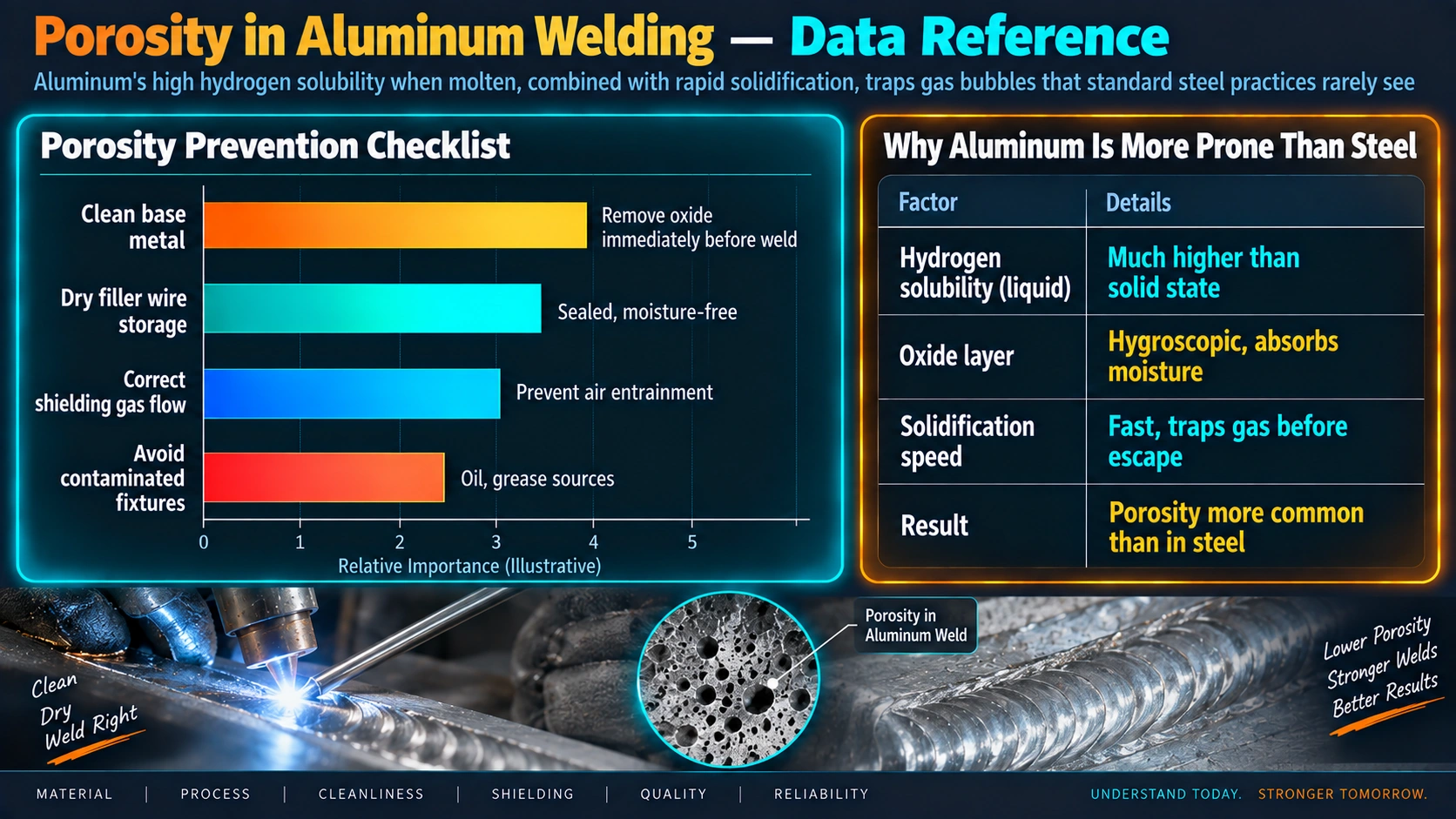
Beyond material preparation and shielding gas, welding parameters and operator technique have a measurable influence on the quantity and distribution of porosity in aluminium welds. The following parameters are the most significant.
TIG (GTAW) — AC Polarity and Balance
As discussed, AC current is mandatory for TIG welding of aluminium to achieve cathodic cleaning. Modern inverter TIG machines offer adjustable AC balance (EP:EN ratio) and AC frequency. Increasing EP percentage widens the cleaning zone but overloads the tungsten; increasing AC frequency narrows the arc column, improving penetration and reducing heat spread. For thin sheet aluminium, higher frequencies (100–200 Hz) are preferred. Refer to the TIG welding settings calculator for guidance on parameter selection.
MIG (GMAW) — Wire Feed Stability
In MIG welding of aluminium, wire feed instability is a significant driver of porosity. Aluminium wire is softer and more prone to birdnesting than steel wire. Use a push-pull gun or a Teflon-lined conduit to reduce feed resistance. Match drive roll type and pressure to the wire diameter — excessive pressure flattens and shaves soft aluminium wire, generating aluminium swarf that contaminates the wire path. Irregular wire feed causes arc instability, momentary loss of shielding, and erratic heat input — all of which worsen porosity.
Arc Length and Voltage
A shorter arc length reduces the exposure of the molten pool to atmospheric contamination and concentrates the shielding gas envelope. However, excessively short arcs risk tungsten contamination in TIG welding or weld-toe undercut in MIG. The optimum arc length for TIG welding of aluminium is typically equal to the tungsten diameter; for MIG, follow manufacturer recommendations for the specific wire/gas combination, adjustable through the MIG welding settings calculator.
Travel Speed and Heat Input
Higher welding currents increase hydrogen solubility in the pool (which may worsen porosity) but also increase pool turbulence and potentially improve outgassing of hydrogen bubbles before solidification. In practice, the competing effects mean that moderate to high heat input combined with adequate travel speed — avoiding excessively slow, cold starts — tends to produce the best results. The use of a run-on tab to avoid cold-start porosity at the weld initiation point is good practice.
Preheating
Light preheating is beneficial in specific circumstances. For thick-section aluminium (>20 mm) or when welding in cold, humid environments, preheating to 60–120°C drives off surface moisture and reduces the thermal quench rate, giving hydrogen more time to escape the pool. Preheat should be measured with a contact pyrometer on the actual joint surface. Torch preheating without measurement is unreliable. Preheat temperature should not exceed 150°C for structural alloys (6061, 5083, etc.) to avoid sensitisation and property reduction.
Cross-Contamination Isolation
Isolating aluminium welding operations from carbon steel or stainless steel fabrication is sound practice often overlooked in small shops. Grinding dust, carbon steel particles, and iron oxide fumes from adjacent operations settle on aluminium surfaces and filler wire, introducing contamination that causes both porosity and arc instability. If dedicated bays are not possible, weld aluminium at the start of a shift before contamination from other operations accumulates, and cover stored aluminium material between operations.
Detection and Acceptance Criteria for Porosity in Aluminium Welds
Once a weld is complete, porosity that formed during welding must be detected and evaluated against applicable acceptance criteria. The primary detection method depends on access, material thickness, and the governing code.
Radiographic Testing (RT)
RT (X-ray or gamma ray) is the most commonly specified NDT method for porosity detection in aluminium welds. Spherical pores appear as well-defined circular shadows on the radiographic film or digital image. Because aluminium has low atomic number and density, the radiation exposure parameters differ significantly from steel — lower kV and shorter exposure times are typical. RT is highly effective for distributed and clustered porosity but has reduced sensitivity to wormhole (elongated) porosity aligned parallel to the radiation beam direction.
Ultrasonic Testing (UT)
UT can detect both surface and subsurface porosity in thicker aluminium sections (>6–8 mm). Signal interpretation requires care because scattered porosity produces multiple overlapping echoes. Phased array UT (PAUT) is increasingly used for aluminium pressure vessel and pipe welds where RT is impractical.
Dye Penetrant Testing (PT)
PT reveals only surface-breaking porosity. It is most useful as a production control check during root pass welding or for identifying active porosity sources during welding trials. PT does not detect subsurface pores.
Acceptance Criteria — Summary
| Standard | Weld Type / Application | Porosity Limit (simplified) |
|---|---|---|
| AWS D1.2 | Structural aluminium welds | Individual pore ≤2.4 mm dia.; sum of pores ≤9.5 mm in any 25 mm of weld length for CJP welds |
| ASME Section VIII / B31.3 | Pressure vessels and piping | Refer to UW-51/UW-52 (RT) or applicable appendix; aligned porosity and clustered porosity typically rejectable |
| EN ISO 10042 | Aluminium arc welds (European) | Acceptance level B/C/D depending on quality level; individual pore diameter limited to fraction of material thickness |
Porosity Prevention Checklist for Aluminium Welding
The following checklist consolidates the preventive controls discussed throughout this guide. It is structured as a pre-weld, in-process, and post-weld check that can be adapted to a workshop quality control procedure.
Recommended Reading — Aluminium Welding
Aluminium Welding Technology
Covers TIG and MIG processes, filler alloy selection, joint design, and defect prevention including porosity control for aluminium fabrication.
View on AmazonAWS Welding Handbook — Materials and Applications
The standard industry reference covering non-ferrous metals including aluminium alloys, processes, and quality control methods for welded fabrications.
View on AmazonNon-Destructive Testing of Welds
Practical NDT guide covering radiographic, ultrasonic, and penetrant testing methods for detecting porosity and other weld discontinuities.
View on AmazonWelding Metallurgy — Sindo Kou
The definitive text on solidification, porosity, cracking, and phase transformation in welds, with dedicated aluminium alloy chapters.
View on AmazonDisclosure: WeldFabWorld participates in the Amazon Associates programme (StoreID: neha0fe8-21). If you purchase through these links, we may earn a small commission at no extra cost to you. This helps support free technical content on this site.