Intermetallic Phases — What Engineers Must Know
Intermetallic phases are among the most consequential microstructural features an engineer will encounter in fabricated components. Unlike simple solid solutions, these ordered compounds — sigma, Laves, chi, mu, and others — form at discrete compositions, carry their own crystal structures, and almost always degrade the properties of the host alloy. Understanding when they form, why they form, and how to prevent or remove them is not academic; it is a daily concern in duplex stainless fabrication, Cr-Mo power piping, nickel superalloy repair welding, and any service environment that combines high temperature with aggressive chemistry.
In welding practice, intermetallics typically precipitate in two locations: the heat-affected zone (HAZ) of the base metal, where the thermal cycle holds the material within a critical temperature window long enough for nucleation and growth; and the weld metal itself, where composition imbalances or slow post-weld cooling promote the same reactions. The consequences range from catastrophic brittle fracture at ambient temperature to accelerated pitting corrosion and stress corrosion cracking. This guide covers the principal intermetallic phases encountered in industrial fabrication, their metallurgical origins, detection methods, relevant ASTM and ASME code implications, and practical prevention strategies.
Whether you are qualifying a welding procedure for super duplex piping, specifying heat treatment for a P91 pressure vessel, or troubleshooting a failed Charpy test on austenitic stainless weld coupons, this article gives you the fundamental knowledge to diagnose and resolve intermetallic-related problems with confidence. Topics such as delta ferrite control and duplex stainless welding are tightly coupled to intermetallic phase management and are cross-referenced throughout.
1. What Is an Intermetallic Phase?
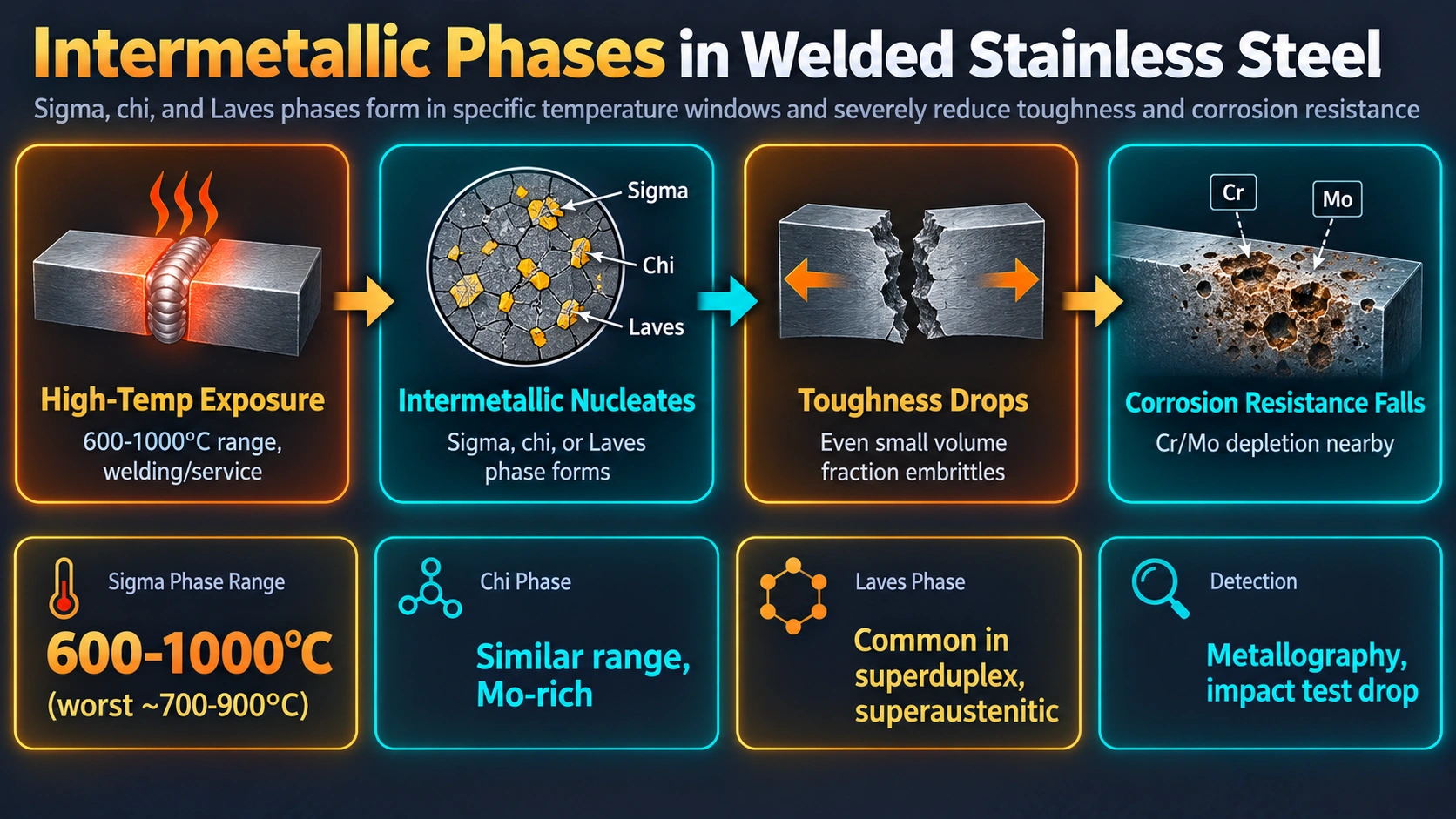
The term “intermetallic” describes an ordered, stoichiometric or near-stoichiometric compound formed between two or more metallic elements whose crystal structure differs from those of the constituent metals. The classic definition, attributed to G. E. R. Schulze, covers solid phases with two or more metallic elements whose atomic positions are filled in a regular, repeating pattern — distinct from the random substitutional arrangement in a solid solution. The result is a structure that behaves more like a ceramic than a metal: hard, brittle, resistant to dislocation motion, and often highly ordered right up to its melting point.
In the context of Fe-Cr-Ni-Mo engineering alloys, most problematic intermetallics belong to the family of topologically close-packed (TCP) phases. This group includes sigma, Laves, chi, mu, and R-phase. They share a common characteristic: their crystal structures are built from close-packed layers of atoms with alternating large and small atomic radii, creating a rigid framework that inhibits plastic deformation and acts as a stress concentrator under load.
Why Intermetallics Form
Intermetallics form because certain alloy compositions minimise their Gibbs free energy by segregating elements into an ordered compound rather than keeping them in solid solution. The driving forces are:
- Composition: High concentrations of Cr, Mo, W, Nb, or Si relative to Fe and Ni push the alloy into a two-phase or multi-phase field on the phase diagram.
- Temperature: Diffusion must be fast enough to allow atoms to redistribute, yet the temperature must be below the phase’s solvus. This creates a critical window, typically 600°C to 950°C for sigma in stainless steels.
- Time: At very short hold times, nucleation may not occur even at the optimal temperature. Intermetallics in duplex stainless can appear in as little as a few minutes at peak kinetic temperatures; in fully austenitic grades, hours may be required.
- Prior microstructure: Ferrite transforms far more readily to sigma than austenite does. The bcc lattice of ferrite is crystallographically closer to the sigma structure, and diffusion coefficients in ferrite are orders of magnitude higher than in austenite at the same temperature.
2. Sigma Phase (σ)
Sigma phase is the most widely documented and commercially significant intermetallic in austenitic and duplex stainless steels. It is a topologically close-packed compound based primarily on the Fe-Cr binary system, with a primitive tetragonal unit cell containing 30 atoms. Its composition in practical alloys ranges roughly from FeCr to FexCryMoz, with molybdenum strongly promoting its formation by raising the electron-to-atom ratio into the favourable range (approximately 6.2 to 7.0).
2.1 Composition and Crystal Structure
The sigma phase unit cell contains 30 atoms arranged in five crystallographically distinct sites (A through E), each preferentially occupied by atoms of a particular size. In Fe-Cr alloys, Cr typically occupies two of the five sites; iron fills the remaining three. The addition of Mo, Mn, Ni, or Si redistributes this site occupancy and shifts the formation kinetics. The resulting compound is non-magnetic, with a Vickers hardness of 900 to 1,000 HV and a density close to that of the matrix — making it difficult to detect by simple visual or magnetic inspection.
2.2 Formation in Duplex Stainless Steels
In standard 2205 (UNS S31803 / S32205) and super duplex 2507 (UNS S32750) grades, sigma nucleates preferentially at ferrite-austenite boundaries and ferrite-ferrite-ferrite triple junctions. The driving mechanism is the decomposition of delta ferrite: Fe, Cr, and Mo diffuse rapidly through the bcc ferrite lattice, allowing sigma and secondary austenite (γ2) to form simultaneously. The overall reaction can be represented schematically as:
δ-ferrite → σ + γ2 (secondary austenite)
Occurs in the range 600 °C – 950 °C; peak kinetics at ~820 °C for 2507
Consequence
Ferrite Number (FN) drops sharply — Charpy impact energy falls toward 0 J
As little as 1–2 vol.% sigma can reduce critical pitting temperature (CPT) by >20 °C
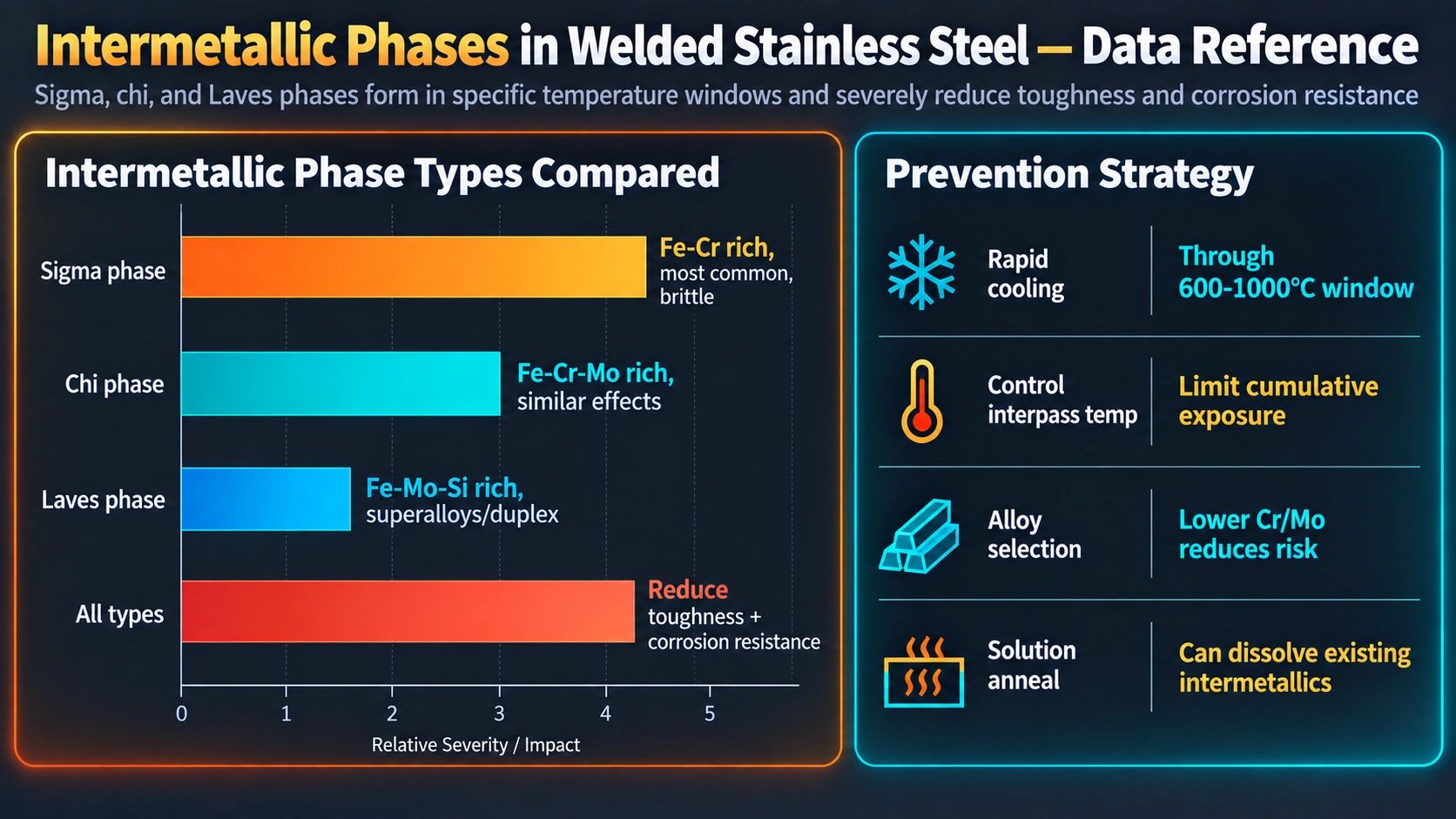
In multi-pass welding, the fill passes reheat the root and intermediate beads into the sigma-forming window. This is the single most common cause of ASTM A923 Method B or Method C failures in duplex weld procedure qualifications. Controlling interpass temperature to below 150 °C and keeping heat input within the 0.5 to 2.5 kJ/mm range specified in most client welding procedure specifications is essential.
2.3 Formation in Austenitic Stainless Steels
Fully austenitic grades (304, 316, 321, 347) are significantly more resistant to sigma formation than duplex grades because diffusion in the fcc austenite lattice is much slower than in bcc ferrite. However, grades containing delta ferrite in the weld metal — which is deliberately introduced to prevent solidification cracking in austenitic welds — provide rapid diffusion pathways that promote sigma after long service exposures at 600°C to 900°C. High-Mo grades (316L, 317L) are particularly susceptible. In the stainless weld decay mechanism, sensitisation to chromium carbide precipitation is distinct from sigmatisation but can occur simultaneously. See the dedicated article on stainless steel weld decay for the full intergranular corrosion picture.
3. Laves Phase (η)
Laves phases are a family of intermetallic compounds with the general formula AB2, where B atoms are approximately 1.225 times smaller than A atoms. This size ratio allows particularly efficient close-packing. The three structural polytypes are C14 (hexagonal, MgZn2-type), C15 (cubic, MgCu2-type), and C36 (dihexagonal). In engineering alloys, the most practically important Laves phases are:
- Fe2Mo and Fe2Nb in high-Mo ferritic and austenitic stainless steels
- Fe2W and Cr2(W,Mo) in P91 and P92 creep-resistant Cr-Mo steels
- Fe2Ti in Ti-stabilised stainless grades
- Ni2Nb in Inconel 625 and alloy 718
3.1 Laves Phase in P91 and P92
The Cr-Mo steels P91 (9Cr-1Mo-V-Nb) and P92 (9Cr-0.5Mo-1.8W-V-Nb) derive much of their creep strength from M23C6 carbides and MX-type fine precipitates (V and Nb carbonitrides). During long-term service above 550°C, these fine strengthening precipitates coarsen while a coarse Laves phase — primarily Fe2(W,Mo) in P92 — nucleates at lath boundaries and prior austenite grain boundaries. This Laves phase consumes W and Mo from the matrix, reducing the solid-solution strengthening contribution and accelerating the coarsening of MX precipitates. The combined effect is a progressive reduction in creep rupture strength. For a comprehensive treatment of P91 welding and metallurgy, see the P91 welding guide on this site.
3.2 Laves Phase in High-Si and High-Mo Ferritic Stainless
Ferritic grades such as Type 430 and 441 can form Fe2Nb or Fe2Ti Laves phase during slow cooling through 500°C to 800°C. In thin sections welded without filler, the weld metal and HAZ may contain enough Laves phase to show a 475°C embrittlement-type toughness loss compounded by the Laves effect. Solution annealing above 950°C followed by water quench is the standard remedy.
4. Chi Phase (χ)
Chi phase is a body-centred cubic (bcc) intermetallic, structurally related to the alpha-manganese structure, with up to 58 atoms per unit cell. In Fe-Cr-Mo alloys, chi phase has a nominal composition of approximately Fe36Cr12Mo10, making it significantly enriched in molybdenum relative to sigma. The higher Mo content means chi phase is particularly prevalent in super duplex (2507) and supermartensitic stainless steels, as well as high-Mo austenitic grades.
4.1 Relationship Between Chi and Sigma
Chi phase often precipitates earlier than sigma at a given temperature because its composition is closer to that of the ferrite phase from which it nucleates. Once chi has precipitated, it can dissolve as sigma grows and consumes the Mo and Cr that stabilised chi. In prolonged thermal exposures, the final microstructure at 850°C is dominated by sigma rather than chi. This transition is diffusion-controlled: chi is the kinetically favoured product at short times; sigma is the thermodynamically stable endpoint. Both phases are equally detrimental to impact toughness and corrosion resistance during the period when they coexist.
5. Mu Phase (μ) and R-Phase
5.1 Mu Phase
Mu phase (also written μ-phase) has an ideal stoichiometry of A6B7 with the prototype structure W6Fe7, forming a rhombohedral unit cell with 13 atoms. In practical alloys, mu phase carries high concentrations of W, Mo, and sometimes Re, with Fe and Co filling the remaining positions. It is most commonly encountered in nickel-base superalloys and high-W steels such as P92 during long-term service above 600°C. Mu phase reduces creep ductility by consuming tungsten and molybdenum from the matrix, similar in effect to Laves phase in P91/P92. In some CrNiMo stainless steels, mu phase forms alongside sigma during prolonged exposure, accelerating grain boundary embrittlement.
5.2 R-Phase
R-phase is a hexagonal TCP compound with a large unit cell (159 atoms) and a composition close to Mo6Fe7Cr in austenitic stainless steels. It forms at slightly lower temperatures than sigma — typically 550°C to 750°C — and is favoured in high-Mo grades (317L, 904L, 254 SMO) after prolonged service or slow cooling. R-phase is generally considered less detrimental than sigma or chi because it is less brittle, but it still depletes Mo from the matrix and can serve as a nucleation site for the more harmful sigma phase during subsequent thermal exposure.
6. Intermetallic Phases in Nickel-Base Alloys
Nickel-base alloys occupy a unique position: they rely on intermetallic precipitates for their mechanical strength, yet are simultaneously vulnerable to detrimental TCP phases if composition or thermal management is incorrect. The distinction between beneficial and harmful intermetallics is fundamental to alloy design in this family.
6.1 Beneficial Intermetallics: Gamma-Prime and Gamma-Double-Prime
Gamma-prime (γ′, Ni3Al or Ni3(Al,Ti)) is the primary strengthening precipitate in wrought superalloys such as Inconel 718 and Waspaloy. It forms as coherent, ordered L12 precipitates within the austenite matrix, impeding dislocation glide and providing the high-temperature strength essential in gas turbine applications. Gamma-double-prime (γ″, Ni3Nb with D022 structure) performs the same function in Nb-rich alloys like Inconel 718. These precipitates are intentional; maintaining them requires strict control over ageing heat treatment temperatures.
6.2 Detrimental TCP Phases in Ni Alloys
When the alloy composition deviates from design limits — through dilution with dissimilar filler metals, segregation during weld solidification, or composition variability between heats — TCP phases precipitate at grain boundaries and interdendritic regions. The most common detrimental intermetallics in Ni-alloy welds are:
- Laves phase (Ni2Nb) in Inconel 625 and 718: forms during weld solidification due to Nb segregation to the final liquid. Reduces ductility and rupture strength. Minimised by limiting Nb segregation through low heat input and post-weld solution annealing above 1,150°C.
- Sigma and mu phases in high-Mo, high-W nickel alloys: form during prolonged service at 700°C to 900°C. Detected by SEM-EDS and XRD on extracted residues.
- Delta phase (δ, orthorhombic Ni3Nb) in Inconel 718: forms above approximately 900°C during overageing, consuming Nb that would otherwise contribute to strengthening γ″ precipitates.
7. Comparison of Principal Intermetallic Phases
| Phase | Formula / Type | Crystal Structure | Formation Range | Key Alloy Systems | Primary Effect | Severity |
|---|---|---|---|---|---|---|
| σ (Sigma) | FeCr, FeCrMo | Tetragonal (30 atoms) | 600–950°C | DSS, SDSS, 316L, 317L | Brittle fracture, pitting corrosion | Critical |
| η (Laves) | AB2 (Fe2Mo, Fe2W, Ni2Nb) | Hexagonal C14 / Cubic C15 | 600–900°C | P91, P92, Inconel 625/718 | Creep strength loss, ductility reduction | Critical |
| χ (Chi) | Fe36Cr12Mo10 | bcc alpha-Mn (58 atoms) | 700–900°C | SDSS 2507, high-Mo DSS | Precursor to σ; impact loss, pitting | High |
| μ (Mu) | A6B7 (W6Fe7) | Rhombohedral (13 atoms) | 600–900°C | P92, Ni superalloys, Co alloys | Creep ductility loss, W/Mo depletion | High |
| R-Phase | Mo6Fe7Cr | Hexagonal (159 atoms) | 550–750°C | 317L, 904L, 254 SMO | Mo depletion, σ nucleation site | Moderate |
| δ (Delta-Ni3Nb) | Ni3Nb (orthorhombic D0a) | Orthorhombic | 900–1,020°C | Inconel 718 | Nb depletion, loss of γ″ strengthening | High |
| Laves (Ni2Nb) | Ni2Nb | Hexagonal C14 | Solidification & 600–900°C | Inconel 625, 718 | Interdendritic cracking, rupture reduction | Critical |
8. Effects on Mechanical and Corrosion Properties
8.1 Impact Toughness
The most immediate engineering consequence of TCP phase formation is a catastrophic loss of Charpy impact toughness. Sigma phase at even 5 vol.% in a duplex stainless steel can reduce the upper-shelf Charpy energy from a typical 200 to 250 J (in the solution-annealed condition) to near-zero values at ambient temperature. This is because sigma is both hard (HV ~ 950) and brittle, with no slip systems available at room temperature. Cracks initiate at sigma particles and propagate across grain boundaries with minimal plastic work. The transition to brittle behaviour is essentially instantaneous: a single multi-pass weld that passes through the sigma window multiple times may produce a Charpy failure on a 10 × 10 mm specimen even when the sigma volume fraction is too low to detect by optical microscopy.
8.2 Corrosion Resistance
Sigma, chi, and mu phases are all enriched in Cr and Mo relative to the alloy’s nominal composition. Their precipitation removes these elements from the surrounding matrix, creating Cr- and Mo-depleted zones that are highly susceptible to localised corrosion. In duplex stainless steels, a reduction in critical pitting temperature (CPT) of 20°C to 30°C is typical for sigma fractions of 1 to 3 vol.%. In service environments meeting the criteria of sour service (H2S environments per NACE MR0175 / ISO 15156), intermetallic phases also increase susceptibility to sulphide stress cracking and hydrogen-induced cracking by providing high-hardness crack initiation sites. Corrosion testing to ASTM G48 Method A or F (elevated-temperature ferric chloride test) is routinely used to screen for intermetallic-induced pitting. The methodology is described in the ASTM G48 corrosion testing guide.
8.3 Creep and High-Temperature Properties
In Cr-Mo and Ni-base alloys intended for elevated-temperature service, TCP phase formation during welding or PWHT directly reduces the long-term creep rupture strength. In P92 steel, excessive Laves phase precipitation reduces the 100,000-hour rupture strength at 600°C by up to 25% compared with the design curve values. The mechanism is a combination of solid-solution depletion (W and Mo removed from the matrix) and the pinning of recovery processes: the coarse Laves particles impede subgrain boundary migration initially but do not prevent it during very long exposures, accelerating creep damage accumulation at these locations.
9. Prevention Strategies During Welding
9.1 Duplex and Super Duplex Stainless Steels
- Heat input control: Hold heat input between 0.5 and 2.5 kJ/mm. The lower bound prevents excessive ferrite in the weld metal; the upper bound prevents excessive time in the sigma formation window.
- Interpass temperature: Limit to 150°C maximum. Use a contact pyrometer on the weld cap, not an infrared gun, for reliable measurement in shielded environments.
- Shielding gas: Use 98% Ar + 2% N2 for TIG (GTAW) root and fill passes. Nitrogen additions suppress secondary austenite formation and help maintain the target 40 to 60% ferrite balance.
- Back purging: For root passes in pipe, back purge with pure Ar or 90% Ar + 10% N2 to prevent nitrogen loss and oxidation. See the GTAW welding guide for back-purge setup details.
- Avoid PWHT in the sigma window: Stress relief is generally not applied to duplex stainless; if dimensional stabilisation is required, use mechanical stress relief or vibration stress relief below 300°C.
9.2 Cr-Mo Steels (P91, P92)
- Control PWHT temperature strictly within the specified range (730°C to 780°C for P91). Use calibrated Type K thermocouples within 50 mm of the weld centreline.
- Avoid slow cooling between 450°C and 300°C during post-weld cooling; this window promotes temper embrittlement through Laves and M2X coarsening at grain boundaries.
- Filler metal selection: match composition to the base metal specification (ER90S-B9 / E9015-B9 for P91; ER90S-G / E9015-B9 modified for P92). Over-alloyed fillers increase the risk of TCP phases in the dilution zone.
9.3 Nickel-Base Alloys
- Keep heat input low to minimise Nb segregation to the interdendritic regions in 625 and 718. Travel speed should be on the higher end of the qualified range.
- For Inconel 625 weld cladding and buttering, specify a minimum 1,150°C solution anneal after welding if the component geometry permits, to dissolve any Laves phase formed during solidification.
- Avoid overheating the HAZ of age-hardened superalloys above the γ″ or γ′ solvus, as this dissolves the strengthening precipitates and promotes TCP formation on re-ageing.
10. Detection and Testing Methods
10.1 Non-Destructive Indicators
No single non-destructive method definitively identifies intermetallic phases in a finished weld, but the following provide reliable screening:
- Ferrite number measurement (Feritscope or Fischer FMP30): A significant drop in FN below the expected post-weld value indicates ferrite decomposition and is consistent with sigma formation. Calibrate per AWS A4.2 for duplex grades.
- Hardness survey (HV10 Vickers): Localised hardness spikes above HV 350 in duplex stainless, or above HV 265 in P91 welds, indicate possible TCP phases or inadequate PWHT.
- Impact testing (ASME / ASTM A923 Method B): Charpy impact testing at −40°C per ASTM A923 is one of the most sensitive indicators of sigma in duplex stainless. A minimum absorbed energy of 54 J is typically required; values below 27 J are an immediate rejection criterion.
10.2 Destructive and Analytical Methods
| Method | Standard | What It Reveals | Limitations |
|---|---|---|---|
| Oxalic acid etch (optical) | ASTM A923 Method A | Presence / distribution of sigma; ferrite balance | Cannot distinguish sigma from chi; quantitative analysis requires image analysis |
| Ferric chloride / Beraha etch (optical) | ASTM E407 | Phase differentiation; sigma (dark), chi (lighter), austenite/ferrite contrast | Etchant sensitivity; operator dependent |
| SEM-EDS mapping | — | Local composition of each phase; Cr, Mo, W distribution | Requires polished section; semi-quantitative without ZAF correction |
| XRD (bulk or extracted residue) | ASTM E975 | Definitive phase identification by lattice parameter; quantitative vol.% | Requires sufficient phase fraction (>~1 vol.%); complex pattern fitting for multi-phase |
| Corrosion test (ASTM G48 Method C / ASTM A923 Method C) | ASTM G48, A923 | Critical pitting temperature; fitness-for-service against intermetallic-induced pitting | Destructive; consumptive of material; affected by surface finish |
| EBSD (electron backscatter diffraction) | — | Crystal structure identification; texture; phase mapping at sub-micron scale | High capital cost; requires smooth surface; time-intensive |
11. Remediation — Dissolving Intermetallic Phases
Once intermetallic phases have formed, the remediation options are limited but well-defined:
11.1 Solution Annealing
For duplex and austenitic stainless steels, solution annealing at 1,050°C to 1,100°C (for standard 2205) or 1,080°C to 1,150°C (for super duplex 2507) is the standard remedy. Hold time depends on section thickness: a minimum of 30 minutes per 25 mm of section, followed by water quenching. The quench rate through the 600°C to 950°C window must be rapid enough to prevent re-precipitation; air cooling is generally insufficient for sections above 10 mm in super duplex.
11.2 Re-tempering of P91/P92
For P91 where PWHT was performed incorrectly, re-tempering at the correct temperature (730°C to 780°C) after a new normalising treatment (if accessible) may partially restore properties. However, if sigma or Laves phase has coarsened significantly, full normalise-and-temper is the only reliable approach. On finished assemblies, this is typically not feasible, requiring weld removal and replacement.
11.3 Weld Removal and Repair
Where geometry does not permit solution annealing, the affected weld must be removed by arc gouging or mechanical grinding to sound base material, and re-welded under the corrected procedure with verification that interpass temperatures and heat inputs comply with the WPS. Post-repair testing per the original qualification standard (ASTM A923, mechanical testing) confirms restoration of properties.
12. ASME and AWS Code Implications
Intermetallic phase formation is not directly addressed by name in ASME Section IX, but its consequences — toughness reduction and corrosion attack — trigger requirements in several code sections:
- ASME Section VIII Division 1, UG-84 and UHA-51: Charpy impact testing requirements for high-alloy steels at design temperatures. A weld displaying sigma-induced toughness loss will fail the minimum impact values required by Table UHA-51. See the detailed guide to UG-84 impact testing.
- ASME B31.3 Chapter IX (High-Purity Piping): Duplex stainless piping in high-purity service is frequently tested against ASTM A923; compliance is referenced in B31.3 or client specifications.
- AWS D1.6 (Structural Stainless Steel Welding): Procedure qualification for duplex stainless includes requirements for ferrite measurement and Charpy testing that effectively screen for sigma phase.
- NACE MR0175 / ISO 15156: Duplex stainless in sour service must have ferrite content within the specified range; excessive sigma formation (which alters the ferrite reading) is therefore a disqualifying condition for wet H2S service.
- P-Number and F-Number assignments: Duplex stainless steels are assigned P-Number 10H in ASME Section IX, with filler metals matched accordingly. Deviations from qualified base metal or filler composition can push the dilution zone into the TCP formation field. Understand your P-Number and F-Number assignments before selecting consumables.
Recommended Reference Books
Frequently Asked Questions
What is an intermetallic phase in welding metallurgy?
An intermetallic phase is an ordered, stoichiometric or near-stoichiometric compound formed between two or more metallic elements with a crystal structure that differs from those of the parent metals. In welding contexts, intermetallics such as sigma, Laves, chi, and mu phases precipitate in the heat-affected zone or weld metal when specific alloy compositions are held within critical temperature ranges during welding, PWHT, or service. They are generally hard, brittle, and detrimental to both toughness and corrosion resistance. Their formation is controlled by composition, temperature, time, and the prior microstructural state — particularly whether ferrite or austenite dominates the matrix.
In which temperature range does sigma phase form?
Sigma phase forms most rapidly in the temperature range of 600°C to 900°C (1,110°F to 1,650°F). The kinetics peak around 800°C to 850°C in duplex stainless steels. Even brief exposure of a few minutes in this window can produce a measurable volume fraction, particularly in ferritic and duplex grades where diffusion rates are higher than in fully austenitic steels. In austenitic grades such as 316L, significantly longer hold times (hours) are needed at equivalent temperatures, making sigma a more relevant concern in slow-cooled castings or very thick sections than in well-controlled weld procedures.
How does sigma phase affect toughness and corrosion resistance?
Sigma phase is non-magnetic, extremely hard (HV 900 to 1,000), and inherently brittle, causing a sharp reduction in Charpy impact toughness — sometimes to near-zero values even at ambient temperature. It also sequesters chromium and molybdenum from the surrounding matrix, creating chromium-depleted zones that dramatically reduce pitting and crevice corrosion resistance. Even 1 to 2 vol.% sigma can reduce the critical pitting temperature (CPT) of super duplex stainless by more than 20°C. For components in sour service or aggressive offshore environments, this is a disqualifying condition and will result in failure of the mandatory ASTM G48 acceptance test. See the guide to ASTM G48 corrosion testing for test methodology and acceptance criteria.
What is the difference between Laves phase and sigma phase?
Sigma phase is an FeCr-based (or FeCrMo) topologically close-packed compound with a tetragonal unit cell and 30 atoms per cell, forming primarily in Cr-rich stainless steels and duplex grades. Laves phase (general formula AB2) is a hexagonal or cubic TCP compound that forms in alloys containing elements with large atomic size differences, such as Fe2Mo, Fe2Nb, Fe2Ti, and Fe2W. In Cr-Mo steels like P91 and P92, the Laves phase Fe2(W,Mo) precipitates during long-term high-temperature service and contributes to creep strength degradation. Both phases embrittle the microstructure, but their formation conditions, alloy systems, and predominant engineering consequences differ significantly. Sigma is primarily a corrosion and toughness concern in stainless steels; Laves is primarily a creep and elevated-temperature ductility concern in ferritic Cr-Mo steels and Ni alloys.
Can sigma phase be dissolved after it forms?
Yes. Sigma phase is soluble at temperatures above approximately 1,050°C. In duplex stainless steels, a solution anneal at 1,050°C to 1,100°C followed by rapid water quenching will dissolve sigma and restore a balanced ferrite-austenite microstructure. However, if sigmatisation has been extensive or accompanied by secondary austenite formation, full restoration may require higher temperatures and longer hold times. The ASTM A923 standard provides test methods for confirming that intermetallic phases have been successfully dissolved. On complex fabricated assemblies, solution annealing may not be feasible, requiring weld removal and repair under a corrected welding procedure specification.
Which welding processes and parameters minimise intermetallic formation in duplex stainless steel?
To minimise intermetallic phase formation in duplex stainless steels, use low heat input (generally 0.5 to 2.5 kJ/mm), controlled interpass temperatures below 150°C, and nitrogen-bearing shielding gases (typically 98% Ar + 2% N2) to maintain austenite balance. Avoid PWHT unless essential, and never hold in the 600°C to 950°C range. TIG (GTAW) and SAW with appropriate parameters are preferred; SMAW may require careful bead sequencing to control thermal input. The SAW process guide covers heat input management for multi-pass fabrication. Post-weld solution annealing at 1,050°C to 1,100°C with water quench is the most reliable corrective action if sigmatisation is suspected after fabrication.
What non-destructive test methods detect sigma phase in welds?
Ferrite content measurement with a Feritscope or magnetic balance is the most common in-situ method: a sharp drop in ferrite number below the expected range suggests ferrite decomposition, consistent with sigma formation. Hardness testing (Vickers HV) may show localised hardness increases above HV 350 in duplex grades. Definitive identification requires destructive testing: optical metallography with oxalic acid etch or ferric chloride etch, SEM-EDS for composition mapping, and ASTM A923 Methods A (macro etch), B (Charpy impact), and C (corrosion test) provide the full assessment. X-ray diffraction (XRD) confirms phase identity in extracted samples. Complete mechanical test requirements are covered in the mechanical testing guide.
Do intermetallic phases form in nickel-base superalloys during welding?
Yes. Nickel-base superalloys are particularly susceptible to topologically close-packed (TCP) phases including sigma, mu, and Laves in both the weld metal and HAZ. The gamma-prime (Ni3Al) and gamma-double-prime (Ni3Nb) strengthening precipitates are also intermetallics, but are intentional and beneficial. Detrimental TCP phases form when the alloy composition is off-balance — too much Mo, W, or Re relative to Al and Ti — or when exposure to intermediate temperatures occurs. In Inconel 625 weld overlays and Inconel 718 repairs, Laves phase (Ni2Nb) is the primary concern, forming during weld solidification through Nb segregation to the last-to-freeze interdendritic regions. Alloy selection, filler metal matching, and strict heat input control are essential to avoid TCP precipitation.