Decarburization in Welding and Heat Treatment
Decarburization in welding and heat treatment is the loss of carbon from the surface of steel components when they are heated to elevated temperature in an atmosphere that reacts readily with carbon. Unlike the segregation and banding phenomena that redistribute carbon and alloying elements within the bulk of a material without changing its overall composition, decarburization physically removes carbon from a thin surface layer, leaving that layer softer and mechanically weaker than the core it protects.
This matters directly to fabrication quality because decarburization occurs routinely, and often invisibly, during operations welding engineers and QA/QC inspectors oversee every week: post-weld heat treatment, oxy-fuel preheating and flame cutting, and multi-pass welding with inadequate shielding at elevated interpass temperature. This guide explains the mechanism of decarburization, where it commonly occurs in fabrication, how it affects mechanical performance, and the atmosphere and procedure controls used to prevent it.
Decarburization is an atmosphere-driven surface reaction, distinct from the bulk solidification phenomena covered elsewhere in the Welding Metallurgy series. For carbon and alloy redistribution that occurs within the material during solidification, see segregation in weld metal and banding in steel microstructure. This article covers only surface carbon loss to a reactive atmosphere.
What Is Decarburization?
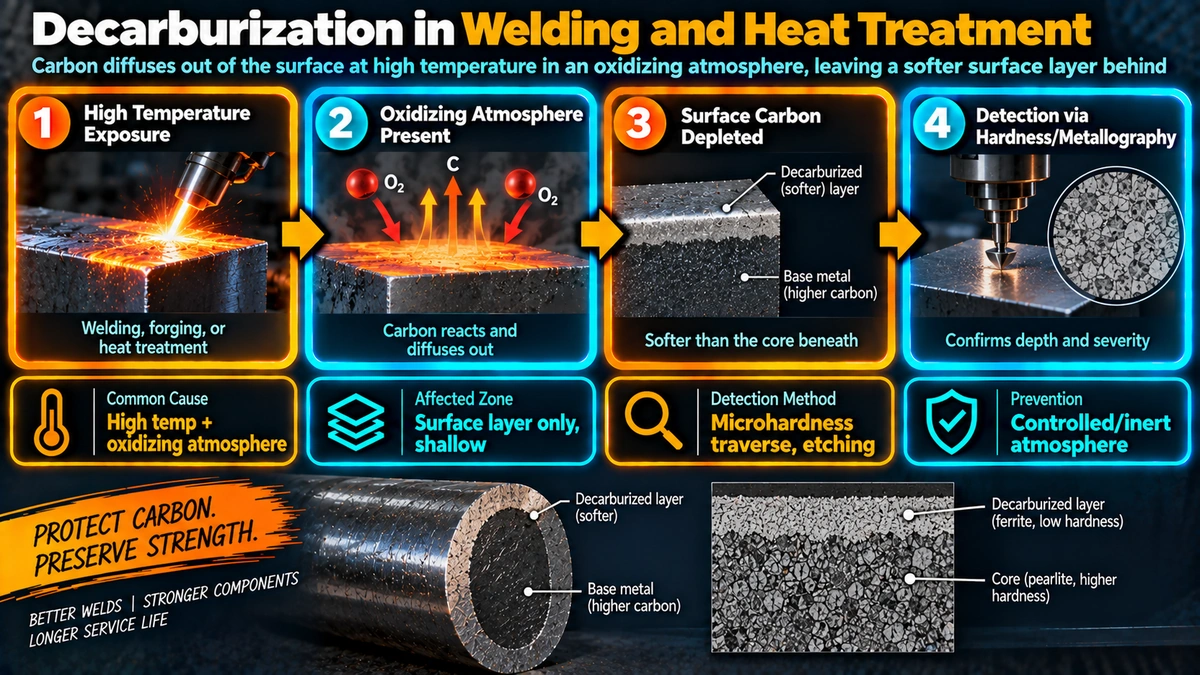
Decarburization occurs when steel is heated above approximately 700 degC, into the range where carbon becomes mobile enough to diffuse through the iron lattice, while the surrounding atmosphere has a lower carbon potential than the steel itself. Under these conditions, carbon at and near the surface reacts with oxygen, carbon dioxide, water vapour, or hydrogen present in the furnace or flame atmosphere, forming gaseous carbon monoxide, carbon dioxide, or methane that escapes from the surface. As surface carbon is consumed by this reaction, a concentration gradient is established, and carbon diffuses outward from the interior to replace what has reacted away, progressively depleting a surface layer while the core composition remains essentially unaffected.
1. A chemical reaction at the steel surface consumes carbon, converting it to a gaseous carbon compound that leaves the surface.
2. A concentration gradient forms between the depleted surface and the unaffected core, driving solid-state diffusion of carbon toward the surface.
3. As dissolved carbon near the surface is depleted, carbide phases (cementite, alloy carbides) in that region progressively dissolve to resupply carbon to the diffusion process, until the surface layer is left substantially carbide-free.
The Diffusion-Controlled Nature of Decarburization
Because decarburization is fundamentally a diffusion process once the surface reaction is underway, the depth of the affected layer follows an approximately parabolic relationship with time, and rises steeply with temperature because carbon diffusivity in iron increases exponentially with temperature.
Where Decarburization Occurs in Welding and Fabrication
Post-weld heat treatment furnaces
PWHT furnaces that rely on uncontrolled ambient combustion atmosphere, poor burner adjustment, or air infiltration can expose the weldment surface to an oxidising or otherwise reactive atmosphere for the full soak duration, which for heavy-section pressure vessel and piping work can run to several hours. See the PWHT soak time calculator for how code-minimum soak times are determined, since holding beyond the required minimum increases decarburization risk with no metallurgical benefit.
Oxy-fuel preheating and flame cutting
An oxy-fuel torch set with an oxidising flame, or one held too close or too long against the steel surface during preheat, produces localised surface decarburization at the flame-contact zone. Flame-cut edges likewise show a thin decarburized and often reoxidised skin that should be accounted for in edge preparation, particularly where the cut surface will remain in the finished weld root or fusion zone.
Open-arc welding at elevated interpass temperature without adequate shielding
When hot weld metal or hot base metal at high interpass temperature is exposed to atmosphere for an extended period, such as during a shielding gas interruption, inadequate trailing shield coverage, or a paused multi-pass sequence with the joint left uncovered, surface decarburization of the exposed hot metal can occur in addition to the more commonly discussed risk of atmospheric contamination (nitrogen and oxygen pickup).
Forging and hot forming operations
Components reheated for forging, bending, or hot forming and held in a conventional gas-fired furnace for extended soak periods are exposed to the same mechanism as PWHT, and decarburization depth on forgings is a routinely specified acceptance criterion, particularly for components that will not be subsequently machined on the affected surface.
Effects of Decarburization on Component Performance
Surface softening and reduced strength
Removal of carbide-forming carbon from the surface layer directly reduces its hardness and tensile strength relative to the core, since strengthening mechanisms that depend on carbon content, solid solution strengthening and carbide precipitation, are diminished in the depleted layer.
Reduced fatigue strength
Because fatigue cracks overwhelmingly initiate at the surface, a decarburized layer with a lower local strength and endurance limit than the core can significantly reduce the fatigue life of a component even when bulk properties on a machined test specimen appear fully compliant. This is discussed further in the fractography guide, where decarburization-related fatigue initiation produces a characteristic diffuse, poorly defined origin zone rather than a sharp geometric stress raiser.
Reduced wear resistance
On components where the as-heat-treated surface is the final wearing surface, such as certain forged tooling or hardfacing substrates, the softer decarburized layer wears preferentially, accelerating surface degradation in service.
Complications for post-PWHT hardness acceptance
Hardness testing performed too close to a decarburized surface can give a falsely low reading that does not represent the bulk HAZ hardness the test is intended to verify, which is why hardness surveys should account for decarburization depth when selecting indent locations, particularly for sour service hardness verification. See the hardness conversion calculator for scale conversions and NACE MR0175 acceptance limits used in this context.
Decarburization Compared with Related Phenomena
| Phenomenon | Direction of carbon movement | Where it acts | Driven by |
|---|---|---|---|
| Decarburization | Carbon leaves the surface | Thin surface layer only | Reactive atmosphere at high temperature |
| Carburization | Carbon enters the surface | Thin surface layer only | High carbon-potential atmosphere (intentional case hardening) |
| Weld metal segregation | Redistributed, not lost | Throughout the weld pool, dendritic scale | Solute partitioning during solidification — see segregation guide |
| Banding | Redistributed, not lost | Throughout rolled plate thickness, band scale | Mn segregation in cast slab, elongated by rolling — see banding guide |
Detection and Measurement
| Method | What it reveals |
|---|---|
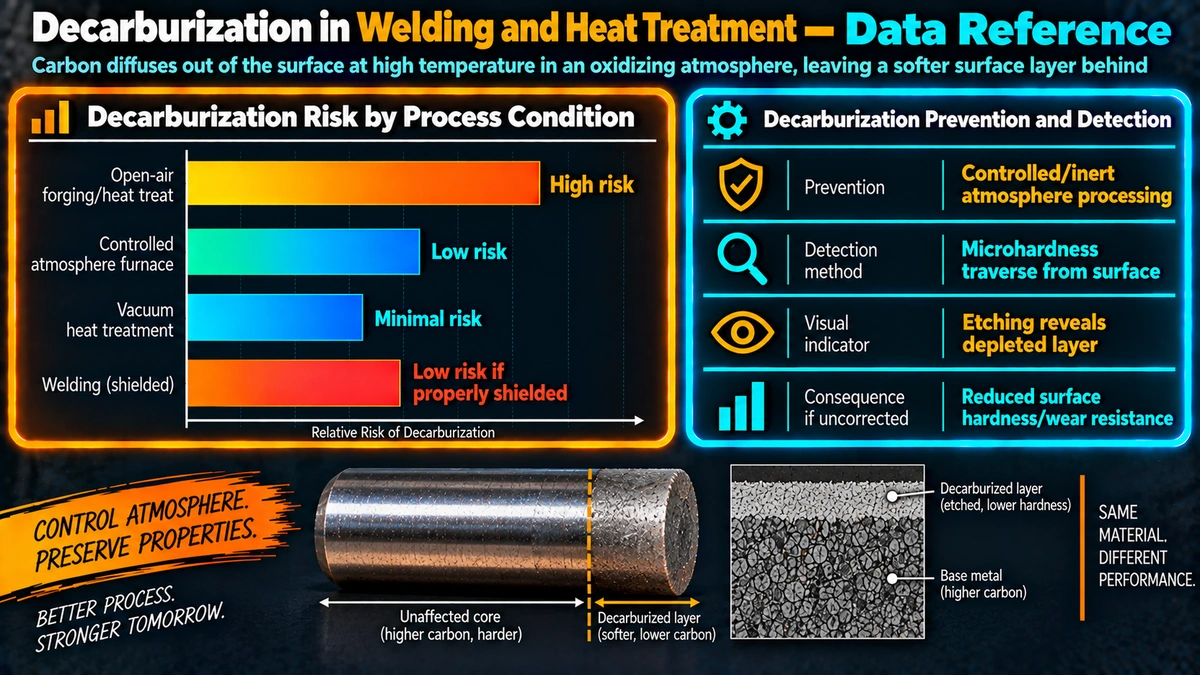
| Microhardness traverse (ASTM E1077) | Hardness gradient from surface inward, quantifies decarburization depth |
| Metallographic cross-section | Visual ferrite/carbide-depleted depth; distinguishes total vs partial decarburization |
| Case depth comparison charts | Standardised reference micrographs for rating decarburization severity |
| Surface carbon analysis (OES spot check) | Confirms surface carbon content is below the bulk specification value |
Total decarburization describes a surface layer that has become essentially fully ferritic, with carbide phases completely dissolved. Partial decarburization describes a layer with reduced but not eliminated carbide content. Total decarburization produces a more severe and more clearly defined drop in surface hardness and is generally the more serious finding in an inspection report.
Prevention and Control
1. Use a controlled furnace atmosphere for PWHT and heat treatment: neutral or slightly reducing gas blends (endothermic gas, dissociated ammonia, high-purity nitrogen mixtures), or a vacuum furnace for critical components, rather than uncontrolled ambient combustion atmosphere.
2. Hold PWHT to the code-minimum time and temperature required for the material and thickness rather than exceeding it — see the PWHT soak time calculator for the applicable minimum.
3. Set oxy-fuel preheat and flame-cutting torches to a neutral or very slightly carburizing flame rather than an oxidising one, and avoid prolonged flame dwell on a single surface location.
4. Maintain continuous, adequate shielding or backing gas coverage during multi-pass welding, especially where interpass temperature is high and the joint is exposed to atmosphere between passes.
5. For components that will be machined after heat treatment, specify a stock removal allowance sufficient to remove the expected decarburization depth from the as-heat-treated surface.
Practical Engineering Notes
When a component shows lower-than-expected surface hardness after PWHT, or a fatigue failure with an unusually diffuse initiation site, decarburization should be considered alongside the more commonly suspected causes of over-tempering or grain coarsening. A quick microhardness traverse from the surface inward, compared against a reading taken deeper in the section, is a fast way to confirm or rule out decarburization before pursuing more involved root cause investigation.
Frequently Asked Questions
What is decarburization in steel?
Decarburization is the loss of carbon from the surface layer of steel when it is heated above roughly 700 degC in contact with an oxidising, decarburizing, or hydrogen-bearing atmosphere. Carbon at or near the surface reacts with oxygen, carbon dioxide, water vapour, or hydrogen in the surrounding gas to form CO, CO2, or CH4, which leave the surface, progressively depleting carbon in a thin surface layer while the core composition remains unaffected.
How is decarburization different from carburization?
Decarburization and carburization are opposite processes acting on the same surface. Decarburization removes carbon from the steel surface when the surrounding atmosphere has a lower carbon potential than the steel. Carburization adds carbon to the surface when the atmosphere has a higher carbon potential than the steel, as in gas carburizing used to case-harden low carbon steel gears and shafts. Both are diffusion-controlled surface reactions but move carbon in opposite directions.
Where does decarburization commonly occur during welding fabrication?
The most common sources are post-weld heat treatment furnaces with poorly controlled atmosphere, prolonged oxy-fuel flame preheating or flame cutting where the torch flame is locally oxidising, open-arc welding without adequate gas shielding at elevated interpass temperature, and hot forming or forging operations where steel is held at high temperature in ambient furnace air for extended periods.
How does decarburization affect mechanical properties?
Decarburization removes carbide-forming carbon from the surface layer, softening it relative to the core and reducing surface hardness, tensile strength, and wear resistance in that layer. Because fatigue cracks almost always initiate at the surface, a decarburized layer with a lower endurance limit than the core significantly reduces fatigue strength, even when bulk mechanical properties on a machined test coupon appear satisfactory.
How deep does decarburization typically penetrate?
Decarburization depth follows an approximately parabolic relationship with time, increasing with the square root of exposure time, and increases strongly with temperature because carbon diffusivity rises exponentially with temperature. Depths of a few hundredths to a few tenths of a millimetre are typical for controlled PWHT cycles with reasonable atmosphere control, while poorly controlled furnace atmospheres, long soak times, or repeated PWHT cycles can produce depths of several tenths of a millimetre or more.
How is decarburization detected and measured?
Decarburization is measured using a microhardness traverse from the surface inward per ASTM E1077, which detects the drop in hardness across the decarburized layer, combined with metallographic examination of a polished and etched cross-section to visually measure the depth of free ferrite or reduced-pearlite structure at the surface. Total decarburization and partial decarburization are distinguished by this metallographic examination.
How is decarburization prevented during PWHT and welding?
The primary control is furnace atmosphere: using a controlled, neutral, or slightly reducing atmosphere, or heat treating in a vacuum furnace for critical components. PWHT should be held to the minimum code-required time and temperature rather than exceeding it, since decarburization depth increases with both. During welding, adequate shielding or backing gas coverage prevents atmospheric exposure of hot weld metal and adjacent base metal, and oxy-fuel preheating should use a neutral or slightly carburizing flame setting.
Can a decarburized layer be removed after heat treatment?
Yes, where component geometry allows, machining a stock allowance sufficient to remove the decarburized layer after PWHT or heat treatment is the most reliable remedy, and is standard practice for components where the finished surface is machined after heat treatment, such as shafts, forgings, and gear blanks. For components heat treated in the final finished condition, such as many welded pressure vessels and piping, prevention through atmosphere control is the only practical option.
Recommended Reading
Heat Treatment of Metals — ASM Handbook Volume 4
Comprehensive reference covering furnace atmosphere control, carburizing and decarburizing reactions, and heat treatment process metallurgy.
View on AmazonPrinciples of Heat Treatment of Steel
Core metallurgy text on diffusion, phase transformations, and surface reactions including decarburization mechanisms.
View on AmazonWelding Metallurgy and Weldability
Graduate-level reference connecting PWHT thermal cycles, HAZ microstructure, and surface effects to weldability.
View on AmazonASM Handbook — Metallography and Microstructures
Standard reference for metallographic technique and interpretation, including decarburized layer identification and depth measurement.
View on AmazonDisclosure: WeldFabWorld participates in the Amazon Associates programme (StoreID: neha0fe8-21). If you purchase through these links, we may earn a small commission at no extra cost to you. This helps support free technical content on this site.