Jominy End Quench Hardenability Test Explained
The Jominy end quench test is the standard method used to measure hardenability, the property that determines how deep into a steel section martensite will form for a given cooling rate. It is easy to confuse hardenability with hardness, but they answer different questions: hardness tells you how hard a specific piece of steel actually is, while hardenability tells you how readily that steel will harden, at any given cooling rate, before you have even quenched it. The Jominy test isolates this property directly, using a single, simply shaped specimen quenched under standardised conditions.
Although the Jominy test is most closely associated with heat treatment shops selecting steel grades and quench media, the same hardenability principle it measures governs whether a weld heat-affected zone forms hard, crack-susceptible martensite or a more forgiving microstructure, which is why hardenability sits directly behind carbon equivalent formulas and preheat selection in welding engineering. This guide explains the test procedure, how to read the resulting curve, and how the underlying concept carries over into welding practice.
This article explains hardenability as measured by the Jominy test and its practical use, distinct from the general tempering behaviour covered in the tempering curves guide and from the compositional shortcut used in welding, covered in the carbon equivalent guide.
What Is Hardenability?
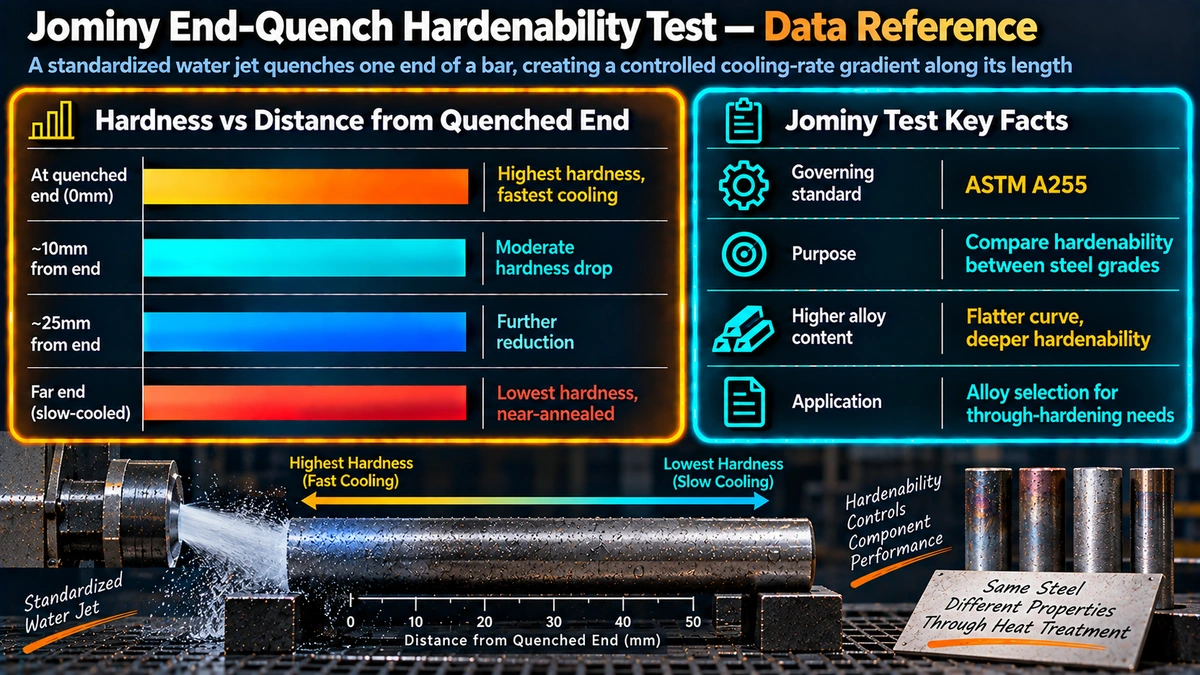
Hardenability is the capacity of a steel to transform to martensite, and therefore to harden, at a given cooling rate, as opposed to transforming to softer, more diffusion-dependent phases such as pearlite or bainite at that same cooling rate. Two steels quenched under identical conditions can reach very different depths of hardening if one has higher hardenability than the other, even if both are capable of reaching the same maximum surface hardness. A steel with low hardenability may harden fully only at its very surface, where cooling is fastest, while the interior cools too slowly to escape pearlite formation; a steel with high hardenability can harden through a much greater thickness, or even fully through a thick section, because it resists pearlite and bainite formation even at comparatively slow cooling rates.
The Jominy End Quench Test Procedure
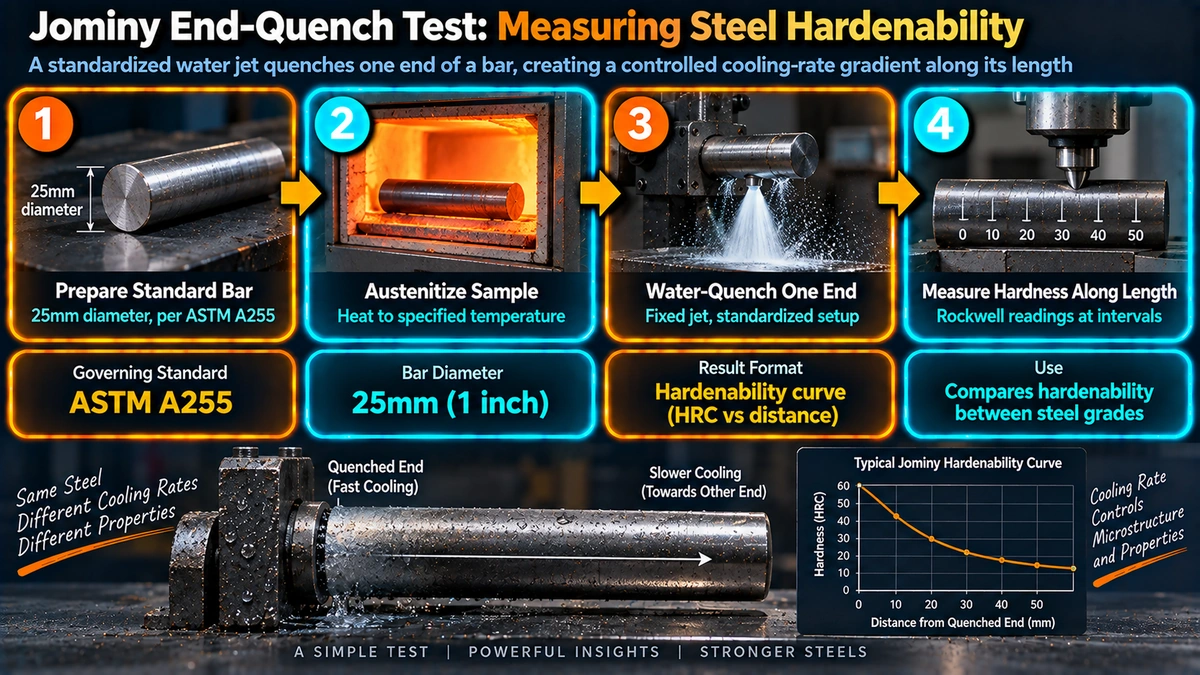
The Jominy test, standardised in ASTM A255 and the closely equivalent ISO 642, uses a simple specimen geometry to generate a continuous, reproducible range of cooling rates in a single test.
1. A cylindrical bar 25.4 mm (1 inch) in diameter and 100 mm (4 inches) long is machined, typically with a small collar near the top end to support it in the quench fixture.
2. The specimen is heated into the fully austenitic range, typically 800 to 950 degC depending on the grade, and held for a specified soak time to ensure uniform austenitisation.
3. The hot specimen is rapidly transferred to a fixture that holds it vertically and directs a controlled jet of water against the bottom face only, from a fixed standoff distance and flow rate specified by the standard, while the remainder of the bar is shielded from the water and cools in still air.
4. After the bar has fully cooled, two flat surfaces are ground along its length, 180 degrees apart, removing any decarburized surface layer.
5. Rockwell C hardness is measured along these flats at 1.5 mm (1/16 inch) intervals starting from the quenched end, typically out to 50 mm or more, with wider spacing permitted at greater distances where hardness has stabilised.
Reading the Jominy Curve
The resulting Jominy curve plots hardness against distance from the quenched end. Interpretation is straightforward once the underlying physics is clear: distance from the quenched end is a direct proxy for cooling rate, since positions closer to the quenched face experience faster cooling and positions further away cool progressively more slowly, approaching a still-air cooling rate at the far end.
| Curve shape | Interpretation | Practical meaning |
|---|---|---|
| High and flat over a long distance | High hardenability | Martensite forms even at slow cooling rates; hardens deep into thick sections |
| High near the end, steep drop shortly after | Low hardenability | Only the fastest-cooled surface layer hardens fully; thin sections only |
| Low hardness even at the quenched end | Low maximum hardness (low carbon) | Limited martensite hardness regardless of cooling rate, independent of hardenability |
Individual points on the curve are often referenced by their Jominy distance, written as J followed by the distance in sixteenths of an inch from the quenched end, for example J8 refers to the hardness measured at 8/16 inch (12.7 mm) from the quenched end. Specifications for hardenability-controlled steel grades commonly state minimum and maximum acceptable hardness at one or more specific J-distances, defining an acceptable hardenability band for that grade rather than a single curve.
What Controls Hardenability: The Role of Alloying Elements
Carbon content and hardenability answer two different questions and should not be conflated. Carbon controls the maximum hardness attainable at the quenched end, since it is carbon dissolved in the martensite lattice that produces high hardness through lattice distortion; but carbon on its own has a comparatively modest effect on how far that hardness extends along the bar. Hardenability, the reach of the curve, is governed mainly by other alloying elements.
| Element | Effect on hardenability | Relative potency |
|---|---|---|
| Manganese (Mn) | Slows pearlite formation, increases hardenability | Moderate-high |
| Chromium (Cr) | Slows pearlite and bainite formation | Moderate-high |
| Molybdenum (Mo) | Strong retarder of diffusional transformation | High |
| Nickel (Ni) | Moderate hardenability increase, also improves toughness | Moderate |
| Boron (B) | Extremely potent even at trace levels (0.0005-0.003%), effective mainly in low to medium carbon steels | Very high per unit content |
| Silicon (Si) | Mild hardenability contribution, mainly a deoxidiser | Low |
These elements work by slowing the diffusional processes that allow austenite to decompose into pearlite or bainite, effectively pushing the transformation start further out on a time axis. At a given cooling rate, this leaves less time for diffusional transformation to occur before the martensite start temperature is reached, so a higher fraction of martensite forms instead. See the effect of alloying elements guide for a broader discussion of how these same elements affect steel properties beyond hardenability.
From Jominy Distance to Real Component Cooling Rates
A Jominy bar is a laboratory specimen, not a real part, so a practical bridge is needed to apply the data to an actual round bar, plate, or forging quenched in a specific medium. Grossmann’s hardenability correlation charts provide this bridge, relating the cooling rate at a given Jominy distance to the cooling rate that would occur at the surface or centre of round bars of various diameters, quenched in a specified medium such as still water, agitated oil, or air, characterised by a quench severity factor, H.
Using these charts, a heat treater can determine which position on the Jominy bar experiences the same cooling rate as the centre of, for example, a 50 mm diameter round bar quenched in agitated oil, then read the hardness expected at that Jominy distance directly from the measured curve. This predicts the as-quenched core hardness of the real component without having to quench and destructively section that actual part, which is the main practical payoff of running a Jominy test on a given heat of steel.
Relevance of Hardenability to Welding
The heat-affected zone of a weld experiences an extremely rapid, highly localised thermal cycle, effectively a severe quench imposed by the surrounding cold base metal mass rather than by a water or oil bath. Whether that HAZ forms hard, crack-susceptible martensite, a tougher bainitic structure, or a softer ferritic-pearlitic structure depends on exactly the same hardenability principle the Jominy test measures: a steel chemistry with high hardenability will tend to form martensite readily in the HAZ across a wide range of realistic weld cooling rates, increasing susceptibility to hydrogen-assisted cold cracking unless preheat, interpass temperature, and heat input are controlled to slow the effective cooling rate through the transformation range.
Running a physical Jominy test for every heat of steel encountered on a fabrication job is not practical. Carbon equivalent formulas were developed as an empirical shortcut to estimate the same hardenability tendency from bulk chemistry alone, weighting broadly the same elements, chromium, molybdenum, manganese, and others, that dominate the Jominy curve shape. See the carbon equivalent guide for how CE is calculated and used to select preheat in practice, and the tempering curves guide for the related tool used once martensite has formed and needs to be tempered.
Jominy Data and CCT Diagrams
Because each position along a Jominy bar experiences a known, reproducible cooling rate, examining the microstructure at multiple positions along a quenched bar, in addition to measuring hardness, provides a practical experimental route to correlate specific cooling rates with the resulting phase mixture for that steel. This data is one of the standard methods used to construct or validate continuous cooling transformation (CCT) diagrams, which map the phases that form as a function of cooling rate and are widely referenced in welding metallurgy for predicting HAZ microstructure at a given heat input and preheat combination.
Practical Engineering Notes
When comparing two candidate steel grades or two heats of the same nominal grade, remember that a mill certificate chemistry alone does not directly show hardenability the way a Jominy curve does. Where hardenability-controlled (“H-band”) steel is specified for a critical application, request the actual Jominy hardenability data or H-band designation from the supplier rather than relying on bulk chemistry and a carbon equivalent estimate alone, particularly for thick-section components where core properties matter.
Frequently Asked Questions
What does the Jominy end quench test measure?
The Jominy end quench test measures hardenability, a steel’s capacity to form martensite, and therefore reach high hardness, at a given cooling rate, as distinct from hardness itself. A standard cylindrical specimen is austenitised and then quenched at one end only, producing a continuous range of cooling rates along its length, from very fast at the quenched end to slow air-cooling-like rates at the far end, and hardness is measured at fixed intervals to build a hardenability curve.
What is the standard Jominy test specimen and procedure?
The standard specimen, per ASTM A255 and the closely equivalent ISO 642, is a cylindrical steel bar 25.4 mm (1 inch) in diameter and 100 mm (4 inches) long. It is heated into the fully austenitic range, held for a specified soak time, then rapidly transferred to a fixture that holds it vertically and directs a controlled water jet against the bottom face only. After quenching, two flats are ground along the bar, and Rockwell C hardness is measured at 1.5 mm (1/16 inch) intervals starting from the quenched end.
How do you read a Jominy curve?
A Jominy curve plots hardness against distance from the quenched end. Hardness is highest at the quenched end and generally decreases with distance as cooling slows and pearlite or bainite increasingly form instead of martensite. A curve that stays high and flat over a long distance indicates high hardenability; a curve that drops off steeply close to the quenched end indicates low hardenability, meaning only the fastest-cooled surface layer hardens fully.
Does carbon content control hardenability?
Carbon content primarily controls the maximum hardness attainable at the quenched end, since carbon trapped in the martensite lattice produces high hardness, but carbon has a comparatively modest effect on how far that hardness extends, which is hardenability. Hardenability is controlled mainly by other alloying elements such as manganese, chromium, nickel, molybdenum, and especially boron, which slow the diffusional transformation of austenite to pearlite and bainite, allowing martensite to form even at slower cooling rates.
How is Jominy distance converted to an actual bar diameter?
Standard correlation charts, developed from Grossmann’s hardenability work, relate the cooling rate at a given Jominy distance to the cooling rate at the surface and centre of round bars of various diameters, quenched in a specified medium such as still water, agitated oil, or air. Using these charts, an engineer can read the hardness expected at the Jominy distance corresponding to the cooling rate at the centre of a real component, predicting as-quenched core hardness directly from the Jominy curve.
Why does hardenability matter for welding, not just heat treatment?
The weld heat-affected zone experiences an extremely rapid, highly localised thermal cycle that is, in effect, a severe quench imposed by the surrounding cold base metal. Whether that HAZ forms hard, crack-susceptible martensite or a more tolerant structure depends on the same hardenability principles measured by the Jominy test: steel chemistry with high hardenability will tend to harden readily in the HAZ, increasing hydrogen cracking risk unless preheat and heat input are controlled to slow the effective cooling rate.
How does carbon equivalent relate to the Jominy hardenability test?
Carbon equivalent formulas are empirical shortcuts developed to estimate the same hardenability tendency the Jominy test measures directly, without requiring a physical Jominy specimen for every heat of steel encountered on a job site. Both approaches weight the same core alloying elements because both describe how readily austenite transforms to martensite rather than softer, more crack-tolerant phases at a given cooling rate. The carbon equivalent guide explains how these formulas are applied to select preheat.
Can Jominy data be used to build a CCT or TTT diagram?
Yes. Because each position along a Jominy bar experiences a known, reproducible cooling rate, examining the microstructure at multiple positions along a quenched bar, in addition to measuring hardness, provides a practical way to correlate specific cooling rates with the resulting microstructure for that steel. This data is one of the standard experimental routes used to construct or validate continuous cooling transformation (CCT) diagrams, widely referenced in welding metallurgy for predicting HAZ microstructure.
Recommended Reading
Principles of Heat Treatment of Steel
Core metallurgy text covering hardenability theory, Jominy testing, and Grossmann correlation methods in detail.
View on AmazonSteels: Microstructure and Properties
Reference on alloying element effects, hardenability, and CCT/TTT diagram construction from experimental cooling data.
View on AmazonWelding Metallurgy and Weldability
Graduate-level reference connecting hardenability principles directly to HAZ microstructure and cold cracking risk.
View on AmazonASM Handbook — Heat Treating, Volume 4
Comprehensive industrial reference including standard Jominy test procedure and hardenability band (H-steel) data.
View on AmazonDisclosure: WeldFabWorld participates in the Amazon Associates programme (StoreID: neha0fe8-21). If you purchase through these links, we may earn a small commission at no extra cost to you. This helps support free technical content on this site.