Segregation in Weld Metal: Causes and Effects
Segregation in weld metal is one of the least visible but most consequential outcomes of the fusion welding process. Every weld pool that solidifies produces some degree of segregation, because the alloying and impurity elements that make up steel, stainless steel, and nickel-based filler metals do not distribute themselves evenly between the solid and liquid phases as the pool cools. Instead, they redistribute in predictable patterns dictated by solidification physics, concentrating in specific regions of the weld microstructure while depleting others.
Understanding segregation matters because it is the root cause behind several defects and failure modes that welding engineers and QA/QC inspectors deal with regularly, including solidification hot cracking, reduced pitting corrosion resistance, and localised loss of toughness. This guide explains the mechanism of segregation from first principles, identifies which elements are most prone to it in common weld metal systems, and lays out practical steps for controlling its effects during welding procedure development and production welding.
This article covers the fundamentals of solute segregation during weld metal solidification — the “why” and “what” behind the phenomenon. For the specific cracking mechanism that segregation drives, see the dedicated guide to liquation cracking. For solid-state grain boundary segregation that occurs after welding during heat treatment or service, see temper embrittlement.
What Is Segregation in Weld Metal?
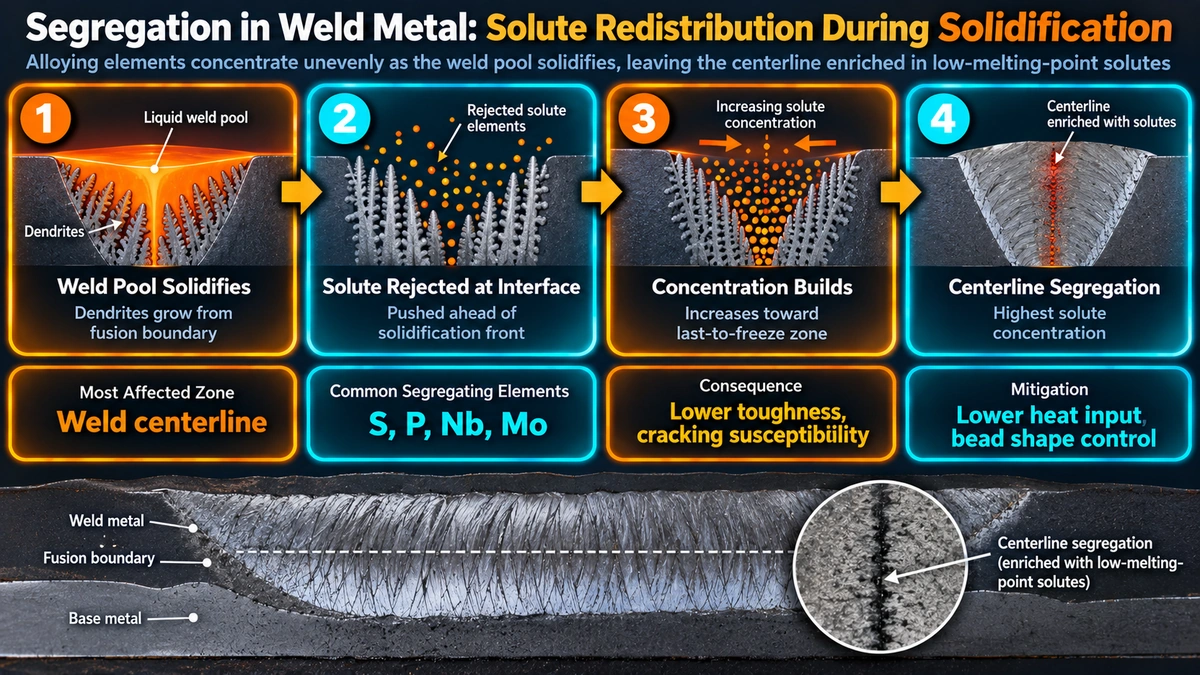
Segregation is the departure of local composition from the nominal, bulk composition of the weld deposit. A weld metal chemistry report from a certified filler metal might state 0.02% sulphur and 18.5% chromium as bulk values, but at the microscopic scale within that same weld, sulphur content can be several times higher in certain regions and chromium content measurably lower in others. The bulk analysis is an average; segregation is the variation around that average.
The physical driver behind this variation is the solidification behaviour of alloys, as opposed to pure metals. A pure metal solidifies at a single, fixed temperature, and the solid that forms has exactly the same composition as the liquid it grew from. An alloy, by contrast, solidifies over a temperature range, and at every point within that range the solid phase forming has a different composition from the remaining liquid. This composition difference between solid and liquid at equilibrium is described by the partition coefficient, k, and it is the starting point for understanding every form of segregation discussed in this article.
k is defined as the ratio of solute concentration in the solid to solute concentration in the liquid at the solidification interface, at a given temperature: k = Csolid / Cliquid. Most alloying and impurity elements relevant to weld metal have k less than 1, meaning they are more soluble in the liquid than in the solid. As solidification proceeds, these elements are progressively rejected from the growing solid into the remaining liquid, which becomes steadily enriched. Elements with k close to 1 partition almost evenly and produce little segregation.
Types of Segregation in Weld Metal
Segregation in weld metal is generally classified by the length scale over which it occurs. The two forms behave differently, are detected using different techniques, and respond differently to remedial action.
Microsegregation
Microsegregation, also called dendritic or interdendritic segregation, occurs at the scale of an individual dendrite, typically tens to a few hundred micrometres. As the weld pool solidifies, it does not form as a smooth, planar solid-liquid front. Instead, it grows as tree-like dendrites, with primary arms extending from the fusion boundary toward the centre of the pool, and finer secondary arms branching off the primary arms. The core of each dendrite arm is the first material to solidify at that location and is therefore leanest in rejected solute. The interdendritic regions, the last liquid to solidify between the arms, become progressively enriched as solidification proceeds, in some cases reaching concentrations several times the nominal alloy composition before the last liquid finally freezes.
Macrosegregation
Macrosegregation occurs at a much larger scale, from millimetres to the full width of a weld pass or bead, and is driven by different physics. Convective flow within the molten weld pool, driven by surface tension gradients (Marangoni flow), electromagnetic (Lorentz) forces from the arc, and buoyancy, can transport solute-enriched liquid across the pool before it solidifies. This produces banding: visible, often continuous streaks of enriched composition running parallel to the direction of weld travel or along the centreline of a pass, frequently seen in macro-etched cross-sections of multi-pass welds.
The Physical Mechanism: Solute Redistribution During Solidification
The Scheil equation is the standard simplified model used to describe non-equilibrium solute redistribution during dendritic solidification, and it explains why interdendritic regions become so enriched even when the partition coefficient itself is modest. The model assumes complete mixing in the liquid, no diffusion in the solid once formed, and a constant partition coefficient, which is a reasonable approximation for the fast cooling rates typical of arc welding.
The Scheil model shows that segregation is not a minor statistical spread around the nominal composition — for elements with low partition coefficients, the last liquid to freeze can reach several times the bulk alloy content. This is precisely the composition and location where low-melting eutectic films form and where solidification cracking initiates.
Elements That Segregate in Weld Metal and Their Effects
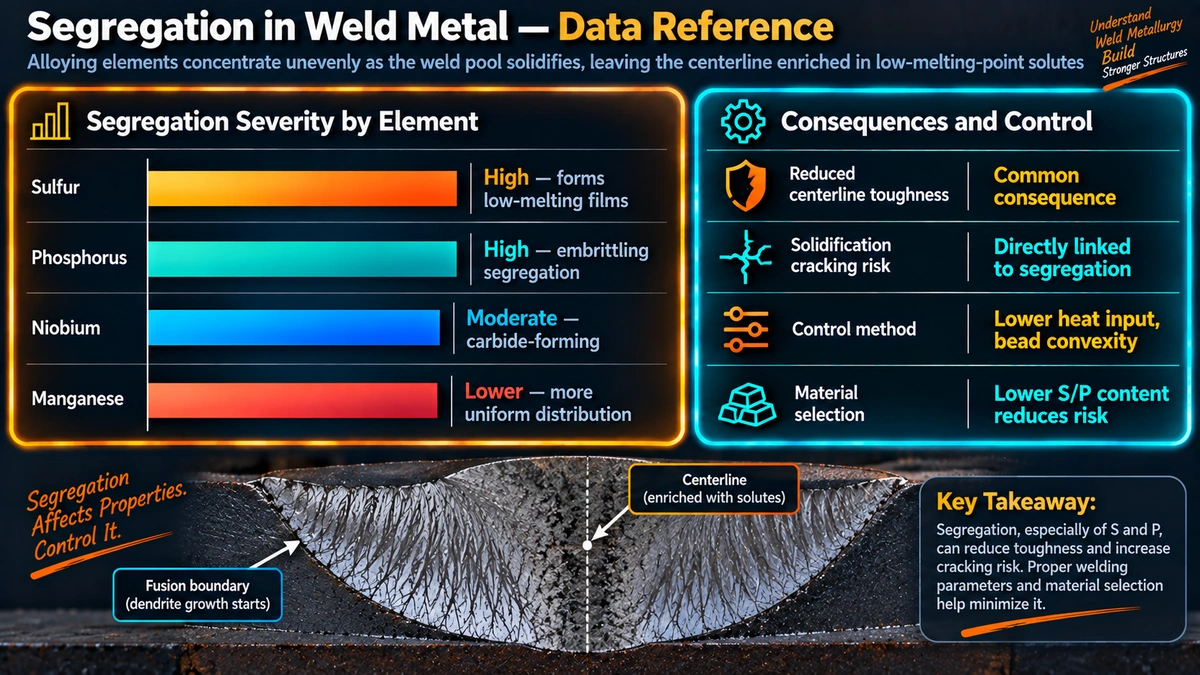
Not every alloying element behaves the same way during weld solidification. The table below summarises the segregation tendency and practical consequence of the elements most frequently implicated in weld metal quality issues.
| Element | Typical alloy system | Segregation tendency | Primary consequence |
|---|---|---|---|
| Sulphur (S) | Carbon and low alloy steel | High | FeS eutectic films, solidification hot cracking |
| Phosphorus (P) | Carbon and low alloy steel | High | Grain boundary embrittlement, temper embrittlement |
| Niobium (Nb) | Stainless steel, nickel alloys | High | NbC and Laves phase formation, liquation cracking |
| Silicon (Si) | All ferrous and Ni-base systems | Medium | Low-melting eutectics, contributes to hot cracking |
| Molybdenum (Mo) | Stainless steel, duplex, Ni-base | Medium | Local depletion lowers PREN and pitting resistance |
| Chromium (Cr) | Stainless and duplex steel | Low-Med | Local depletion affects passive film and PREN |
| Titanium (Ti) | Nickel alloys, stabilised stainless | Medium | TiN/TiC formation, constitutional liquation |
| Carbon (C) | All ferrous systems | Medium | Interdendritic carbide precipitation, hardness variation |
| Boron (B) | Alloy and creep-resistant steels | High | Grain boundary films even at trace levels, reheat cracking risk |
Effects of Segregation on Weld Properties
Segregation is rarely a defect in itself, but it is the underlying cause of several defects and property losses that are inspected for and specified against in fabrication codes.
Solidification hot cracking and liquation cracking
The low-melting eutectic films formed by segregated sulphur, phosphorus, niobium, and silicon remain liquid after the surrounding matrix has solidified. Because weld pools solidify under tensile strain from thermal contraction, these residual liquid films are pulled apart before they can heal, producing centreline or interdendritic cracks. The specific mechanism, susceptible alloys, and prevention measures are covered in the dedicated liquation cracking guide.
Reduced local corrosion resistance
In stainless and duplex stainless weld metal, chromium and molybdenum depletion in the dendrite cores lowers the local pitting resistance equivalent number below the level calculated from bulk composition. This creates preferential pitting initiation sites that would not be predicted from a certified material test report alone. Use the PREN calculator to check whether a filler metal’s bulk PREN provides sufficient margin over the minimum required for the service environment, and see ASTM G48 for the standard pitting and crevice corrosion test method used to qualify weld procedures for corrosive service.
Loss of toughness and ductility
Segregated phosphorus, tin, antimony, and arsenic at prior austenite grain boundaries reduce cohesive strength and promote intergranular fracture, particularly after slow cooling through the 350 to 575 degC range during PWHT or in long-term high-temperature service. This solid-state grain boundary segregation mechanism, distinct from the liquid-state segregation discussed elsewhere in this article, is the subject of the temper embrittlement guide.
Banding and anisotropic mechanical properties
Macrosegregation bands create planes of differing hardness, strength, and ductility within the weld cross-section. Because these bands are often oriented parallel to the weld surface or along the fusion line, they can produce direction-dependent mechanical properties, complicating both bend testing and in-service performance prediction, particularly in thick-section, multi-pass welds on heavy wall pressure vessel and piping components.
Segregation Behaviour in Different Alloy Systems
Carbon and low alloy steel
Segregation of sulphur, phosphorus, and carbon is the primary concern. Modern clean-steel practice with vacuum degassing and calcium treatment keeps bulk sulphur and phosphorus low, which limits but does not eliminate interdendritic enrichment. Carbon equivalent calculations, used to predict hydrogen cracking susceptibility, should be understood as bulk figures; local carbon content in segregated bands can exceed the value used in the carbon equivalent calculation.
Austenitic and duplex stainless steel
Niobium, molybdenum, and silicon segregation dominate. In fully austenitic weld metal, continuous interdendritic films of these elements are especially damaging because there is no delta ferrite skeleton to interrupt them. Controlling ferrite number, as covered in the delta ferrite importance guide, is one of the most effective practical countermeasures against segregation-driven hot cracking in these alloys. In duplex grades, molybdenum and chromium partitioning between ferrite and austenite phases adds a second layer of complexity beyond solidification segregation alone, discussed further in the duplex stainless steel guide.
Nickel-base alloys
Niobium and titanium segregation is severe in nickel-base filler metals such as ERNiCrMo-3 (625) and ERNiCr-3 (82), where interdendritic niobium content can reach five to ten times the nominal alloy composition, forming Laves phase and NbC. This is the dominant mechanism behind liquation cracking in the partially melted zone of nickel-alloy overlay and dissimilar metal welds.
Detection and Characterisation Methods
| Method | Scale detected | What it reveals |
|---|---|---|
| Macro-etch (nital, Kalling’s reagent) | Macrosegregation, banding | Visible contrast bands under low magnification |
| Optical microscopy | Dendrite morphology | Dendrite arm spacing, secondary phase distribution |
| SEM-EDS elemental mapping | Microsegregation | Point-to-point elemental concentration across dendrites |
| Electron probe microanalysis (EPMA) | Microsegregation | Quantitative, high-precision compositional profiles |
| Microhardness traverse | Both scales | Hardness variation correlating with segregated zones |
Prevention and Control Strategies
1. Reduce heat input and increase cooling rate where metallurgically acceptable, which refines primary dendrite arm spacing and shortens the diffusion distance available for solute rejection, producing finer and less severe segregation.
2. Select filler metals with lower concentrations of strongly segregating elements (Nb, Si, S, P) where the base metal and service conditions allow.
3. Control dilution from the base metal, since dilution changes the effective bulk composition entering the weld pool and can push local segregation above the threshold for eutectic film formation.
4. Use stringer bead technique with controlled interpass temperature rather than heavy weave, which reduces the volume of weld metal solidifying under high thermal gradient at any one time.
5. Maintain adequate ferrite number in austenitic stainless weld metal, since the ferrite-austenite phase boundary interrupts continuous segregated films — see the ferrite control guide for target ranges.
Post-weld heat treatment reduces microsegregation through solid-state diffusion, but typical PWHT hold times are short relative to the diffusion distances of slow substitutional elements such as niobium and molybdenum. PWHT is effective for stress relief and tempering but should not be relied upon as the primary control for segregation-driven cracking or corrosion susceptibility; those risks must be controlled at the welding procedure stage.
Practical Engineering Notes
When a weld procedure qualification shows unexpected cracking, reduced impact toughness, or a failed pitting corrosion test despite compliant bulk chemistry on the certified material test report, segregation should be an early item on the root cause checklist, not an afterthought. A macro-etch and microhardness traverse across the weld cross-section is a fast, low-cost first check before committing to more expensive SEM-EDS analysis.
Frequently Asked Questions
What is segregation in weld metal?
Segregation in weld metal is the non-uniform distribution of alloying and impurity elements that develops as the weld pool solidifies. Because most solutes are more soluble in liquid steel than in solid steel, the growing dendrites reject solute into the remaining liquid, concentrating certain elements in the last regions to solidify. The result is a weld deposit whose local composition varies from point to point even though the overall bulk composition matches the filler metal or base metal chemistry.
What is the difference between microsegregation and macrosegregation?
Microsegregation occurs at the scale of individual dendrite arms, typically tens of micrometres, caused by solute rejection at the solid-liquid interface during dendritic growth. Macrosegregation occurs over millimetre to centimetre distances, such as banding along the weld centreline or between passes, driven by fluid flow in the weld pool and the sequence of multi-pass deposition. Macrosegregation is generally more damaging because it creates continuous planes of weak material rather than dispersed pockets.
Which elements segregate most strongly in weld metal?
Elements with a partition coefficient well below 1 segregate most strongly. In carbon and low alloy steel weld metal this includes sulphur, phosphorus, carbon, and boron. In stainless steel and nickel alloy weld metal, niobium, molybdenum, titanium, and silicon dominate, often concentrating enough in interdendritic regions to form secondary phases such as Laves phase or NbC.
How does segregation cause weld cracking?
Segregating elements such as sulphur, phosphorus, niobium, and silicon depress the local melting point of the last liquid to solidify, forming thin, low-melting eutectic films along interdendritic and grain boundaries. Under the tensile strain that accompanies weld pool solidification and cooling, these films rupture, producing solidification hot cracking or liquation cracking. The full mechanism and prevention approach are covered in the guide to liquation cracking.
Does PWHT remove segregation from weld metal?
Post-weld heat treatment reduces microsegregation through solid-state diffusion, but the effect is limited because diffusion distances at typical PWHT temperatures and hold times are short compared to interdendritic spacing, especially for slow-diffusing elements like niobium and molybdenum. PWHT is more effective at relieving residual stress and tempering hard microstructures than at fully homogenising segregated weld metal composition.
How is segregation in weld metal detected?
Macrosegregation and banding are usually revealed by macro-etching a polished cross-section with a reagent such as nital or Kalling’s reagent, showing contrast between solute-rich and solute-lean zones under low magnification. Microsegregation is characterised at higher resolution using SEM-EDS or electron probe microanalysis, which map elemental concentration across individual dendrite arms, supported by microhardness traverses that detect the harder, more brittle segregated zones.
Can segregation in weld metal be prevented entirely?
Segregation cannot be eliminated in fusion welding because it is an inherent consequence of dendritic solidification, but its severity can be controlled. Lower heat input and faster cooling rates reduce dendrite arm spacing and shorten diffusion distances, reducing the degree of microsegregation. Selecting filler metals with lower concentrations of strongly segregating elements, controlling dilution, and using stringer bead technique with adequate interpass cooling all reduce the practical impact of segregation.
Why does segregation matter for corrosion resistance?
In corrosion-resistant alloys, chromium and molybdenum are essential for passive film stability, and their local depletion in solute-lean dendrite cores lowers the local pitting resistance equivalent number even when bulk weld composition meets specification. This creates preferential attack sites in service, particularly in chloride environments. The relationship between local composition and pitting resistance is covered in the PREN calculator and corrosion guide.
Recommended Reading
Welding Metallurgy and Weldability
Graduate-level reference covering solidification, phase transformations, and segregation phenomena across ferrous and non-ferrous weld metal systems.
View on AmazonWelding Metallurgy and Weldability of Stainless Steels
Focused text on solidification behaviour, ferrite control, and segregation-driven cracking mechanisms in austenitic and duplex stainless weld metal.
View on AmazonPrinciples of Solidification
Materials science reference on dendritic growth, partition coefficients, and the Scheil model that underpins microsegregation in cast and welded metals.
View on AmazonASM Handbook — Welding, Brazing, and Soldering
Comprehensive industry reference covering weld metal metallurgy, defect mechanisms, and process control across the full range of arc welding processes.
View on AmazonDisclosure: WeldFabWorld participates in the Amazon Associates programme (StoreID: neha0fe8-21). If you purchase through these links, we may earn a small commission at no extra cost to you. This helps support free technical content on this site.