How Are SAW Wire and Flux Combinations Selected?
Last updated:
Quick Answer: A SAW wire and flux combination is selected as a matched pair, not as two independent choices, because AWS A5.17 (carbon steel) and A5.23 (low-alloy steel) classify the flux-electrode combination itself, encoding the minimum tensile strength, the heat-treatment condition (as-welded or PWHT’d) the impact properties were tested in, the impact test temperature, the wire chemistry, and optionally a diffusible hydrogen limit. Selection works backward from the base metal’s strength, toughness, and hydrogen-control requirements to find a classification, and specific brand-name combination, that satisfies all of them together.
A submerged arc weld’s final mechanical properties come from the wire and the flux acting together, not from either one alone. This is exactly why AWS classifies SAW consumables as a combination rather than rating the wire’s properties independently: the same wire can produce meaningfully different tensile strength, toughness, and hydrogen content depending on which flux it runs with, and the same flux can shift its behavior depending on the wire.
This guide walks through how to actually read an AWS A5.17 or A5.23 flux-electrode classification, what each part of that code tells you, and the practical sequence of decisions, strength, toughness, PWHT condition, base metal grouping, and hydrogen control, used to select the right combination for a specific job.
- AWS A5.17 and A5.23 classify the flux and electrode as a combination, because weld metal properties depend on both together, not on either consumable in isolation.
- A classification such as F7A2-EM12K-H8 encodes tensile strength, heat-treatment condition, impact test temperature, wire chemistry, and diffusible hydrogen level, all in one designation.
- Selection works from the base metal and service requirements backward: required strength and toughness set the flux digits, base metal alloy group sets the wire series (A5.17 carbon steel vs A5.23 low-alloy), and hydrogen-sensitive service sets the H-designator.
- The “A” (as-welded) or “P” (PWHT’d) letter in the classification must match the actual fabrication condition of the joint, since impact properties can differ meaningfully between the two.
- Changing either the wire or the flux in a qualified combination is commonly treated as an essential variable requiring requalification, since it can change weld metal chemistry and mechanical properties even if one component stays the same.
Why Wire and Flux Are Classified as a Combination
SAW wire and flux are selected and classified together because the final weld metal composition and mechanical properties result from chemical reactions between the two in the arc, not from the wire’s chemistry alone. The same wire paired with a different flux, or the same flux paired with a different wire, can produce a meaningfully different tensile strength, toughness, or oxygen content in the deposited weld metal.
AWS reflects this reality directly in its classification system: rather than classifying wire and flux separately by their own individual properties, AWS A5.17 (carbon steel) and A5.23 (low-alloy steel) classify the specific flux-electrode combination based on the mechanical properties actually produced when that pair is welded together under specified test conditions.
What this means practically: A classification like F7A2-EM12K is not simply “flux F7A2” plus “wire EM12K” evaluated separately. It is a statement that this specific flux, welded with this specific wire, under the conditions specified in the standard, produced weld metal meeting 70 ksi minimum tensile strength and a defined impact toughness at -20°F. Change either the wire or the flux, and that classification no longer strictly applies.
Decoding an AWS A5.17 / A5.23 Classification
Take a representative classification: F7A2-EM12K-H8. Each segment carries specific meaning:
The diffusible hydrogen designator is optional and, when present, applies across all matching flux-electrode classifications at a given level (commonly H16, H8, H4, and H2, corresponding to a maximum of 16.0, 8.0, 4.0, and 2.0 mL of diffusible hydrogen per 100 g of deposited weld metal respectively), giving a direct, quantitative control point for hydrogen-sensitive applications.
The Selection Sequence
In practice, selecting a SAW wire-flux combination follows a fairly consistent order, working from the base metal and service requirements toward a specific classification:
- Determine required tensile strength. The base metal specification and the welding procedure’s design basis set a minimum weld metal tensile strength (the first digit after F).
- Determine required impact toughness and test temperature. The lowest anticipated service temperature, together with the governing code’s impact testing requirements, sets the temperature designator digit.
- Determine the PWHT condition. If the joint will be post-weld heat treated, a “P” classification, tested in the PWHT condition, is the correct basis for qualification; an “A” (as-welded) classification does not represent the properties the joint will actually have in service if PWHT changes them.
- Select the wire series matching the base metal group. Carbon steel base metal generally pairs with an AWS A5.17 wire; low-alloy base metal, such as Cr-Mo steel, requires the corresponding A5.23 low-alloy wire series to match alloy content across the joint.
- Apply a diffusible hydrogen limit if required. Higher-strength, higher-restraint, or hydrogen-cracking-sensitive applications commonly specify an H-designator (H8, H4, or H2) to directly control weld metal hydrogen content.
- Confirm flux type suits the joint (single-pass vs multi-pass). As covered in flux type selection, a neutral flux is generally preferred for multi-pass joints where consistent chemistry across many passes matters most.
Caution: A specific brand-name flux and wire product must actually be tested and classified together to carry a given AWS designation; a wire and flux that individually carry the “right” component classifications are not guaranteed to produce the intended combined classification unless that specific pairing has itself been tested and classified, or the combination is otherwise confirmed through the welding procedure qualification.
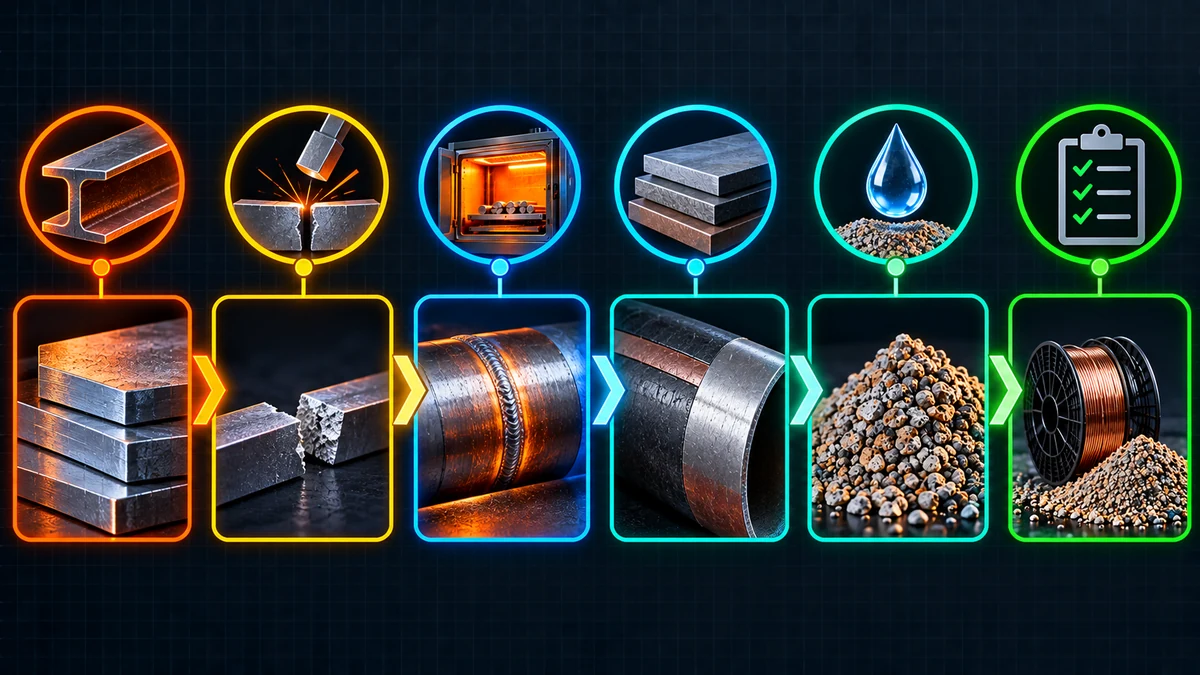
Carbon Steel (A5.17) vs Low-Alloy Steel (A5.23) Wires
| Wire Classification | Governing Standard | Composition Note | Typical Use |
|---|---|---|---|
| EM12K | AWS A5.17 | Medium manganese (~1.1%), ~0.12% carbon, silicon-killed | General-purpose carbon steel structural and pressure vessel welding |
| EH14 | AWS A5.17 | Higher manganese (~2.0%), ~0.14% carbon | Higher strength or toughness needed from the wire alone |
| EA2 | AWS A5.23 | Approximately 0.5% molybdenum addition | Entry-level low-alloy wire for Cr-Mo pipe and pressure vessel applications |
| EB2 / EB3 (and similar B-series) | AWS A5.23 | Chromium-molybdenum compositions matching common Cr-Mo base metals | Cr-Mo pressure equipment (e.g. 1-1/4Cr-1/2Mo, 2-1/4Cr-1Mo) requiring matching alloy content |
Matching wire alloy series to base metal group is not optional cosmetics; it governs whether the finished weld has adequate creep strength, corrosion resistance, or hardenability compatibility with the base metal, especially in elevated-temperature Cr-Mo service where alloy content directly affects long-term performance.
Worked Example
Consider a carbon steel pressure vessel shell requiring 70 ksi minimum weld metal tensile strength, Charpy impact toughness qualified at -20°F, fabricated with a mandatory PWHT cycle, and a project specification calling for controlled hydrogen (8 mL/100g maximum) due to joint restraint concerns.
Why Substitution Requires Requalification
Because the classification represents a tested combination, changing either the wire or the flux, even to another product that individually carries a similar classification, is commonly treated as an essential variable under codes such as ASME Section IX and AWS D1.1, requiring the welding procedure to be requalified rather than simply updated on paper.
This is not bureaucratic caution for its own sake: field experience and industry forum discussion consistently show that substituting a flux or wire, even one that appears equivalent on a data sheet, can shift toughness, hardness, or diffusible hydrogen content enough to matter, particularly at the lower end of an impact toughness requirement or on a hydrogen-sensitive material.
Field tip: When a welding procedure specification does not explicitly state whether the flux used is active, neutral, or basic, some reviewing authorities will flag this as incomplete, since flux type can be treated as its own essential variable under some codes. Specifying flux type explicitly, not just the AWS classification number, avoids this class of procedure review finding.
Quick Reference: Classification Code Elements
| Segment | Meaning |
|---|---|
| F | Flux (fixed prefix) |
| First digit | Minimum tensile strength in 10,000 psi increments |
| Letter (A or P) | Heat-treatment condition tested: as-welded or post-weld heat treated |
| Second digit | Impact test temperature designator (per the standard’s table) |
| E | Electrode (fixed prefix for the wire portion) |
| Wire code (e.g. M12K, H14, A2, B2) | Wire chemistry: manganese level, carbon content, and alloy additions |
| H-designator (optional) | Maximum diffusible hydrogen content, mL per 100g deposited metal |
Common Mistakes and Limitations
- Assuming any “matching” component pair achieves the combined classification. Only the specific flux-and-wire combination actually tested and classified together carries that AWS designation; assembling components that individually look right does not guarantee it.
- Using an “A” (as-welded) classification for a joint that will be PWHT’d. PWHT can change weld metal toughness and hardness; the classification basis should match the actual fabrication condition of the joint.
- Pairing a carbon steel wire series with a low-alloy base metal, or vice versa. This mismatches alloy content across the joint, which matters especially for elevated-temperature Cr-Mo service where creep strength depends on matching alloy content.
- Treating flux type (active/neutral/basic) as unspecified detail. Some reviewing authorities and codes treat flux type as significant enough to require explicit statement in the WPS, not just the AWS numeric classification.
- Substituting a component without requalifying. Even an apparently equivalent wire or flux substitution can be an essential variable requiring requalification under the governing code; verify before treating a substitution as a formality.
Specific classification requirements, essential variable definitions, and hydrogen limits depend on the code edition and welding procedure specification applicable to your project; confirm against the governing code and material specification.
Key Terms
- Flux-Electrode Classification
- An AWS designation describing the tested mechanical properties of a specific flux and wire welded together, rather than either component individually.
- AWS A5.17
- The AWS specification covering carbon steel electrodes and fluxes for submerged arc welding.
- AWS A5.23
- The AWS specification covering low-alloy steel electrodes and fluxes for submerged arc welding.
- Diffusible Hydrogen Designator
- An optional part of the classification (H16, H8, H4, H2) specifying the maximum diffusible hydrogen content of the deposited weld metal, in mL per 100g.
- As-Welded (A) / Post-Weld Heat Treated (P) Condition
- The heat-treatment condition in which the classification’s impact properties were tested, which should match the joint’s actual fabrication condition.
- Essential Variable
- A welding procedure parameter which, if changed beyond specified limits, requires requalification of the welding procedure under the governing code.
Frequently Asked Questions
Why does AWS classify SAW flux and wire together instead of separately?
Weld metal properties in submerged arc welding result from chemical reactions between the flux and wire in the arc, not from either consumable’s own composition alone. Classifying the combination, as AWS A5.17 and A5.23 do, reflects the properties actually produced when that specific flux and wire are welded together, which can differ meaningfully from what either component would suggest on its own.
What does the “A” or “P” in a SAW flux classification mean?
The letter indicates the heat-treatment condition the classification’s impact properties were tested in: “A” means as-welded, and “P” means post-weld heat treated. This should match the actual fabrication condition of the joint, since post-weld heat treatment can change toughness and hardness compared to the as-welded condition.
What does the H-designator (like H8) mean in a SAW classification?
The H-designator specifies the maximum diffusible hydrogen content of the deposited weld metal, in milliliters per 100 grams. Common levels are H16, H8, H4, and H2, corresponding to progressively lower maximum hydrogen content, used to directly control hydrogen-assisted cracking risk on higher-strength or higher-restraint applications.
Can I substitute a different brand of flux or wire if the AWS classification is the same?
Not automatically. Only the specific flux-and-wire combination actually tested and classified together carries a given AWS designation. A substitute product with an apparently matching individual classification is not guaranteed to reproduce the same combined properties, and changing wire or flux is commonly treated as an essential variable requiring requalification under codes such as ASME Section IX.
How do I choose between an AWS A5.17 and an AWS A5.23 wire?
AWS A5.17 covers carbon steel wire and flux combinations, generally matched to carbon steel base metal. AWS A5.23 covers low-alloy steel combinations, including chromium-molybdenum wire series matched to Cr-Mo base metals used in elevated-temperature service. The choice follows the base metal’s alloy group, since matching alloy content across the joint affects properties such as creep strength in high-temperature applications.
Does the flux type (active, neutral, basic) need to be stated separately in a WPS?
Some reviewing authorities and code interpretations treat flux type as a significant detail beyond the numeric AWS classification, since active versus neutral flux behavior affects weld metal chemistry differently across multiple passes. Stating flux type explicitly in the welding procedure specification, rather than relying on the classification number alone, avoids ambiguity during procedure review.
What is the first step in selecting a SAW wire and flux combination?
The first step is determining the required minimum weld metal tensile strength from the base metal specification and design basis, which sets the leading digit of the flux classification. From there, selection proceeds through impact toughness and test temperature, heat-treatment condition, base metal alloy group, and, where required, diffusible hydrogen level, before identifying a specific tested product combination that satisfies all of them.
Standards and References
- AWS A5.17/A5.17M, Specification for Carbon Steel Electrodes and Fluxes for Submerged Arc Welding, American Welding Society.
- AWS A5.23/A5.23M, Specification for Low-Alloy Steel Electrodes and Fluxes for Submerged Arc Welding, American Welding Society.
- AWS D1.1/D1.1M, Structural Welding Code – Steel, American Welding Society – essential variable requirements for flux-electrode combination changes.
- ASME Boiler and Pressure Vessel Code, Section IX, American Society of Mechanical Engineers – essential variable requirements for filler metal and flux changes in welding procedure qualification.
Conclusion
Selecting a SAW wire and flux combination is really an exercise in translating base metal requirements, tensile strength, toughness at the lowest anticipated service temperature, heat-treatment condition, and hydrogen sensitivity, into a specific AWS classification, and then finding a real, commercially tested product pair that actually carries it. The classification code looks cryptic at first glance, but each segment answers a specific engineering question, and reading it correctly is what keeps a substitution decision from becoming an unplanned requalification. For related consumable topics, see the types of SAW flux guide and the welding consumable nomenclature guide on WeldFabWorld.
About This Guide: This article was prepared by the WeldFabWorld technical team from the standards listed in the References section above. Classification code details and essential variable requirements vary by standard edition and governing code; verify current designator tables and requalification rules against the specific edition referenced in your project’s material specification.