Why Does TIG Use High-Frequency (HF) Start?
Last updated:
Quick Answer: TIG (GTAW) uses a high-frequency generator to ionize the air gap between the tungsten electrode and the workpiece, letting the arc jump the gap without the tungsten ever touching the metal. This avoids tungsten contamination and electrode burn-off that occur with contact starting, and on AC TIG the same high-frequency energy is often used continuously to help the arc re-establish itself every time the current reverses polarity.
Every TIG weld begins with the same small problem: how do you start an arc between a non-consumable tungsten electrode and the workpiece without letting that electrode physically touch the metal? Touching contaminates the tip, and a contaminated tip means erratic arc behavior and possible tungsten inclusions in the weld for the rest of that electrode’s life. High-frequency (HF) start solves this by using a high-voltage, high-frequency spark to bridge the gap electrically instead of mechanically.
This guide explains exactly how HF start works, why AC TIG welding on aluminum often needs high frequency running continuously rather than just at the start, how HF compares with the alternative lift-arc and scratch-start methods, and the practical downside, electromagnetic interference, that leads some shops to avoid it in sensitive environments.
- HF start uses a high-voltage, high-frequency spark, typically in the range of a few hundred kilohertz, to ionize the gap between tungsten and workpiece so the arc can jump without contact.
- Contact starting methods (scratch start) risk tungsten contamination of the weld and can burn off the electrode tip if contact is held too long.
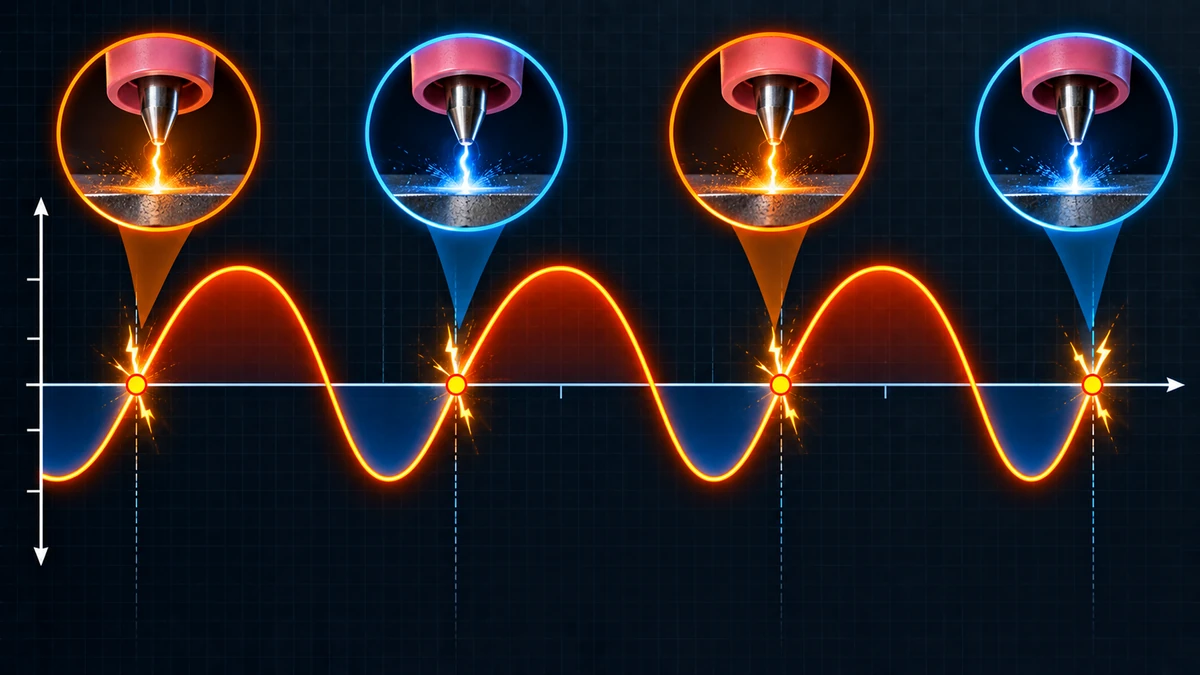
- On AC TIG, high frequency is frequently kept running throughout welding, not just at start, to help the arc reignite every time the current passes through zero and reverses polarity.
- Lift-arc starting avoids HF-related electromagnetic interference by touching the tungsten to the work at low current and lifting it to establish the arc, at the cost of a small risk of contamination compared to a clean HF start.
- HF energy can interfere with nearby sensitive electronics, which is why some facilities specify lift-arc starting instead of HF start in electronics-dense environments.
The Problem HF Start Solves
TIG welding needs a way to initiate an arc between a pointed tungsten electrode and the workpiece without the two ever making contact, because contact contaminates the tungsten tip and can introduce tungsten into the weld pool. The simplest method, scratch starting, does the opposite of this: it touches the tungsten to the work and drags or lifts it away, similar in spirit to striking a stick electrode.
Scratch starting works, but it carries real costs. Contact between tungsten and the workpiece can transfer tiny particles of tungsten into the weld, creating hard, brittle tungsten inclusions that show up on radiographic inspection as small bright spots and act as stress concentrators. Extended or repeated contact can also burn off part of the electrode tip, changing its geometry and arc characteristics for the rest of the job.
Why this matters more for TIG than other processes: In SMAW or GMAW, the electrode is consumed as filler metal, so minor contamination at the tip is far less consequential. In TIG, the tungsten electrode is meant to remain intact and unconsumed for the entire weld, sometimes for many welds on the same grind, so keeping the tip clean at the moment of arc initiation matters far more than in a consumable-electrode process.
How High-Frequency Start Actually Works
A TIG power source equipped with HF start includes a high-frequency generator, historically a spark-gap oscillator, that superimposes a high-voltage, high-frequency signal onto the welding circuit at the moment the torch trigger or pedal is activated. This high-frequency voltage is strong enough to ionize the air gap between the tungsten tip and the workpiece, creating a conductive path for the main welding current to follow without any physical contact.
Once the arc is established through this ionized path, the welding current takes over and the arc behaves as a normal, low-voltage welding arc; the high-frequency component is no longer needed to sustain it on DC TIG, and in most DC applications the HF signal switches off automatically once the main arc is detected.
Why AC TIG Often Needs Continuous HF
AC TIG welding, most commonly used for aluminum and magnesium, alternates the welding current’s polarity many times per second. Each time the current passes through zero on its way to reversing polarity, the arc can momentarily go out, since there is a brief instant with no current flowing at all. Re-establishing the arc after each polarity reversal is called rectification, and if the arc fails to reignite reliably, welding becomes unstable or stops entirely.
On older or simpler AC TIG power sources without an advanced square-wave switching design, high-frequency energy is often kept running continuously throughout the weld specifically to encourage the arc to reignite at every zero crossing, not just at the initial start. This is a key reason HF start on many conventional AC TIG machines is not a start-only feature: the operator will often hear the characteristic high-frequency buzz for the entire duration of the weld, not only at ignition.
Caution: On these conventional AC machines, disabling continuous HF to reduce electromagnetic interference can cause the arc to become unstable or extinguish during welding, not just at start-up. Any decision to run without continuous HF on AC TIG should be verified against the specific power source’s design and the process stability actually achieved, not assumed to work the same as on a DC machine.
HF Start vs Lift-Arc vs Scratch Start
| Method | How It Works | Contamination Risk | EMI Risk |
|---|---|---|---|
| Scratch Start | Tungsten dragged or scratched against the work, then lifted, similar to striking a stick electrode | Higher Contact required | None |
| Lift-Arc | Tungsten touched to the work at low current, then lifted; internal circuitry initiates the arc as contact breaks | Low Brief, low-current contact | None |
| HF Start | High-frequency spark ionizes the air gap, allowing the arc to jump without any contact | Lowest No contact | Present Can affect nearby electronics |
Lift-arc offers a practical middle ground: it avoids the electromagnetic interference associated with HF while keeping contact brief and at low current, which limits (though does not entirely eliminate) contamination risk compared to a full scratch start. Many modern TIG machines offer all three methods as selectable options, letting the operator choose based on the specific job’s priorities.
The Downside: Electromagnetic Interference
The same high-frequency, high-voltage energy that makes HF start effective can also radiate as electromagnetic interference (EMI), potentially disrupting nearby sensitive electronic equipment such as computers, programmable logic controllers, communication equipment, and, in the most safety-critical case, personal medical devices such as pacemakers.
- Shop floor electronics: Unshielded or poorly grounded HF-equipped TIG machines can occasionally cause nuisance interference with nearby computer-controlled equipment if cabling and grounding are not properly managed.
- Medical device concerns: Facilities with personnel who use pacemakers or similar implanted medical devices often adopt lift-arc starting specifically to avoid HF energy exposure, following guidance from equipment manufacturers and workplace safety policies.
- Proper installation reduces risk: Good welding cable routing, secure work clamp connections, and proper equipment grounding significantly reduce the practical EMI footprint of HF-equipped machines, even where HF remains in use.
Field tip: If nearby electronic equipment shows unexplained glitches only while TIG welding is underway, check whether HF start (or continuous HF on an AC machine) is in use nearby before assuming an unrelated cause. Verifying work clamp connection quality and cable routing is often the fastest fix; switching to lift-arc is the more definitive solution where HF cannot be adequately contained.
Modern Inverter Machines and Reduced HF Reliance
Modern inverter-based AC TIG power sources commonly use advanced square-wave polarity switching circuitry that reignites the arc reliably at each polarity reversal without depending on continuous HF energy the way older transformer-based AC machines often do. On these machines, HF may be used only momentarily at arc start, similar to how it typically behaves on DC TIG, rather than running continuously through the weld.
This is a meaningful practical distinction when specifying or troubleshooting equipment: whether HF is expected to run continuously or only at start is a function of the specific power source’s design, not a universal rule for “AC TIG” as a category, and should be confirmed against the manufacturer’s documentation for the machine in use.
Quick Reference: Arc Starting Methods
| Situation | Typically Preferred Method |
|---|---|
| General shop TIG welding, DC, no EMI concerns | HF start (start-only) |
| Conventional (non-inverter) AC TIG on aluminum | HF start, often continuous through the weld |
| Environment with sensitive electronics nearby | Lift-arc |
| Basic or older equipment without HF or lift-arc circuitry | Scratch start (accepted with added contamination risk) |
| Modern inverter AC TIG with square-wave switching | HF start, typically only momentary at ignition |
Common Mistakes and Limitations
- Assuming HF is only ever needed at start. On many conventional AC TIG machines, HF runs continuously to manage arc reignition at every polarity reversal, not just at ignition; disabling it mid-weld on such a machine can destabilize the arc.
- Blaming unrelated electronic faults before checking for HF interference. Intermittent nearby electronic glitches that only occur during welding are worth checking against HF use and grounding quality before pursuing other root causes.
- Treating lift-arc as risk-free for contamination. Lift-arc still involves brief tungsten-to-work contact at low current; it reduces contamination risk relative to scratch start but does not eliminate it the way a true HF start does.
- Ignoring cable and ground quality as an EMI mitigation. Much of the practical interference risk from HF-equipped machines can be reduced through proper cable routing and grounding, an often-overlooked first step before switching starting methods entirely.
- Assuming all AC machines behave the same regarding continuous HF. Whether HF runs continuously or only at start depends on the specific machine’s internal design (conventional transformer-based vs modern inverter square-wave); confirm against the manufacturer’s documentation rather than assuming based on machine age or price point alone.
Specific arc-starting requirements and restrictions on HF use depend on the welding procedure specification, equipment design, and workplace safety policy applicable to your project; confirm requirements against the governing WPS and site safety rules.
Key Terms
- High-Frequency (HF) Start
- A TIG arc-starting method that uses a high-voltage, high-frequency spark to ionize the gap between tungsten and workpiece, allowing the arc to jump without contact.
- Scratch Start
- An arc-starting method requiring the tungsten electrode to touch and drag or lift from the workpiece, similar to striking a stick electrode.
- Lift-Arc
- An arc-starting method where the tungsten touches the work at low current and the arc initiates as it is lifted away, avoiding HF-related interference.
- Rectification (AC TIG)
- The phenomenon where the TIG arc fails to reignite as the current passes through zero and reverses polarity during AC welding.
- Square-Wave Power Supply
- A modern inverter-based AC power source design that reduces reliance on continuous high frequency by switching polarity more abruptly and reliably than older transformer-based designs.
- Electromagnetic Interference (EMI)
- Disruption of nearby electronic equipment caused by radiated high-frequency energy, a known downside of HF-equipped TIG machines.
Frequently Asked Questions
Why does TIG welding need high-frequency start instead of just touching the tungsten?
Touching the tungsten electrode to the workpiece to start the arc contaminates the tip and can transfer tungsten particles into the weld pool, creating tungsten inclusions. High-frequency start ionizes the air gap electrically, letting the arc jump the gap without any contact, keeping the tungsten tip clean and avoiding this contamination.
Does high-frequency stay on during the whole weld or just at the start?
It depends on the machine and the current type. On DC TIG, HF is typically used only momentarily to start the arc and switches off once the main welding current is established. On many conventional AC TIG machines, HF often runs continuously through the weld to help the arc reignite every time the current reverses polarity, though modern inverter machines with square-wave switching may need HF only at start even on AC.
What is the difference between HF start and lift-arc start?
HF start ionizes the air gap electrically so the tungsten never touches the workpiece, avoiding contamination entirely but radiating high-frequency energy that can interfere with nearby electronics. Lift-arc requires the tungsten to briefly touch the work at low current before being lifted to initiate the arc, which avoids HF-related interference but carries a small residual contamination risk from that brief contact.
Can high-frequency TIG start interfere with other electronic equipment?
Yes. The high-frequency, high-voltage energy used to start (or sustain) the arc can radiate as electromagnetic interference, potentially disrupting nearby sensitive electronics such as computers, programmable logic controllers, and personal medical devices. Proper cable routing and grounding reduce this risk, and lift-arc starting is often used instead in environments where it is a significant concern.
Why does AC TIG welding have trouble maintaining the arc without high frequency?
AC TIG current reverses polarity many times per second, and each time it passes through zero, the arc can momentarily extinguish. Reigniting the arc reliably at every one of these polarity reversals is called rectification. On machines without advanced square-wave switching, continuous high-frequency energy is used to help the arc reignite consistently at each reversal, which is why the characteristic HF buzz is often heard throughout an AC TIG weld rather than only at the start.
Is scratch start still used in modern TIG welding?
Scratch start is less common on modern equipped machines, which typically offer HF start or lift-arc as cleaner alternatives, but it remains available as a basic fallback method, particularly on simpler or older power sources without dedicated arc-starting circuitry. It carries the highest contamination risk of the common starting methods due to the direct, often less controlled, contact required.
Does the frequency used in HF start affect the weld itself?
The high-frequency signal operates at a comparatively low current and is primarily used to ionize the starting gap or, on some AC machines, assist arc reignition; it is not the source of the main welding heat, which comes from the welding current itself once the arc is established. The specific frequency and design details vary by manufacturer and are generally not something the welding procedure needs to specify beyond confirming the starting method used.
Standards and References
- AWS C5.5/C5.5M, Recommended Practices for Gas Tungsten Arc Welding, American Welding Society – arc initiation methods and equipment guidance for GTAW.
- ANSI Z49.1, Safety in Welding, Cutting, and Allied Processes, American Welding Society – general equipment and workplace safety guidance applicable to arc welding processes.
Conclusion
High-frequency start exists to solve a specific, narrow problem: letting a TIG arc jump a gap that scratch starting would otherwise require touching, and on AC TIG, keeping that arc alive through every polarity reversal a transformer-based machine’s current waveform throws at it. It is a clean, reliable solution, but not a free one; the same energy that ionizes the starting gap can radiate as interference with sensitive electronics nearby, which is exactly why lift-arc exists as an alternative. Understanding which starting method your machine uses, and why, turns troubleshooting an erratic arc, a contaminated tungsten, or an unexplained equipment glitch from guesswork into a quick diagnostic check. For related process topics, see the types of SAW flux guide and the welding consumable selection guide on WeldFabWorld.
About This Guide: This article was prepared by the WeldFabWorld technical team from the references listed above. Equipment behavior varies by manufacturer and model; verify specific arc-starting method availability, continuous HF behavior on AC, and interference mitigation guidance against your TIG power source’s operating manual.