How Does Voltage Affect Weld Bead Width?
Last updated:
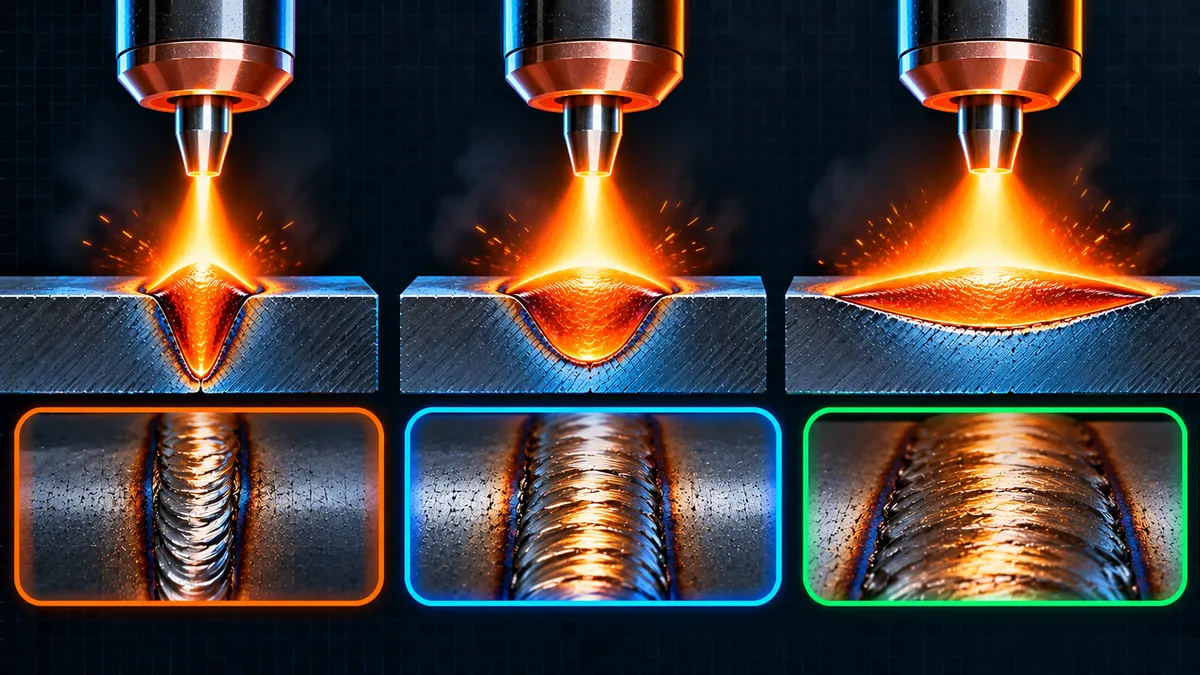
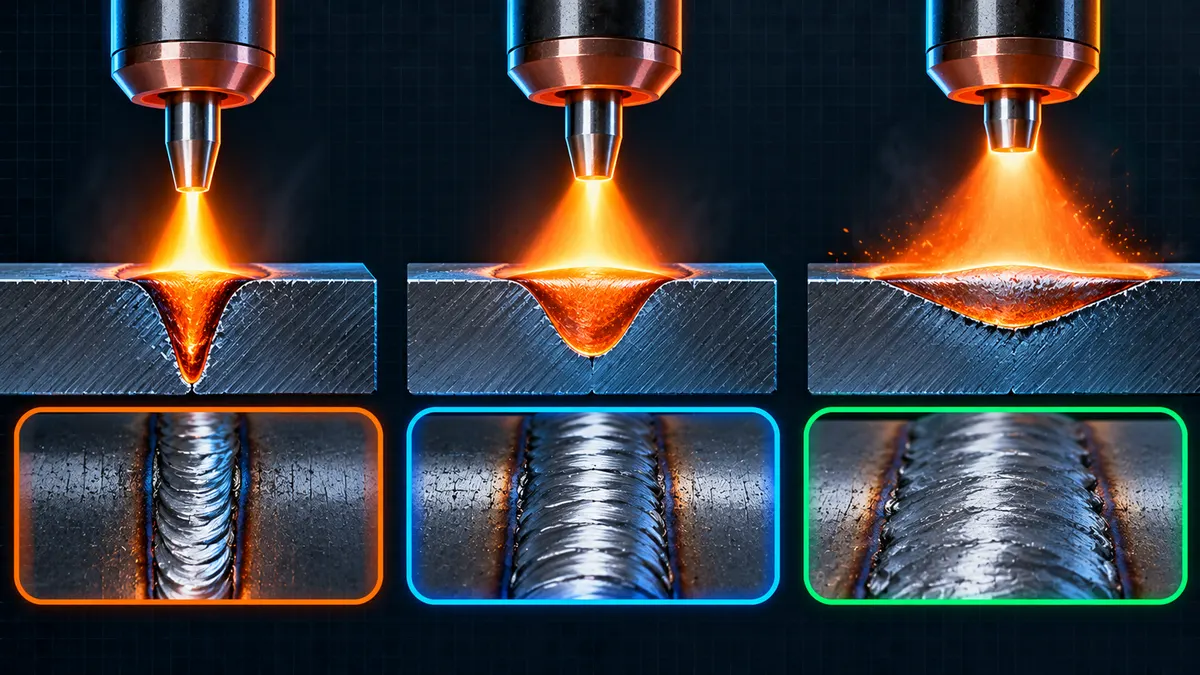
Quick Answer: Higher arc voltage lengthens the arc, which spreads its heat and force over a wider area of the workpiece, producing a wider, flatter bead. Lower voltage does the opposite, producing a narrower, higher-crowned bead. On a flat surface or square-edge joint this widening comes with little change in penetration, but on a prepared groove joint, raising voltage too far can actually cause lack of fusion at the root, because the wider arc no longer reaches the bottom of the preparation.
Voltage is often described as the setting that controls bead width, and that is broadly true, but the full picture is more interesting: voltage changes bead width by changing arc length, and a longer arc spreads its energy differently depending on whether it is welding on an open, flat surface or reaching down into a narrow, prepared groove. Get this distinction wrong, and “just turn up the voltage for a wider, nicer-looking bead” can quietly leave a joint unfused at the root.
This guide explains the mechanism behind voltage’s effect on bead width, why that effect changes depending on joint geometry, and what happens at both the high and low ends of the voltage range across common arc welding processes.
- Higher voltage lengthens the arc, spreading its heat and force over a wider area and producing a wider, flatter bead with more reinforcement.
- On bead-on-plate and square-edge close butt joints, increasing voltage widens the bead with comparatively little change in penetration depth.
- On a prepared V-groove or similar joint, raising voltage too far can cause lack of fusion at the root, because the wider arc column can no longer reach the bottom of the preparation the way a narrower, lower-voltage arc can.
- Excessively high voltage produces a wide, flat, “hat-shaped” bead prone to cracking, along with more difficult slag removal and, in SAW, increased flux consumption and alloy pickup from the flux into the weld metal.
- Excessively low voltage produces a narrow, high, humped bead with poor wetting at the toes and very difficult slag removal, though it improves penetration into a deep, narrow groove.
The Mechanism: Voltage, Arc Length, and Bead Width
Arc voltage rises with arc length, and a longer arc spreads its heat and mechanical force over a wider area of the workpiece surface, which is why higher voltage generally produces a wider weld bead. A shorter, lower-voltage arc concentrates that same energy over a smaller area, producing a narrower, more sharply defined bead.
This is the same underlying arc length relationship covered in more general terms elsewhere on WeldFabWorld, but bead width is where the effect is most visually obvious: change voltage on a running weld and the bead visibly widens or narrows in response, often before any change in penetration becomes apparent.
Reinforcement and flux consumption: A wider bead from higher voltage also generally means more weld metal reinforcement (the buildup of weld metal above the base metal surface) and, in flux-shielded processes like SAW, higher flux consumption. In SAW specifically, higher voltage melts more flux, which can allow more alloying elements from the flux to transfer into the weld metal, directly affecting weld metal composition, not just bead shape.
Why the Penetration Effect Depends on Joint Geometry
On a flat, unprepared surface (bead-on-plate) or a square-edge close butt joint, increasing arc voltage widens the bead and increases dilution, while penetration depth remains relatively unaffected. The wider arc simply spreads over more of an already-open surface.
On a prepared V-groove or similar joint, the geometry changes this outcome. Raising voltage too far can actually cause lack of fusion at the root, because the wider arc column can no longer reach down into the narrow bottom of the preparation the way a more concentrated, lower-voltage arc can. In this case, reducing voltage increases penetration depth at the root, since the narrower arc column is better able to reach the bottom of the joint preparation.
Caution: This means the correct voltage response to a “not enough penetration” problem is not automatic. On an open joint, more voltage generally does not fix insufficient penetration, since current is the dominant depth variable there; on a prepared groove joint, more voltage can actively make root penetration worse. Always consider joint geometry before adjusting voltage to solve a penetration issue.
Effects of Voltage That Is Too High
- Wide, flat, “hat-shaped” bead: Excessively high voltage produces an overly wide, flat bead profile, sometimes described as hat-shaped, which is more prone to cracking than a well-proportioned bead.
- Undercut: A wide, less controlled arc can wash out the joint edges faster than filler metal fills them back in, contributing to undercut at the weld toes.
- Increased arc blow risk: Excessive voltage and the resulting longer arc increase susceptibility to arc blow, where the arc is deflected by magnetic effects, particularly on ferromagnetic material.
- Poor slag removal (flux-shielded processes): A wider, flatter bead from high voltage can make slag removal more difficult in SMAW and SAW.
- Increased flux consumption and alloy pickup (SAW specifically): Higher voltage melts more flux, which can transfer more alloying elements into the weld metal from the flux, shifting weld metal composition in ways that matter for procedure qualification.
Effects of Voltage That Is Too Low
- Narrow, high, humped bead: Excessively low voltage produces a narrow, high-crowned bead shape with poor wetting into the base metal at the edges.
- Difficult slag removal: A narrow, high bead in flux-shielded processes tends to trap slag more readily and can be very difficult to clean between passes.
- Stiffer, more penetrating arc: Lower voltage produces a more focused, stiffer arc, which can be an advantage for reaching the bottom of a deep, narrow groove joint.
- Arc instability at the extreme low end: Voltage too low for the process and current combination can make the arc difficult to maintain smoothly.
Voltage and Wetting Action
Wetting action describes how smoothly molten weld metal flows and blends into the base metal at the toes of the bead, rather than sitting on top of it with a sharp, poorly fused transition. Adequate voltage, together with adequate travel speed and heat input, supports good wetting; both excessively low voltage (a narrow, humped bead with poor edge fusion) and excessively high travel speed (not enough time for the puddle to wet out before it solidifies) can produce poor wetting and contribute to undercut or cold lap at the bead edges.
Field tip: A weld described as “timid,” narrow, poorly fused to the base metal, and lacking penetration, is a classic sign of voltage set too low for the joint, sometimes combined with travel speed that is too fast for the puddle to wet out properly. Raising voltage and slightly slowing travel speed, with a slight weave to spread the puddle, is a common combined fix.
Process-Specific Notes
| Process | Notes |
|---|---|
| SMAW | Voltage is a function of arc length held by the welder; high voltage (long arc) widens the bead and increases spatter and slag removal difficulty; low voltage (short arc) narrows and heightens the bead. |
| GMAW | Runs on a constant-voltage power source; the set voltage largely determines arc length and bead width, with wire feed speed (and therefore current) set independently for deposition and penetration. |
| SAW | Voltage strongly affects bead width, reinforcement, and flux consumption; on prepared groove joints, excessive voltage risks lack of fusion at the root, as covered above. |
Quick Reference: Symptoms and Voltage Adjustment
| Symptom | Likely Cause |
|---|---|
| Wide, flat, hat-shaped bead, cracking tendency | Voltage too high Reduce voltage |
| Narrow, high, humped bead, poor wetting | Voltage too low Increase voltage |
| Lack of fusion at root of a prepared groove | Voltage too high for the joint preparation Reduce voltage |
| Difficult slag removal (SMAW/SAW) | Voltage too high (flat, wide bead) or too low (narrow, trapping slag) |
| Excessive flux consumption / alloy shift (SAW) | Voltage too high Reduce voltage |
| Arc blow | Voltage (and resulting arc length) too high, combined with magnetic field effects |
Common Mistakes and Limitations
- Raising voltage to fix insufficient penetration on a prepared groove joint. On a V-groove or similar prepared joint, this can make root fusion worse, not better, because the wider arc no longer reaches the bottom of the preparation.
- Treating bead-on-plate behavior as universal. The relatively unaffected-penetration behavior seen on flat or square-edge joints does not automatically transfer to prepared groove joints, where geometry changes the outcome.
- Chasing bead width with voltage alone, ignoring travel speed. Bead width and wetting also depend on travel speed and technique (such as weaving); voltage is one lever among several.
- Overlooking flux consumption and alloy pickup effects in SAW. A voltage change made purely for bead cosmetics in SAW can shift weld metal composition through increased flux melting, with consequences for mechanical properties.
- Ignoring undercut risk at high voltage. A wider, flatter bead from high voltage can wash out joint edges faster than filler metal fills them back in, producing undercut that may not be immediately obvious during welding.
Specific voltage ranges and their effects depend on the process, consumable, joint design, and welding procedure specification applicable to your project; confirm against the qualified WPS.
Key Terms
- Bead Width
- The lateral (side-to-side) dimension of a weld bead as deposited, strongly influenced by arc voltage.
- Reinforcement
- The buildup of weld metal above the base metal surface, which tends to increase with higher voltage and a wider bead.
- Wetting Action
- How smoothly molten weld metal flows and blends into the base metal at the bead toes, rather than sitting on top with poor fusion.
- Undercut
- A groove melted into the base metal at the weld toe that is not filled back in by weld metal, a common consequence of excessive voltage or travel speed.
- Arc Blow
- Deflection of the welding arc caused by magnetic effects, more likely at higher voltage and longer arc length, particularly on ferromagnetic material.
- Dilution
- The proportion of a weld bead’s composition that comes from melted base metal rather than filler metal, which increases with wider, higher-voltage beads.
Frequently Asked Questions
Does higher voltage always widen the weld bead?
Generally yes: higher voltage lengthens the arc, which spreads its heat and force over a wider area, widening the bead. This holds across bead-on-plate, square-edge, and prepared groove joints; what changes with joint geometry is not whether the bead widens, but what happens to penetration depth, particularly at the root of a prepared groove.
Can too much voltage cause lack of fusion?
Yes, specifically on a prepared groove joint such as a V-butt. As voltage increases, the arc widens and can no longer reach the bottom of a narrow groove preparation as effectively as a more concentrated, lower-voltage arc, which can leave the root unfused even though the overall bead looks wide and well filled at the surface.
What does a hat-shaped weld bead indicate?
A hat-shaped bead, wide and flat with a broad, low profile, generally indicates excessively high voltage. This bead shape is more prone to cracking than a well-proportioned profile and is often accompanied by more difficult slag removal in flux-shielded processes.
Why does low voltage improve penetration in a deep groove joint?
Lower voltage produces a shorter, more concentrated, stiffer arc column, which is better able to reach down into the bottom of a deep, narrow groove preparation than a wider, higher-voltage arc that spreads its energy across a broader area near the top of the joint.
Does voltage affect weld metal composition in SAW?
Yes. In submerged arc welding, higher voltage melts more flux, and where the flux carries alloying or deoxidizing additions, more of that flux content can transfer into the weld metal. This means a voltage change made purely to adjust bead appearance can also shift weld metal chemistry in SAW.
Is bead width controlled only by voltage?
No. While voltage is a primary driver of bead width through its effect on arc length, travel speed and welding technique, such as weaving versus a straight stringer bead, also significantly influence bead width and wetting. Voltage sets the underlying arc behavior; travel speed and technique further shape the final result.
What is the difference between voltage’s effect on width and current’s effect on penetration?
Voltage primarily governs arc length and, through it, bead width and shape. Current primarily governs penetration depth, the dominant variable controlling how deeply the weld fuses into the base metal. The two interact through their combined effect on heat input, but each has a distinct primary role in shaping the finished weld.
Standards and References
- TWI Ltd., “What is the effect of arc voltage in SA (Submerged Arc) welding?” – joint-geometry-dependent effect of arc voltage on bead shape and penetration.
- AWS Welding Handbook, American Welding Society – general reference for arc physics and bead geometry variables.
- ASME Boiler and Pressure Vessel Code, Section IX, American Society of Mechanical Engineers – essential variable requirements for voltage in welding procedure qualification.
Conclusion
Voltage’s effect on bead width looks simple on the surface, more voltage, wider bead, but the full relationship depends on what the arc is actually welding into. On an open surface, a wider bead from higher voltage comes at little cost to penetration; on a prepared groove joint, the same voltage increase can leave the root unfused, because the arc has widened past the point where it can still reach the bottom of the preparation. Reading bead shape correctly, hat-shaped and flat versus narrow and humped, and knowing which direction to adjust voltage for the joint in front of you, is what turns a cosmetic parameter into a genuine quality control tool. For related process topics, see the welding current and penetration guide and the arc length and weld quality guide on WeldFabWorld.
About This Guide: This article was prepared by the WeldFabWorld technical team from the references listed above. Specific voltage ranges and their effects vary by process, consumable, and joint design; verify actual parameters against the qualified welding procedure specification for your application.