How Does Welding Current Affect Penetration?
Last updated:
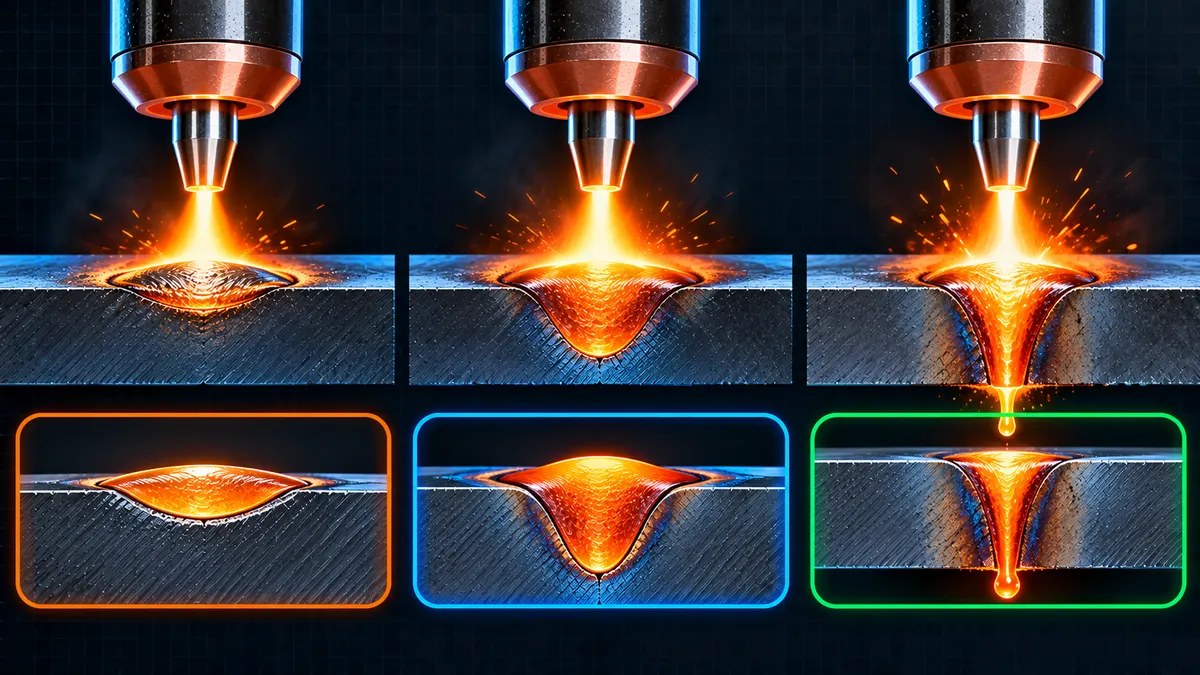
Quick Answer: Welding current (amperage) is the single variable with the greatest effect on weld penetration: higher current produces deeper penetration, and lower current produces shallower penetration. Too little current gives an unstable arc and insufficient fusion; too much current gives excessive penetration, undercut, and burn-through risk. Polarity, electrode diameter, shielding gas, and travel speed all modify how much penetration a given current actually produces, but current itself sets the primary scale.
Ask an experienced welder what single dial matters most for getting good penetration, and the answer is almost always the same: amperage. Voltage shapes the bead, travel speed spreads or concentrates the heat, and shielding gas and polarity fine-tune the arc’s behavior, but welding current is the dominant variable controlling how deep the fusion zone actually reaches into the base metal.
This guide explains why current has this outsized effect, what happens at both ends of the range when it is set wrong, and how polarity, electrode or wire diameter, shielding gas, and travel speed each modify the basic current-to-penetration relationship without displacing current as the primary driver.
- Of all common welding variables, current has the greatest single effect on penetration depth: more amperage means deeper penetration, less amperage means shallower penetration.
- Too little current produces an unstable arc, poor fusion, and a crowned, irregular bead; too much current produces excessive penetration, undercut, spatter, and burn-through risk, especially on thin material.
- DCEP (electrode positive) polarity generally produces deeper penetration than DCEN (electrode negative) at the same current, which is why some self-shielded flux-cored wires deliberately use DCEN for higher deposition with shallower penetration.
- A smaller-diameter electrode or wire carrying the same current has higher current density, generally producing deeper, more localized penetration than a larger-diameter electrode at the same amperage.
- Shielding gases with higher thermal conductivity, such as those with added helium or CO2, tend to produce a broader, more evenly deep penetration profile, while argon-rich gases can produce a narrower, more finger-like penetration profile at higher currents.
Why Current Is the Dominant Penetration Variable
Welding current directly controls the energy density delivered to the base metal at the arc root, and that energy density is what melts base metal deep enough to achieve fusion; more current means more energy delivered per unit time, and therefore deeper melting into the joint. Depth of fusion, commonly called penetration, is the distance that melting actually extends into the base metal or a previous weld pass, and among all the variables a welder or procedure sets, current has consistently been shown to have the largest single effect on that depth.
This relationship holds across the common arc welding processes, SMAW, GMAW, GTAW, and SAW alike: as welding current increases, penetration increases, and as current decreases, penetration decreases, all other variables held constant. It is a simple enough relationship to state, but it is the reason amperage is usually the first thing checked when a weld shows insufficient or excessive fusion.
Current vs voltage: It is worth distinguishing current’s role from voltage’s role, since the two are often confused. Current primarily governs how deep the weld penetrates; voltage primarily governs arc length and, through it, how wide and flat the bead is. A weld can be adjusted for width through voltage while penetration remains governed mainly by current, though in practice both interact through their combined effect on heat input.
Effects of Current That Is Too Low
- Insufficient penetration: There is not enough heat to adequately melt the base metal, leaving a shallow fusion zone and a higher risk of lack of fusion, particularly at the root of the joint.
- Irregular, crowned bead: The weld puddle is too small to control properly, often producing a bead with an irregular, humped or crowned appearance rather than a smooth, well-fused profile.
- Arc instability: In some processes, droplets forming at the electrode tip can bridge to the weld puddle and periodically short-circuit or extinguish the arc, since there is not enough current to sustain smooth metal transfer.
Effects of Current That Is Too High
- Excessive penetration: On thinner material or a joint with limited backing, too much current can penetrate completely through the joint, causing burn-through.
- Wide, flat bead with undercut: Excess current tends to produce a wide, flat bead, and can wash out the joint edges faster than filler metal fills them back in, producing undercut along the weld toes.
- Increased spatter: Higher current, particularly beyond the process and consumable’s intended range, tends to produce more spatter as metal transfer becomes more turbulent.
Caution: The relationship between current and penetration does not mean “more is always safer.” Excess penetration is its own defect category, especially significant on thin-wall material such as tube-to-tubesheet joints or pipe root passes, where burn-through can be as serious a rejection cause as lack of penetration.
Polarity: DCEP vs DCEN Penetration
At the same current setting, polarity meaningfully changes how much of the arc’s heat ends up in the base metal versus the electrode. In direct current electrode positive (DCEP, also called reverse polarity), the arc typically produces deeper penetration into the base metal. In direct current electrode negative (DCEN, also called straight polarity), the arc typically produces shallower penetration but a faster electrode melt-off rate, favoring higher deposition over depth.
| Polarity | Typical Penetration | Typical Deposition Rate | Common Use |
|---|---|---|---|
| DCEP (electrode positive) | Deeper Standard for most GMAW/SMAW | Moderate | Most GMAW solid wire, most SMAW electrodes |
| DCEN (electrode negative) | Shallower | Higher | Some self-shielded FCAW wires for higher deposition on thinner material |
This is exactly why certain self-shielded flux-cored wires are designed to run on DCEN: the process trades some penetration depth for a faster deposition rate and reduced burn-through risk, useful on thinner sections or field conditions where deep penetration is not the priority.
Other Factors That Modify the Current-Penetration Link
- Electrode or wire diameter: At the same current, a smaller-diameter electrode concentrates that current over a smaller cross-sectional area, producing higher current density and generally deeper, more localized penetration than a larger-diameter electrode carrying the same amperage.
- Shielding gas thermal conductivity: Shielding gases with higher thermal conductivity, such as helium or CO2, tend to spread arc heat more broadly into the base metal, producing a wider and more evenly deep penetration profile. Argon-rich shielding gases can instead produce a narrower, more finger-like penetration profile at higher currents, due to differences in arc plasma behavior.
- Travel speed: Slower travel speed keeps the arc over a given point longer, increasing local heat input and penetration; faster travel speed reduces the time the arc spends at any one point, reducing penetration, all else held constant.
- Arc length: A shorter, more focused arc concentrates force and heat over a smaller area, generally supporting deeper localized penetration, while a longer arc spreads heat over a wider area, as covered in more detail in the arc length and weld quality guide.
Field tip: When troubleshooting a penetration problem, check current first, then consider these secondary factors as fine-tuning adjustments rather than primary fixes. A joint with genuinely insufficient penetration rarely gets fixed by changing shielding gas alone if the underlying current setting is wrong for the joint and material thickness.
Current as an Essential Variable
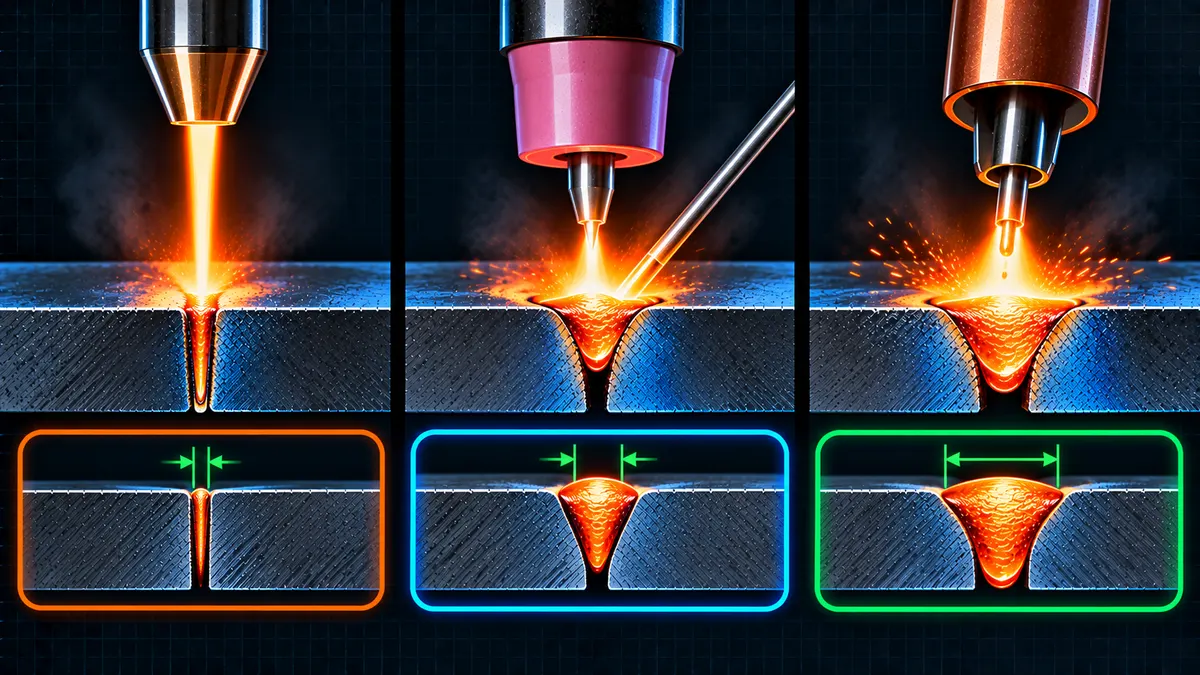
Because of its direct effect on penetration and overall weld quality, welding current (or the amperage range it falls within) is commonly treated as an essential variable in welding procedure qualification under codes such as ASME Section IX and AWS D1.1. Exceeding the qualified current range, even if the weld looks acceptable, generally requires the procedure to be requalified for that range rather than assumed to remain valid.
This is directly connected to the heat input relationship covered in other WeldFabWorld guides: since current is one of the three inputs to the heat input calculation, alongside voltage and travel speed, a current range outside what was qualified can shift not just penetration but also cooling rate and resulting HAZ properties.
Quick Reference: Penetration Symptoms and Causes
| Symptom | Likely Cause |
|---|---|
| Lack of fusion, shallow penetration | Current too low Increase amperage |
| Burn-through on thin material | Current too high Reduce amperage |
| Undercut at weld toes | Current too high, or excessive travel speed combined with high current |
| Irregular, crowned bead with poor puddle control | Current too low |
| Deep, narrow “finger” penetration | Argon-rich shielding gas at higher current, or small electrode diameter (current density effect) |
| Shallower penetration despite adequate current | Check polarity (DCEN vs DCEP) and electrode/wire diameter |
Common Mistakes and Limitations
- Chasing a penetration problem with shielding gas or technique changes before checking current. Current is the dominant variable; secondary factors fine-tune the result but rarely compensate for a current setting that is fundamentally wrong for the joint.
- Assuming “more current is always better” for penetration. Excess penetration, burn-through, and undercut are real defects; the goal is matching current to the joint and material thickness, not maximizing it.
- Ignoring polarity when troubleshooting unexpectedly shallow penetration. A wire or process that has been set up on DCEN for deposition reasons will not achieve DCEP-level penetration no matter how much current is applied within normal range.
- Overlooking current density effects when changing electrode or wire diameter. The same current setting on a different diameter electrode changes current density and therefore penetration behavior, even though the amperage reading is unchanged.
- Treating current changes as free of essential variable consequences. Operating outside a qualified current range is commonly an essential variable violation requiring requalification, not a minor field adjustment.
Specific current ranges, polarity requirements, and essential variable limits depend on the process, consumable, and governing welding procedure specification applicable to your project; confirm against the qualified WPS.
Key Terms
- Penetration (Depth of Fusion)
- The distance that melting extends into the base metal or a previous weld pass from the surface melted during welding.
- Welding Current (Amperage)
- The strength of electrical current flowing through the welding circuit, the dominant variable controlling weld penetration depth.
- DCEP (Direct Current Electrode Positive)
- A polarity configuration, also called reverse polarity, generally associated with deeper penetration in common arc welding processes.
- DCEN (Direct Current Electrode Negative)
- A polarity configuration, also called straight polarity, generally associated with shallower penetration and higher deposition rate.
- Current Density
- The amount of current per unit cross-sectional area of the electrode or wire, which increases as electrode diameter decreases at a constant current.
- Burn-Through
- A defect where excessive penetration melts completely through the base metal, most commonly a concern on thin material.
Frequently Asked Questions
Does higher welding current always mean deeper penetration?
Within the normal operating range for a given process, consumable, and joint, yes, higher current generally produces deeper penetration. However, other variables such as polarity, electrode diameter, shielding gas, and travel speed also influence the actual penetration achieved at a given current, so current is the dominant but not the only factor.
What happens if welding current is set too low?
Current that is too low produces insufficient heat to properly melt the base metal, resulting in shallow penetration, a higher risk of lack of fusion, an irregular or crowned bead shape, and, in some processes, an unstable arc that may periodically extinguish.
What happens if welding current is set too high?
Current that is too high can produce excessive penetration, including burn-through on thin material, along with a wide, flat bead, undercut at the weld toes, and increased spatter as metal transfer becomes more turbulent.
Does polarity affect penetration as much as current?
Polarity has a real and meaningful effect on penetration, generally deeper on DCEP and shallower on DCEN at the same current, but current remains the dominant variable in absolute terms. Polarity is better understood as a factor that shifts the baseline penetration achievable at a given current, rather than one that outweighs current’s overall effect.
Why do some flux-cored wires run on DCEN instead of DCEP?
Some self-shielded flux-cored wires are specifically formulated to run on DCEN because it favors a higher deposition rate and shallower penetration, which is useful on thinner material or field applications where reduced burn-through risk and higher productivity are more valuable than maximum penetration depth.
Does electrode diameter change penetration at the same current?
Yes. A smaller-diameter electrode carrying the same current has a higher current density, since the same amperage is concentrated over a smaller cross-sectional area, which generally produces deeper, more localized penetration than a larger-diameter electrode at the same current setting.
Is welding current an essential variable in procedure qualification?
Welding current, or the qualified amperage range, is commonly treated as an essential variable under codes such as ASME Section IX and AWS D1.1. Operating outside the qualified range generally requires the welding procedure to be requalified, since current changes can affect penetration, heat input, and resulting mechanical properties.
Standards and References
- Lincoln Electric, “Variables that Affect Weld Penetration,” Welding and Cutting Resource Center – general reference for current, polarity, electrode diameter, shielding gas, and travel speed effects on penetration.
- AWS Welding Handbook, American Welding Society – general reference for arc physics and process variable effects on weld geometry.
- ASME Boiler and Pressure Vessel Code, Section IX, American Society of Mechanical Engineers – essential variable requirements for current and polarity in welding procedure qualification.
Conclusion
Of every dial and setting available on a welding machine, current is the one most directly responsible for how deep a weld actually fuses into the base metal. Too little, and the joint is left under-fused and unstable; too much, and the risk shifts to burn-through, undercut, and excess spatter. Polarity, electrode diameter, shielding gas, and travel speed all bend that relationship in useful ways, letting a welding engineer fine-tune penetration for a specific application, but none of them replace getting the current setting right in the first place. For related process topics, see the arc length and weld quality guide and the critical cooling rate guide on WeldFabWorld.
About This Guide: This article was prepared by the WeldFabWorld technical team from the references listed above. Specific current ranges and polarity requirements vary by process, consumable, and equipment manufacturer; verify actual parameters against the qualified welding procedure specification and consumable manufacturer’s data sheet for your application.