Weldability of Steels: Factors and Assessment
The weldability of steels determines whether a joint can be produced without cracking, without unacceptable loss of toughness, and without a welding procedure so restrictive it becomes impractical. It is not a fixed property printed on a mill certificate — it is a relative judgment that depends on chemistry, section thickness, restraint, hydrogen control, and the welding procedure itself. A steel that welds without difficulty in one shop can crack readily in another simply because preheat, consumable storage, or heat input were handled differently.
This guide works through the metallurgical factors that govern weldability, the three classic failure modes engineers must screen for, the carbon equivalent formulas used to predict cracking risk, and the laboratory and procedural methods used to assess and control weldability in practice. Where relevant, it links through to the Carbon Equivalent calculator and other WeldFabWorld tools so the numbers here can be applied directly to a real steel grade.
What “Weldability” Actually Means
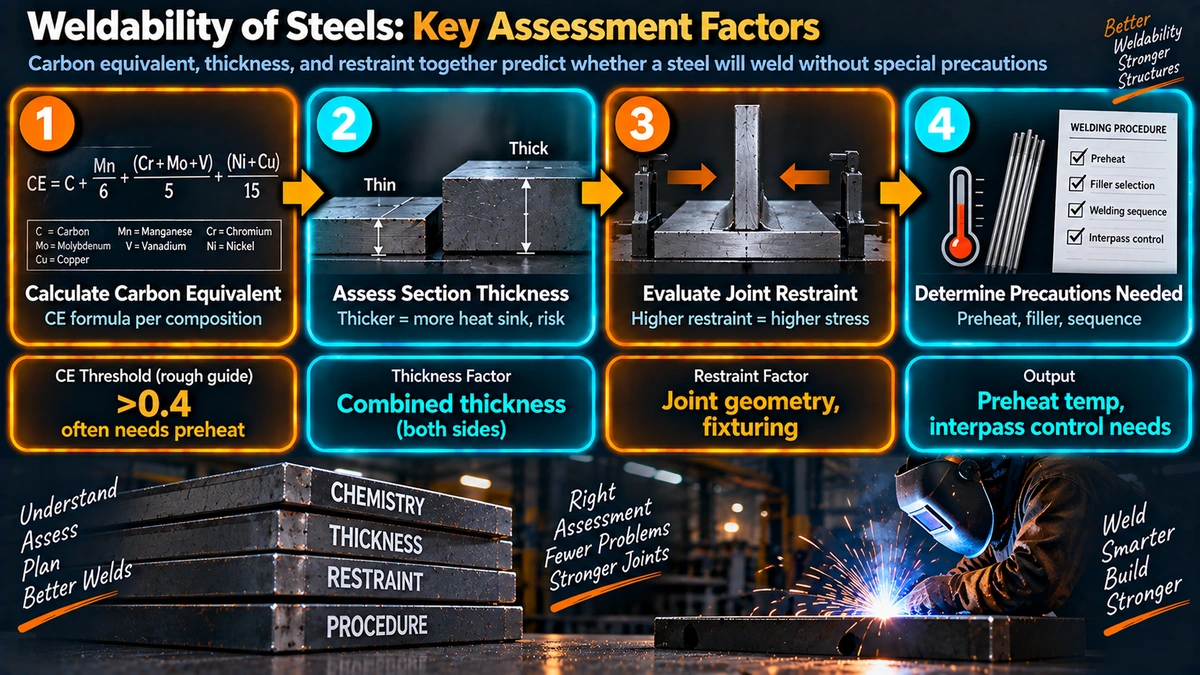
The International Institute of Welding defines weldability qualitatively rather than with a single number: a material is weldable, under given conditions and for a given purpose, when it can be joined by a suitable process to give a joint that meets the requirements of the design. Three things sit inside that definition, and all three matter for an engineering decision:
- Metallurgical weldability — resistance to cracking (hot, cold, reheat) and to unacceptable microstructural degradation in the heat affected zone (HAZ).
- Mechanical weldability — the joint retains the strength, ductility, and toughness the design requires, both in the weld metal and the HAZ.
- Structural/fabrication weldability — the joint can be made economically, with a practical process, without excessive distortion or the need for extreme pre/post-weld controls.
A steel can be metallurgically difficult but still be routinely welded — quenched and tempered structural steels are a good example — provided the procedure compensates with preheat, controlled heat input, and low-hydrogen practice. Weldability assessment is therefore really a risk assessment: how much procedural control does this particular chemistry, thickness, and joint configuration demand to reach an acceptable probability of a sound weld.
Metallurgical Factors That Control Weldability
Carbon Content
Carbon is the single strongest driver of hardenability in steel, and hardenability is the single strongest driver of cold cracking risk. As carbon content rises, the steel forms harder, more brittle martensite in the HAZ for a given cooling rate, and that hard microstructure is far more susceptible to hydrogen-assisted cracking. Plain carbon steels below about 0.25% C are generally considered readily weldable with minimal precautions; above about 0.35-0.40% C, preheat and low-hydrogen practice become essential even for relatively thin sections.
Alloying Elements and Hardenability
Manganese, chromium, molybdenum, nickel, and vanadium all increase hardenability — they shift the continuous cooling transformation curve so that martensite or bainite forms at slower cooling rates. This is metallurgically useful for base metal strength, but it works against weldability because it widens the range of realistic field cooling rates over which a hard, crack-susceptible microstructure can form in the HAZ. This is precisely why carbon equivalent formulas exist: they translate a full chemical analysis into a single number that ranks hardenability, and by extension cold cracking risk, for screening purposes.
Grain Size and Prior Microstructure
Coarse-grained base metal, or a HAZ that experiences significant grain coarsening near the fusion line, is more susceptible to both hydrogen cracking and loss of toughness. High heat input processes such as submerged arc welding widen the coarse-grained HAZ and can also promote softer, more brittle transformation products depending on cooling rate — see the SAW process guide for heat input considerations specific to that process.
Sulphur, Phosphorus, and Non-Metallic Inclusions
Residual sulphur and phosphorus segregate strongly during solidification. Sulphur combines with manganese to form elongated MnS inclusions that are rolled flat during plate production; these are the direct cause of lamellar tearing susceptibility. Phosphorus segregation contributes to temper embrittlement and reheat cracking risk in some low-alloy steels, particularly Cr-Mo grades subjected to post-weld heat treatment.
The Three Classic Steel Weldability Failure Modes
Hydrogen Induced Cold Cracking (HICC)
HICC, also called delayed cracking or underbead cracking, is the dominant weldability concern for structural and pressure-vessel steels. It requires three factors together: diffusible hydrogen in the weld region, a susceptible microstructure (martensite or lower bainite), and tensile stress (residual or applied). Because hydrogen needs time to diffuse to a susceptible location, cracks frequently appear hours to days after welding — which is why codes specify a minimum delay before final NDT on crack-sensitive materials.
Lamellar Tearing
Lamellar tearing occurs in the base plate, not the weld metal, when shrinkage strain acts through the plate thickness against a plane of elongated non-metallic inclusions. It shows the characteristic step-like, terraced fracture surface and is most common in thick-section restrained corner and T-joints, particularly where full-penetration welds are made into the short-transverse direction of the plate. Specifying through-thickness tested (Z-quality) plate and favouring joint designs that load the plate in-plane rather than through-thickness are the standard mitigations.
Reheat (Stress-Relief) Cracking
Reheat cracking occurs during post-weld heat treatment or elevated-temperature service in certain low-alloy Cr-Mo-V steels, when residual stress relaxation concentrates strain at coarse-grained HAZ grain boundaries weakened by precipitate formation. It is a separate risk category from hydrogen cracking and is controlled through PWHT ramp rate control, minimising HAZ grain coarsening, and, where applicable, temper bead technique.
Carbon Equivalent: Turning Chemistry Into a Weldability Number
Carbon equivalent formulas convert a full chemical analysis into a single comparative index of hardenability and cold cracking risk. The two most widely used formulas in steel fabrication are the IIW formula, suited to carbon-manganese and low-alloy structural steels, and the Ito-Bessyo Pcm formula, developed specifically for lower-carbon, higher-strength steels where IIW CE under-predicts cracking risk.
Weldability by Steel Class
| Steel Class | Typical CE(IIW) Range | Weldability Rating | Key Precaution |
|---|---|---|---|
| Low carbon steel (A36 / IS 2062-type) | 0.25 – 0.35 | Good | Minimal preheat below ~25 mm thickness |
| Carbon-manganese structural (Gr 50 / S355) | 0.35 – 0.45 | Good | Preheat on thick or restrained joints |
| Medium carbon steel (AISI 1040-1050) | 0.45 – 0.55 | Fair | Preheat, low-hydrogen consumables mandatory |
| Quenched & tempered HSLA (Q&T 690) | 0.40 – 0.55 (Pcm basis) | Fair | Controlled heat input, tight interpass control |
| Cr-Mo low alloy (P11, P22, P91) | 0.50 – 0.70+ | Difficult | Preheat + controlled PWHT, reheat crack risk |
| High carbon / tool steel (AISI 1080+) | 0.65+ | Difficult | High preheat, slow cooling, often avoided by welding |
For creep-strength-enhanced ferritic steels such as P91, weldability assessment goes beyond CE — see the dedicated P91 welding requirements guide for preheat, interpass, and PWHT specifics that a CE screen alone will not capture.
Assessment Methods: How Weldability Is Actually Tested
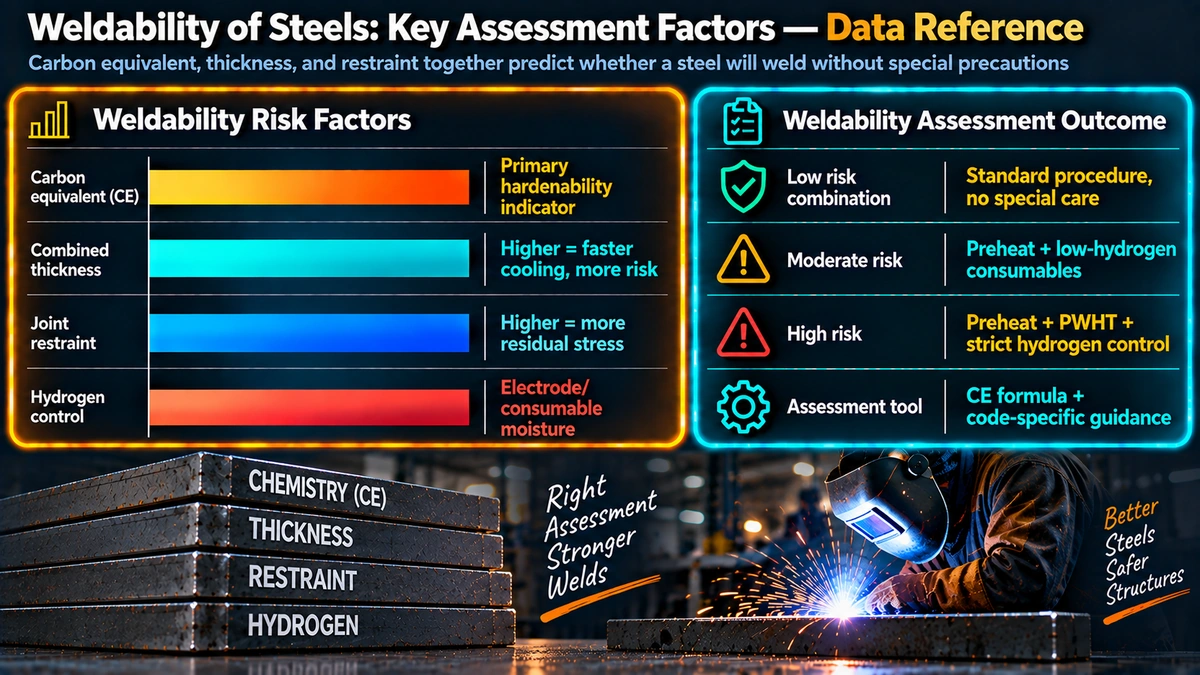
Carbon equivalent screening is a first-pass desk assessment. Where a new steel grade, a thick-section application, or a highly restrained joint configuration is involved, direct weldability testing is used to confirm the screen and to set procedure limits.
Hydrogen Cracking Tests
The Tekken test (a self-restrained Y-groove specimen) and the Controlled Thermal Severity (CTS) test are the two most widely used methods for ranking hydrogen cracking susceptibility of a given steel, consumable, and heat input combination. Both compare crack length or crack incidence against a range of preheat temperatures to establish the minimum preheat that avoids cracking for that specific combination.
Implant Test
The Implant test quantifies the relationship between applied stress, diffusible hydrogen content, and time to cracking, producing a critical stress curve rather than a pass/fail result. It is more instrumented and reproducible than the Tekken or CTS tests and is commonly used for research and for qualifying new higher-strength steel grades.
Varestraint Test
The Varestraint test applies a sudden bending strain to a weld pool in progress to assess susceptibility to solidification cracking and liquation cracking, both of which are strain-rate dependent hot cracking mechanisms that carbon equivalent formulas do not address at all.
Lamellar Tearing Tests
The Cranfield test and the WIC (Welding Institute of Canada) test evaluate through-thickness ductility and restraint response of plate material directly, complementing the routine short-transverse tensile reduction-of-area test that is often specified as a simpler acceptance criterion for Z-quality plate.
Controlling Weldability Through the Welding Procedure
For a fixed steel chemistry, the practical levers available to a welding engineer are all procedural:
- Preheat and interpass temperature — slows HAZ cooling rate, reduces martensite fraction, and gives hydrogen more time to diffuse out before the joint cools to ambient.
- Low-hydrogen consumables — correctly baked and stored basic-coated electrodes, or clean dry flux and wire for SAW/GMAW, directly reduce diffusible hydrogen. See the consumable nomenclature guide for classification of hydrogen levels by electrode designation.
- Controlled heat input — too low a heat input can produce excessively hard, fast-cooled HAZ microstructure; too high a heat input coarsens grain size and can reduce toughness. Both the MIG settings calculator and TIG settings calculator help keep heat input within a qualified WPS window.
- Joint design and restraint reduction — sequencing, backstep welding, and reduced root gap all lower the residual stress available to drive cracking.
- Post-weld heat treatment — tempers hard HAZ microstructure and allows further hydrogen diffusion; timing and ramp rate need to be controlled to avoid reheat cracking in susceptible Cr-Mo-V grades.
Frequently Asked Questions
What does weldability actually mean for a steel?
Weldability describes how easily a steel can be welded into a sound, crack-free joint that meets the required mechanical and metallurgical properties, using a reasonable and economical welding procedure. It is a relative, qualitative property rather than a single fixed number — a steel that is highly weldable with low heat input and proper preheat may crack readily if welded without those controls.
What is the difference between carbon equivalent (CE) and Pcm?
CE, most commonly the IIW formula, is used for medium-to-higher carbon steels (typically above 0.12% C) and weights manganese, chromium, molybdenum, vanadium, nickel, and copper against carbon to estimate hardenability and cold cracking risk. Pcm (Ito-Bessyo) is intended for low-carbon, low-alloy, high-strength steels below about 0.12% C, where it correlates better with cracking susceptibility because it weights carbon much more heavily relative to the other elements. Use the Carbon Equivalent calculator to compute both from a mill chemistry.
Why is hydrogen induced cold cracking the most important weldability failure mode?
Hydrogen induced cold cracking (HICC) accounts for the majority of weld cracking failures in structural and pressure steels because it needs only three things to occur together: diffusible hydrogen in the weld region, a susceptible hard microstructure (martensite or bainite), and residual tensile stress. All three are commonly present in as-welded low alloy steel joints, and the crack can appear hours or even days after welding is complete, which is why delayed inspection timing matters.
How is preheat temperature related to carbon equivalent?
As CE rises, the steel forms harder, more crack-susceptible microstructures in the heat affected zone for a given cooling rate. Preheat slows that cooling rate, allowing more time for hydrogen to diffuse out and reducing the volume fraction of untempered martensite. Codes such as AWS D1.1 and EN 1011-2 publish CE-banded preheat and interpass temperature tables, so a steel with CE above roughly 0.45 typically needs meaningfully more preheat than one below 0.35 at the same thickness.
What is lamellar tearing and which steels are prone to it?
Lamellar tearing is a step-like crack that forms in the base metal, parallel to the rolled plate surface, when weld shrinkage strain pulls through the plate thickness (the through-thickness or short-transverse direction). It is associated with plate containing elongated, planar non-metallic inclusions such as manganese sulphides, and is most often seen in thick-section restrained T- and corner joints in structural and pressure vessel fabrication.
Can weldability be improved without changing the base material?
Yes. For a fixed chemistry, weldability in practice is controlled through the welding procedure: correct preheat and interpass temperature, low-hydrogen consumables that are baked and stored correctly, controlled heat input, appropriate joint design to reduce restraint, and post-weld heat treatment where called for by the code. These procedural controls are exactly what a qualified WPS is meant to lock in.
Which laboratory tests are used to assess weldability directly?
Common weldability tests include the Tekken (y-groove restraint) test and the Controlled Thermal Severity (CTS) test for hydrogen cracking susceptibility, the Implant test for quantifying critical stress versus hydrogen level, the Varestraint test for solidification and liquation cracking, and the Cranfield or WIC lamellar tearing test for through-thickness ductility. These supplement, rather than replace, carbon equivalent screening.
Does a low carbon equivalent guarantee a crack-free weld?
No. Carbon equivalent is a screening tool based on bulk chemistry, not a guarantee. Section thickness, joint restraint, hydrogen content of the consumable, ambient temperature, and actual heat input all affect the real cooling rate and hydrogen level at the weld. A low-CE steel welded with wet, high-hydrogen electrodes in a highly restrained thick joint can still crack, which is why procedure qualification testing remains mandatory alongside CE calculation.
Recommended Reading
Welding Metallurgy (Kou)
Standard graduate-level reference covering solidification, HAZ transformation, and cracking mechanisms behind weldability assessment.
View on AmazonWelding Metallurgy and Weldability (Lippold)
Focused text on weldability testing methods, hydrogen cracking, and carbon equivalent theory for practising engineers.
View on AmazonASM Handbook Vol. 6A: Weldability
Reference-grade coverage of weldability by alloy family, including test methods and code-based preheat approaches.
View on AmazonWelding Metallurgy Principles (Easterling)
Classic treatment of HAZ microstructure evolution and hardenability, foundational for understanding carbon equivalent theory.
View on AmazonDisclosure: WeldFabWorld participates in the Amazon Associates programme (StoreID: neha0fe8-21). If you purchase through these links, we may earn a small commission at no extra cost to you. This helps support free technical content on this site.