Carburization: Causes and Prevention in Welded Components
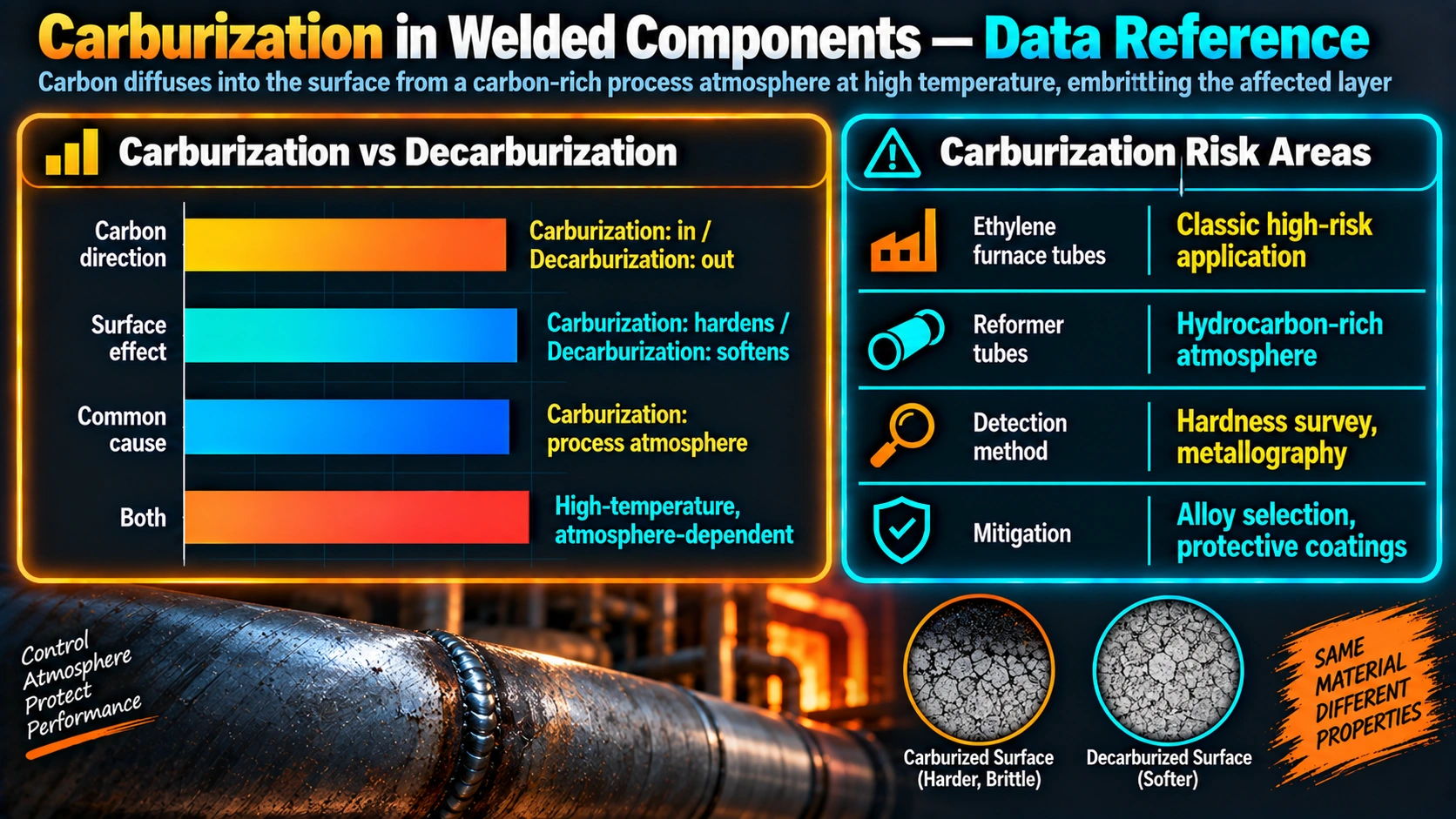
Carburization in welded components is the unwanted absorption of carbon into a steel or alloy surface, the mirror-image problem to the surface carbon loss covered in the companion guide to decarburization. Where decarburization softens and weakens a surface layer, carburization hardens and embrittles it, often far more severely, because the carbon absorbed at elevated temperature precipitates as continuous carbide networks that leave little room for ductility.
For welding engineers and QA/QC professionals, carburization shows up in two very different settings: as a localised welding-process problem caused by an incorrect flame setting or surface contamination, and as a long-term, service-induced material degradation mechanism in high-temperature hydrocarbon processing equipment such as ethylene cracking and steam reforming furnace tubes. This guide covers both, along with detection methods and the practical steps that prevent carburization from compromising a weld or a piece of process equipment.
This article covers unwanted carbon pickup in fabrication and service, not intentional case-hardening carburization used in gear and shaft manufacturing, which is a controlled, beneficial heat treatment process outside the scope of this site. For the opposite phenomenon, surface carbon loss, see the companion guide to decarburization in welding and heat treatment.
What Is Carburization?
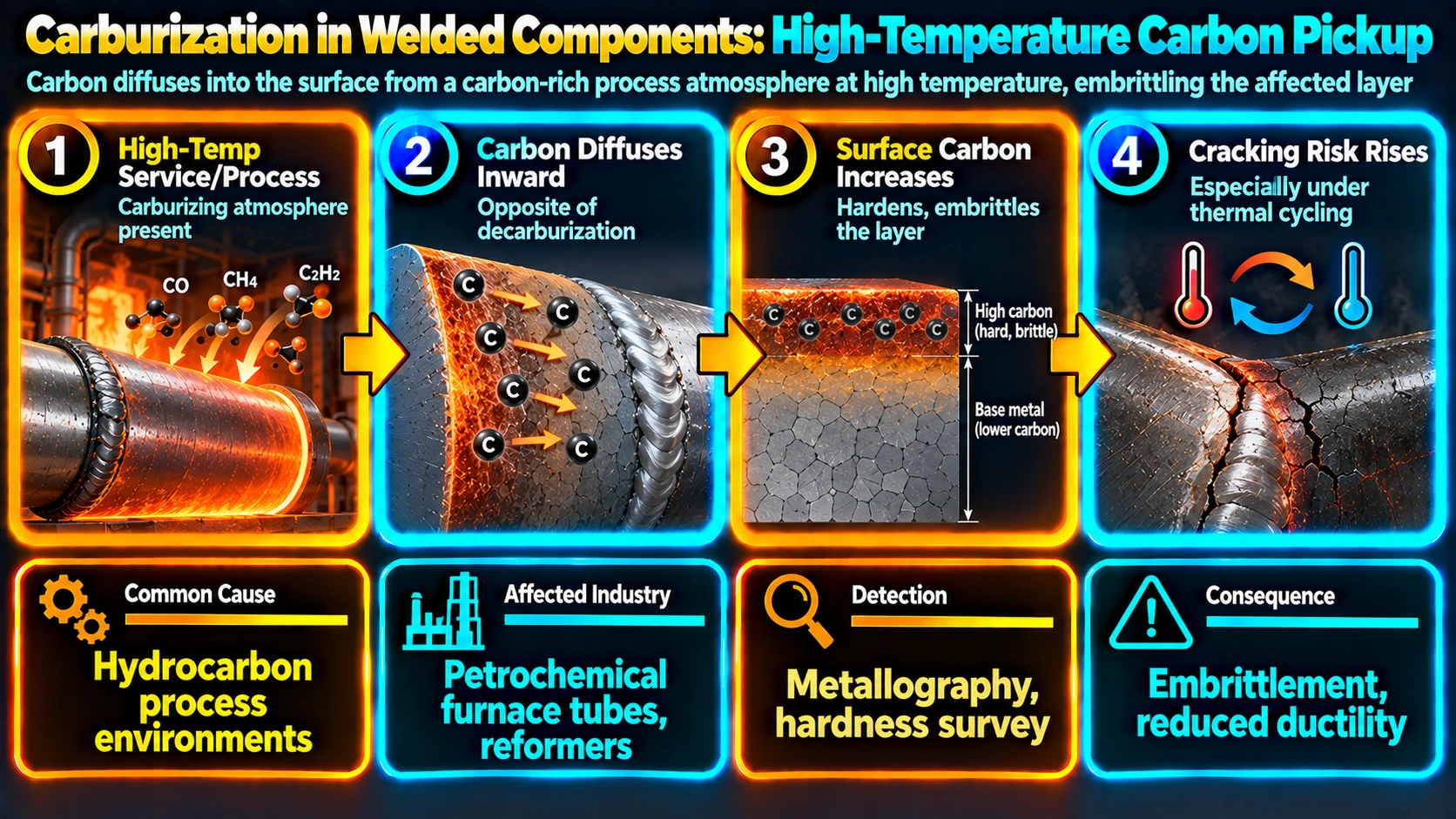
Carburization occurs when a steel or alloy surface is exposed to a carbon-rich atmosphere at a temperature high enough for carbon to diffuse into the material, generally above 800 to 900 degC for sustained service exposure, or at lower but still elevated temperature for shorter, more concentrated exposures such as a carburizing flame. Carbon absorbed at the surface diffuses inward, raising local carbon content well above the bulk specification value, and at the carbon levels typical of severe carburization, precipitates extensively as chromium, iron, or nickel carbides at grain boundaries and within grains.
Carburization Compared with Decarburization and Intentional Case Hardening
| Aspect | Unwanted carburization | Decarburization | Intentional case hardening |
|---|---|---|---|
| Carbon movement | Into the surface | Out of the surface | Into the surface (controlled) |
| Intent | Unintentional, undesirable | Unintentional, undesirable | Deliberate process step |
| Typical result | Hard, brittle, crack-prone zone | Soft, weak surface layer | Hard, wear-resistant case with tough core |
| Process control | None — a defect to be prevented | None — a defect to be prevented | Tightly controlled carbon potential and quench |
| Reference | This article | Decarburization guide | Not covered on WeldFabWorld |
Causes of Unwanted Carburization in Welding and Fabrication
Carburizing oxy-fuel flame settings
An oxy-acetylene flame set with excess acetylene relative to oxygen produces a carburizing (reducing) flame, visually identified by a long, feathery inner cone extending well beyond the sharp, well-defined cone of a correctly adjusted neutral flame. When this flame is used for preheating, gas welding, flame straightening, or gouging on carbon or low alloy steel, excess carbon is absorbed into the hot surface, producing a hard and brittle zone that can crack under subsequent stress, a failure mode covered in standard AWS and CSWIP welding inspector training.
Surface contamination burned in during welding or PWHT
Oil, grease, cutting fluid residue, temporary paint markers, adhesive labels, and similar carbonaceous contamination left on a joint surface before welding or on a component surface before PWHT can pyrolyse at elevated temperature. The carbon released is absorbed directly into the hot steel surface beneath the contamination, producing localised, sometimes severe carburized spots that do not correlate with the bulk furnace atmosphere reading and are easily missed if surface cleanliness is not specifically verified as part of pre-weld and pre-PWHT preparation.
Furnace atmosphere carbon potential drift
PWHT and other elevated-temperature furnace operations that use a protective or reducing atmosphere for oxidation control can inadvertently carburize the load if the atmosphere carbon potential drifts too high, for example from an improperly balanced endothermic gas mixture or soot deposition within the furnace, particularly where the same furnace is shared between different heat treatment cycles without adequate atmosphere verification between loads.
Service exposure in high-temperature hydrocarbon environments
Furnace tubes and fittings in ethylene cracking furnaces, steam reformers, and similar high-temperature hydrocarbon processing equipment, typically fabricated from HK40 or HP-modified cast heat-resistant austenitic alloys, operate for years at 800 to 1100 degC in direct contact with a hydrocarbon-derived, carbon-rich process atmosphere. Over service life, carbon diffuses progressively deeper into the tube wall from the internal surface, precipitating continuous carbide networks that can eventually extend most of the way through the wall thickness.
Green rot is the severe, advanced stage of this service carburization mechanism, named for the distinctive greenish appearance of a fractured or sectioned surface through the heavily carburized zone. Deep, continuous carbide networks leave the affected material with near-total loss of room-temperature ductility, and because the embrittled material cannot tolerate the thermal and mechanical strain of welding, green rot-affected sections are essentially unweldable using conventional procedures and are normally cut out and replaced entirely rather than repaired in place.
Effects of Carburization on Weld and Component Properties
Increased hardness and hydrogen cracking risk
Carburization raises local carbon content, increasing hardness and hardenability in the affected zone. Where a carburized zone falls within or adjacent to a weld heat-affected zone, the effective local carbon equivalent is higher than the bulk material chemistry suggests, increasing susceptibility to hydrogen-induced cold cracking. See the carbon equivalent guide for how CE is normally calculated from bulk chemistry, a calculation that does not capture localised carburization.
Loss of ductility and toughness
Extensive carbide precipitation associated with carburization consumes ductility, since continuous carbide networks along grain boundaries provide an easy crack propagation path. In service-carburized furnace tube alloys, this loss of ductility is the dominant practical consequence, since it removes the material’s ability to accommodate thermal cycling stress in service.
Weldability loss in severely carburized material
Lightly carburized surfaces can sometimes be welded successfully once the affected layer is removed by grinding or machining to sound base metal. Severely carburized or green rot-affected material, however, is generally considered unweldable by conventional procedures, because the embrittled microstructure cannot tolerate the thermal and mechanical strain of the welding process without cracking, and industry practice for furnace tube repair is to cut out and replace the affected section rather than attempt a repair weld through carburized material.
Detection Methods
| Method | What it reveals | Typical application |
|---|---|---|
| Surface hardness survey | Localised hard spots consistent with carbon pickup | Post-weld and post-PWHT quality checks |
| Metallographic cross-section | Carbide network depth, morphology, and continuity | Root cause investigation, furnace tube condition assessment |
| Portable magnetic permeability testing | Depth of carburization in normally non-magnetic austenitic alloys | In-service, non-destructive furnace tube inspection |
| Visual flame inspection during welding | Confirms neutral vs carburizing oxy-fuel flame setting | Preheat and gas welding quality control |
HK40 and HP alloys are normally fully austenitic and therefore essentially non-magnetic in their unaffected condition. Severe carburization consumes chromium and other elements from the austenite matrix to form carbides, locally altering the phase balance enough to produce weak ferromagnetism. Portable magnetic permeability meters exploit this change to estimate carburized depth on tubes still in service, without requiring tube removal or destructive sampling.
Prevention and Control
1. Set and verify oxy-fuel flames to neutral (a sharp, well-defined inner cone) for all preheating, gas welding, and flame straightening work on carbon and low alloy steel — never rely on a carburizing setting for convenience or perceived speed.
2. Clean joint and component surfaces thoroughly of oil, grease, cutting fluid, and temporary markers before welding and before loading into a PWHT or heat treatment furnace.
3. Monitor and control furnace atmosphere carbon potential for any protective or reducing atmosphere heat treatment cycle, and verify atmosphere condition between dissimilar loads sharing the same furnace.
4. For high-temperature hydrocarbon process equipment, follow the operator’s decoking, tube skin temperature monitoring, and inspection schedule designed to limit cumulative carburizing exposure over the design service life.
5. Where lighter carburization is confirmed, remove the affected layer by grinding or machining to sound material before attempting any repair weld, and treat confirmed green rot as a replace-not-repair condition.
Practical Engineering Notes
Before approving a repair weld on an in-service furnace tube, confirm that a magnetic permeability survey or metallographic sample has ruled out significant carburization at and around the proposed weld location. A repair weld attempted on carburized or green rot-affected material is a common source of premature repair failure, since the embrittled base metal cannot reliably accommodate the welding thermal cycle regardless of the filler metal or procedure used.
Frequently Asked Questions
What is carburization in welded components?
Carburization is the unwanted absorption of carbon into the surface of a steel or alloy component when it is exposed to a carbon-rich atmosphere at elevated temperature, typically above 800 degC for service exposure or during localised heating from a carburizing flame. Unlike intentional carburizing used to case-harden gears, carburization in welded fabrication is almost always undesirable, producing a hard, brittle, and often crack-susceptible surface or through-wall layer.
How does a carburizing flame cause carburization during welding?
An oxy-acetylene flame set with excess acetylene relative to oxygen, identified by a long, feathery inner cone rather than a sharp, well-defined one, produces a reducing, carbon-rich flame envelope. When this flame is used for preheating, gas welding, or flame straightening on carbon or low alloy steel, excess carbon from the flame is absorbed into the hot surface, producing a hard, brittle carburized zone that is prone to cracking.
Can surface contamination cause carburization during PWHT?
Yes. Oil, grease, cutting fluid residue, temporary paint markers, and other carbonaceous contamination left on a component surface before PWHT or welding can pyrolyse at elevated temperature, releasing carbon that is absorbed into the hot steel surface directly beneath the contamination. This produces localised, often severe carburized spots that do not correlate with the bulk furnace atmosphere and are frequently missed unless surface cleanliness is verified before heat treatment.
What is green rot and how does it relate to carburization?
Green rot is the severe, often catastrophic form of carburization that develops in HK40, HP, and similar heat-resistant austenitic alloy furnace tubes exposed to a hydrocarbon-derived, carbon-rich atmosphere at 800 to 1100 degC for extended service life. Deep carbon ingress precipitates continuous networks of chromium carbides through the wall thickness, producing a distinctive greenish fracture appearance and near-total loss of room-temperature ductility, making affected material effectively unweldable without complete removal.
How does carburization affect weld and component properties?
Carburization raises local carbon content, which increases hardness and hardenability but sharply reduces ductility and toughness, and raises the local carbon equivalent, increasing hydrogen cracking susceptibility. In severe cases such as green rot, carburization produces near-total embrittlement, making the affected material essentially unweldable and requiring full removal before any repair weld can be reliably made.
How is carburization detected in service or after welding?
Surface hardness testing identifies unusually hard spots consistent with carbon pickup, and metallographic cross-sectioning confirms carbide network depth and morphology. For HK40 and HP furnace tube alloys, portable magnetic permeability testing is a widely used field method, because carburization converts normally non-magnetic austenite into a weakly ferromagnetic, carbide-rich structure, allowing carburized depth to be estimated non-destructively without removing the tube from service.
How is carburization prevented during welding and fabrication?
Set oxy-fuel torches to a neutral flame, verified by a sharp, well-defined inner cone, rather than a carburizing setting, for all preheating, gas welding, and flame work on steel. Thoroughly clean component surfaces of oil, grease, cutting fluid, and temporary markers before welding or heat treatment, since these are common sources of localised carbon pickup. Maintain and monitor furnace atmosphere carbon potential within the intended neutral or protective range.
Can carburized material be repaired by welding?
Lightly carburized material can sometimes be welded successfully after the affected surface layer is removed by grinding or machining down to sound base metal, followed by an appropriate welding procedure. Severely carburized material, particularly green rot-affected furnace tube alloys with deep, continuous carbide networks, is generally not weldable using conventional procedures, and the affected section is normally cut out and replaced entirely.
Recommended Reading
Heat Treatment of Metals — ASM Handbook Volume 4
Comprehensive reference covering furnace atmosphere control, carburizing reactions, and heat treatment process metallurgy.
View on AmazonHigh Temperature Corrosion and Materials Applications
Industrial reference covering carburization, metal dusting, and high-temperature degradation of alloys in process industry service.
View on AmazonWelding Metallurgy and Weldability
Graduate-level reference on carbon-related embrittlement mechanisms and their impact on weldability.
View on AmazonASM Handbook — Metallography and Microstructures
Standard reference for metallographic technique and interpretation, including carburized layer identification.
View on AmazonDisclosure: WeldFabWorld participates in the Amazon Associates programme (StoreID: neha0fe8-21). If you purchase through these links, we may earn a small commission at no extra cost to you. This helps support free technical content on this site.