Nitriding and Case Hardening: Overview for Welders
Nitriding and case hardening are surface treatment processes used throughout industry to give machine parts, gears, shafts, and tooling a hard, wear-resistant outer layer while keeping the core tough and impact-resistant. Welders and QA/QC inspectors do not usually perform these treatments themselves, but they routinely encounter their results: repair welding a worn, case-hardened shaft journal, fabricating an assembly that will be nitrided after welding, or investigating why a repair weld on a hardened gear tooth failed prematurely.
This guide gives welders and welding engineers a practical, working understanding of how nitriding and case hardening work, how the main processes differ, and, most importantly, what happens when welding heat is applied to or near a hardened case, so that repair and fabrication decisions involving these components are made with the right expectations.
This article covers intentional, controlled surface hardening processes. For unwanted, uncontrolled carbon pickup that degrades rather than improves a component, see carburization in welded components. For unwanted surface carbon loss, see decarburization in welding and heat treatment.
What Is Case Hardening?
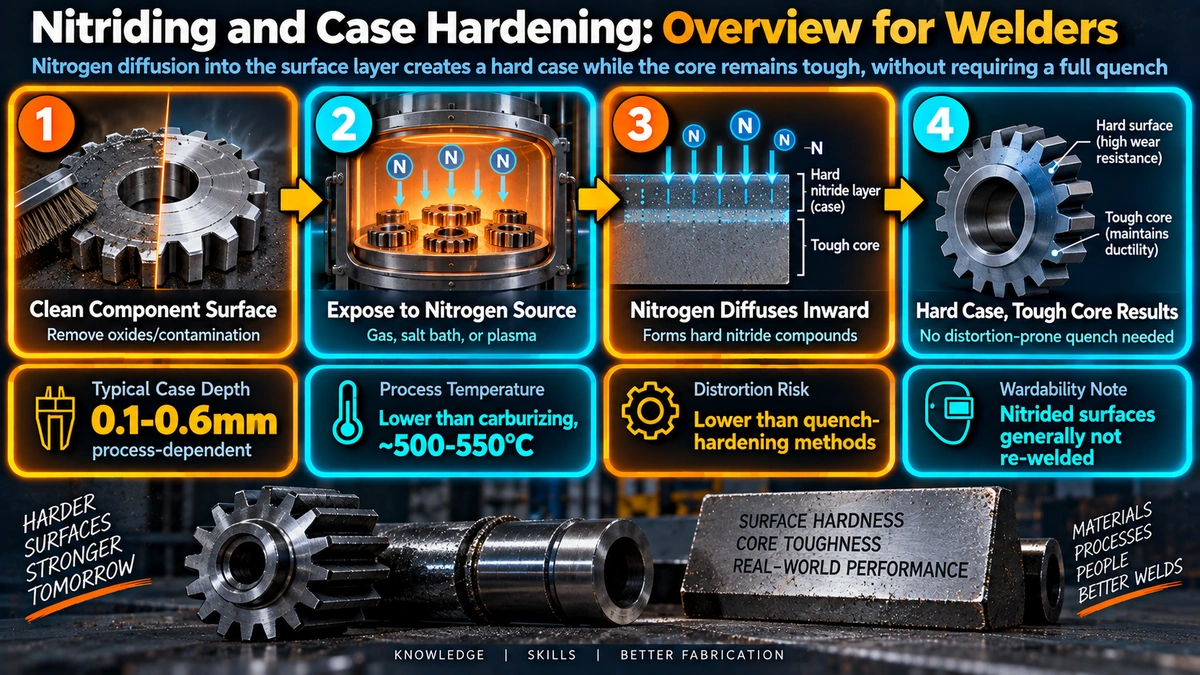
Case hardening describes any process that produces a hard, wear-resistant surface layer, the case, over a tougher, more ductile core, rather than hardening the component uniformly through its full section. This combination is desirable because the surface of a component, where contact stress, sliding wear, and fatigue crack initiation are concentrated, benefits most from high hardness, while the core benefits from retaining toughness to resist fracture under impact or bending load. A fully through-hardened part would have excellent wear resistance everywhere but would also be uniformly brittle; a case-hardened part gets the wear resistance where it matters and keeps the toughness where it matters.
Types of Case Hardening
Carburizing
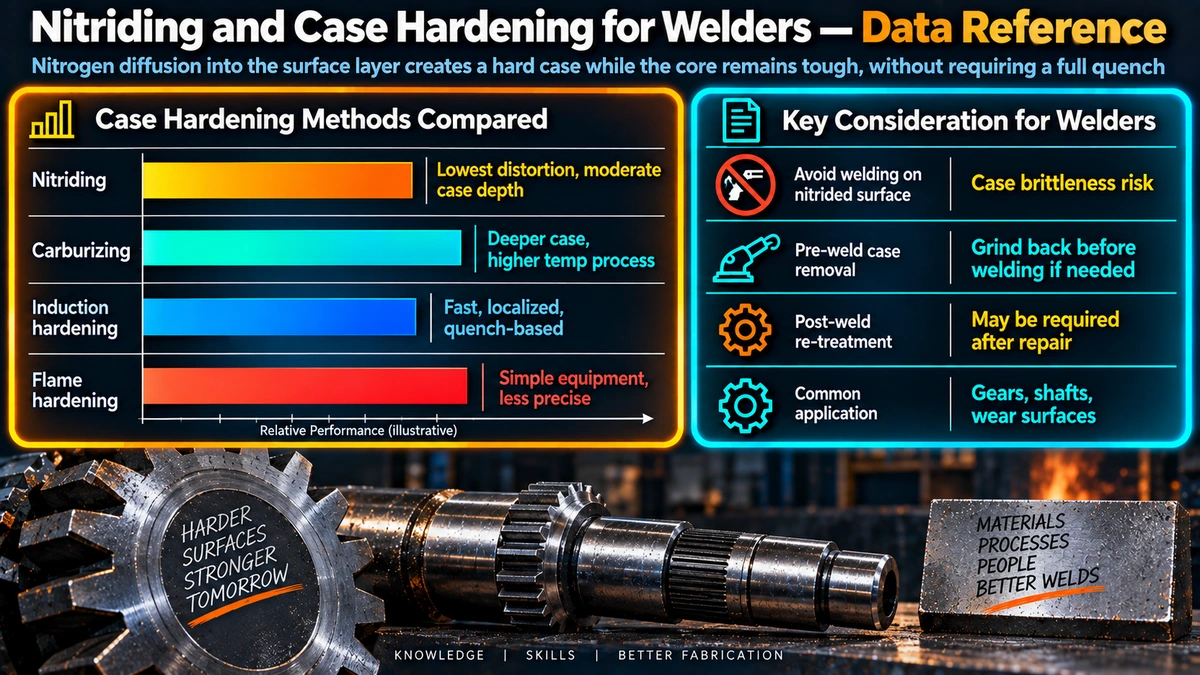
Carburizing adds carbon to the surface of a low-carbon steel at high temperature, typically 850 to 950 degC, where the steel is austenitic and has high carbon solubility. After sufficient time for carbon to diffuse to the required case depth, typically 0.5 to 1.5 mm, the component is quenched to transform the now carbon-rich surface into hard martensite, while the low-carbon core, which did not pick up significant carbon, remains comparatively soft and tough. Pack, gas, and vacuum carburizing are the common industrial variants, differing mainly in how the carbon-rich atmosphere is delivered and controlled. This is the same underlying diffusion mechanism discussed as an unwanted defect in the carburization guide; here the process is deliberate and tightly controlled rather than accidental.
Carbonitriding
Carbonitriding is a variant of carburizing that introduces both carbon and nitrogen simultaneously, usually in a gas furnace with ammonia added to a carburizing atmosphere, at a somewhat lower temperature than pure carburizing. The nitrogen addition improves hardenability, allowing an oil quench rather than the more severe water quench sometimes needed for plain carburized low-alloy steel, which reduces distortion risk.
Nitriding
Nitriding introduces nitrogen, rather than carbon, into the steel surface at a much lower temperature, typically 500 to 550 degC, which is below the temperature at which the steel transforms to austenite. Because no phase transformation and no subsequent quench are required, nitriding produces very little distortion compared with carburizing, which is one of its main advantages for precision components. Gas nitriding (using dissociated ammonia), plasma or ion nitriding (using a nitrogen-bearing plasma in a vacuum chamber), and salt bath nitriding (commonly known by trade names such as Tenifer or QPQ) are the three main industrial variants, differing in atmosphere control, uniformity, and environmental considerations.
Induction and flame hardening
Induction and flame hardening are sometimes grouped with case hardening because they also produce a hard surface over a tougher core, but the mechanism is different: these processes selectively heat only the surface layer of a medium or high carbon steel above its transformation temperature using localised induction coils or an oxy-fuel flame, then rapidly quench that layer, forming martensite only at the surface. No new element is diffused in; the composition of the surface and core remain the same, and only the local thermal history differs. This makes induction and flame hardening a selective through-hardening process rather than a true diffusion-based case hardening process, though the practical result, a hard case over a tough core, is similar.
Nitriding Metallurgy: The White Layer and Diffusion Zone
Nitriding is worth understanding in a bit more metallurgical depth because of a feature that matters directly to welding decisions: the white layer. Nitrogen diffusing into the steel surface reacts with iron and with strong nitride-forming alloying elements, principally aluminium, chromium, molybdenum, and vanadium, to form very fine, hard nitride precipitates through a diffusion zone beneath the surface. At the extreme outer surface, a thin, continuous layer of iron nitride compounds (the epsilon and gamma-prime phases) forms; this is the white layer, named for its featureless white appearance under the microscope after etching, because it resists standard metallographic etchants.
The white layer is very hard, typically 900 to 1100 HV, but also brittle and prone to cracking or spalling under impact or contact fatigue loading, particularly if it is left too thick. It is frequently removed or reduced by light grinding or polishing after nitriding on components subject to significant contact stress. If welding heat is applied near an intact white layer without first removing it, the abrupt hardness transition and brittleness of this layer make it a likely crack initiation site.
Why This Matters to Welders
Welding softens the case in the heat-affected zone
Whether the hardened case was produced by carburizing, nitriding, or induction hardening, welding heat applied to or near that case has the same basic effect: the elevated temperature of the weld thermal cycle tempers the hard martensitic or nitride-strengthened case in the heat-affected zone, reducing its hardness and wear resistance locally, in much the same way that PWHT tempers a martensitic weld HAZ. A repair weld made directly onto a hardened surface, without addressing this, leaves a soft spot exactly where wear resistance was needed most.
Repair welding case-hardened components
Standard practice for repairing a case-hardened component by welding is to first grind away the hardened case in and around the repair area down to sound, unaffected base metal, weld using a procedure and filler metal suited to the base alloy, and then decide whether the repaired area needs to be re-treated. For carburized components, this can mean re-carburizing and re-quenching the repair zone, which is only practical if the component can tolerate a further full heat treatment cycle without distortion issues. For nitrided components, because nitriding causes minimal distortion, re-nitriding after weld repair is more often feasible, though it does add a full process cycle to the repair. In some cases, particularly where the affected area is small or non-critical, the loss of case hardness in the repaired zone is simply accepted as a trade-off of the repair.
Sequencing: weld first, then treat
Nitriding and case hardening are almost always specified as the final manufacturing step, applied after all welding, machining, and any core heat treatment is complete. This sequencing exists precisely because the low nitriding temperature and short carburizing thermal cycle are intended to be the last thing that happens to the component; welding afterward would locally destroy the case that was just created. Fabrication drawings and process routings for assemblies destined for post-weld nitriding should clearly flag the nitriding step as final, and any rework or repair welding discovered necessary after nitriding should be treated as a special case requiring the sequence outlined above, not simply reworked as if the part had not yet been treated.
Hydrogen considerations
Nitrided and carburized surfaces, being hard and often high in residual compressive or tensile stress depending on the process, can be more sensitive to hydrogen embrittlement than the softer core material. Where a repair weld introduces hydrogen into or near a hardened case, whether from moisture, coating residue, or an unsuitable consumable, the combination of high local hardness and hydrogen pickup raises cracking risk, reinforcing the case for using low-hydrogen practice on any repair welding of hardened components, consistent with general hydrogen cracking control principles covered in the carbon equivalent guide.
Process Comparison for Welding Decisions
| Process | Typical case depth | Distortion risk | Weldability of treated part |
|---|---|---|---|
| Carburizing | 0.5 – 1.5 mm | High (quench required) | Case must be ground out before repair welding |
| Carbonitriding | 0.2 – 0.7 mm | Medium | Case must be ground out before repair welding |
| Gas / plasma nitriding | 0.1 – 0.6 mm | Low (no quench) | Case must be ground out; white layer especially crack-prone under weld heat |
| Induction / flame hardening | 0.8 – 4 mm (selective) | Medium (localised quench) | Hardened zone tempers in HAZ; re-harden after repair if required |
Detection and Inspection
| Method | What it reveals |
|---|---|
| Microhardness traverse from surface | Case depth, defined at a specified limiting hardness value |
| Metallographic cross-section | Visible case structure, white layer thickness in nitrided parts, case uniformity |
| Surface hardness testing (Rockwell, Vickers) | Confirms as-treated surface hardness meets specification |
| Post-weld hardness survey of HAZ | Confirms whether and how much the case has been tempered by nearby welding heat |
Practical Engineering Notes
Before repair welding a worn or damaged case-hardened part, confirm the original treatment process, target case depth, and specified hardness from the component drawing or original equipment manufacturer data where available. Grinding out the case, welding, and then deciding on re-treatment based on that original specification gives a far more predictable outcome than welding directly onto a hardened surface and hoping the result meets requirements.
Frequently Asked Questions
What is case hardening?
Case hardening is a family of surface treatment processes that produce a hard, wear-resistant outer layer, or case, on a component while leaving the core relatively soft and tough. This combination gives good wear and fatigue resistance at the surface, where contact and cyclic loading are highest, while retaining the impact resistance and machinability of a tougher core. Carburizing, carbonitriding, and nitriding are the main diffusion-based case hardening processes; induction and flame hardening achieve a similar result without changing composition, through localised rapid heating and quenching.
What is the difference between nitriding and carburizing?
Carburizing adds carbon to the surface at high temperature, typically 850 to 950 degC, and requires quenching to form hard martensite, producing case depths of roughly 0.5 to 1.5 mm with significant distortion risk. Nitriding adds nitrogen at a much lower temperature, typically 500 to 550 degC, below the austenitising temperature, so no quenching is required and distortion is minimal. Nitrided cases are thinner, typically 0.1 to 0.6 mm, but can reach higher surface hardness than carburized cases in steels alloyed with strong nitride formers such as aluminium, chromium, and molybdenum.
What is the white layer in nitriding?
The white layer, also called the compound layer, is a thin, very hard, and relatively brittle iron nitride layer that forms at the extreme outer surface during nitriding, above the tougher diffusion zone beneath it. It is called the white layer because it resists standard etchants and appears featureless white under a metallurgical microscope. Because it is thin and brittle, the white layer is often removed by light grinding or polishing after nitriding on components subject to impact or contact fatigue loading, to avoid spalling.
Can you weld a nitrided or case-hardened component?
Welding directly on or immediately adjacent to a nitrided or case-hardened surface tempers and softens the case in the heat-affected zone, locally destroying the wear resistance the treatment provided, and can crack the brittle white layer in nitrided components if it is not first removed. If a repair weld is unavoidable, standard practice is to grind away the hardened case in and around the repair area down to sound base metal, weld using an appropriate procedure, and then either accept the loss of case hardness or arrange for re-treatment after welding where the process and geometry allow it.
Should nitriding be done before or after welding?
Nitriding is almost always performed as the final manufacturing step, after all welding, machining, and heat treatment of the core material is complete, because the low nitriding temperature is chosen specifically to avoid disturbing the core microstructure, and any subsequent welding would locally destroy the case just created. Welding an assembly and then nitriding it afterward is the correct sequence; nitriding first and welding afterward is avoided except in planned repair scenarios where the case will be reground and, if required, re-nitrided after the weld.
How is case depth measured and verified?
Case depth is most commonly verified by a microhardness traverse from the surface inward on a polished cross-section, with case depth defined as the distance from the surface to the point where hardness drops to a specified limiting value. Metallographic examination of an etched cross-section also reveals the visible case, including the white layer in nitrided parts, and is used to confirm case uniformity and detect unwanted grinding burn or decarburization introduced during finishing.
Does nitriding affect corrosion resistance?
Nitriding can somewhat reduce corrosion resistance in stainless and corrosion-resistant steels, because the process consumes chromium from solid solution to form chromium nitrides in the case, similar in principle to the sensitisation mechanism that reduces corrosion resistance after improper welding of stainless steel. For components where both wear resistance and corrosion resistance are required, this trade-off needs to be evaluated against the specific service environment before specifying nitriding on a corrosion-resistant alloy.
Why do case-hardened gear teeth sometimes need to be welded in the field?
Field damage such as chipped or worn gear teeth, spalled bearing races, or worn shaft journals on case-hardened components is sometimes economically repaired by welding rather than full component replacement, particularly on large or long-lead-time parts. This requires removing the hardened case in the repair zone, welding with a filler metal and procedure suited to the base alloy, and, where practical, re-hardening the repaired area, since a repair weld left in the as-welded condition will not match the wear resistance of the surrounding original case.
Recommended Reading
Heat Treatment of Metals — ASM Handbook Volume 4
Comprehensive reference covering carburizing, carbonitriding, nitriding, and induction hardening process metallurgy and equipment.
View on AmazonPractical Heat Treating
Industry-oriented guide to case hardening processes, equipment selection, and troubleshooting for production heat treatment.
View on AmazonSteel Heat Treatment: Metallurgy and Technologies
Detailed technical reference on nitriding metallurgy, white layer formation, and diffusion zone development.
View on AmazonWelding Metallurgy and Weldability
Graduate-level reference on HAZ tempering behaviour, relevant to how welding affects hardened and case-treated surfaces.
View on AmazonDisclosure: WeldFabWorld participates in the Amazon Associates programme (StoreID: neha0fe8-21). If you purchase through these links, we may earn a small commission at no extra cost to you. This helps support free technical content on this site.