ASME B16.34 Valve Rating: Pressure-Temperature Ratings Explained
The ASME B16.34 valve rating tells you the highest pressure a valve may hold at a given temperature, and it is the number every valve selection starts from. The American Society of Mechanical Engineers (ASME) publishes B16.34 as the standard for flanged, threaded and welding end valves.
Quick Answer
The ASME B16.34 valve rating is the allowable working pressure of a valve at a stated temperature. It depends on the pressure class (150 to 4500) and the material group, and it falls as temperature rises. To select a valve, read the table for the material group at the design temperature and choose the lowest class whose rating meets or exceeds the design pressure.
Valves are only one part of a pressure system, and the same logic runs through pressure vessel design codes and the ASME Section VIII Division 1 rules that govern the vessels they connect to. This guide covers the rating rules in depth. For plain-language definitions of valve terms, use the valve glossary on this site.
You will learn what the standard covers, how classes and material groups work, how to read a pressure-temperature (P-T) table, and how to pick a class with a worked example. A decision flowchart, a derating cheat sheet and a common-mistakes list close the guide.
Key Takeaways
- ASME B16.34 sets pressure-temperature ratings, minimum wall thickness, testing and marking for flanged, threaded and welding end valves.
- The class number, such as Class 300, is a dimensionless designation and not a pressure in psi.
- Rating depends on the material group and falls as temperature rises, so the temperature must be part of every selection.
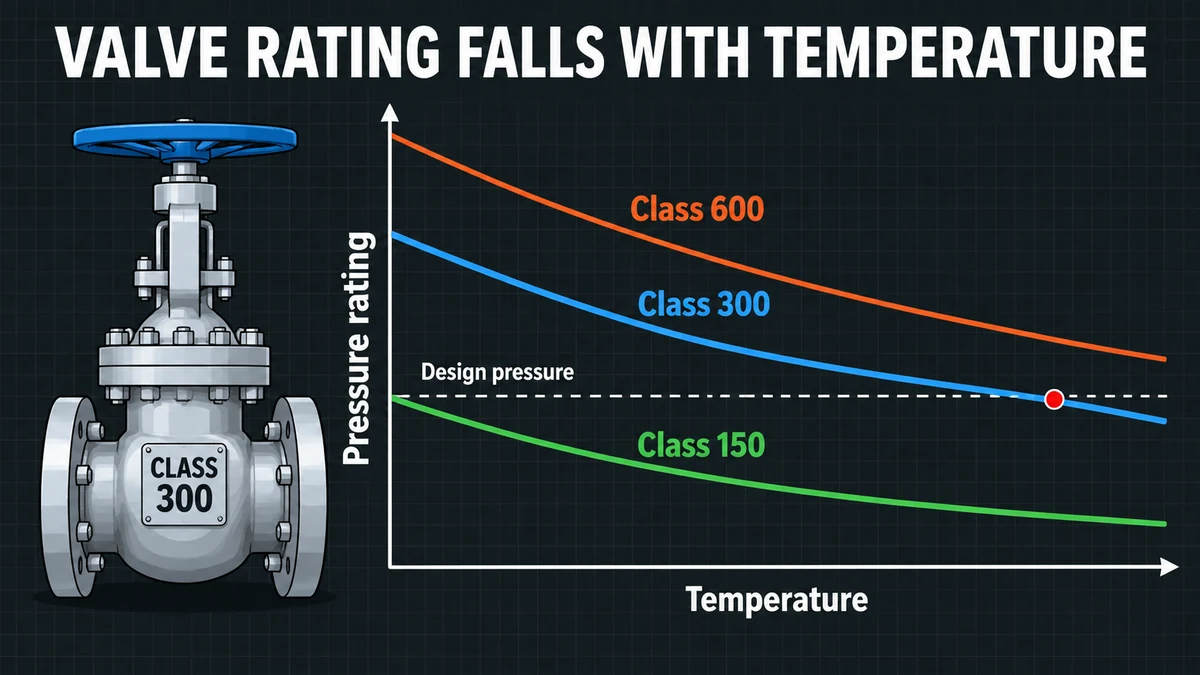
- For Group 1.1 carbon steel, Class 300 keeps about 77 percent of its 38 °C rating at 316 °C, while Class 150 keeps about 49 percent.
- A flanged valve is limited by the lower of its own rating and the rating of its end flanges.
- Requirements depend on the code edition and contract specification applicable to your project.
What Is ASME B16.34?
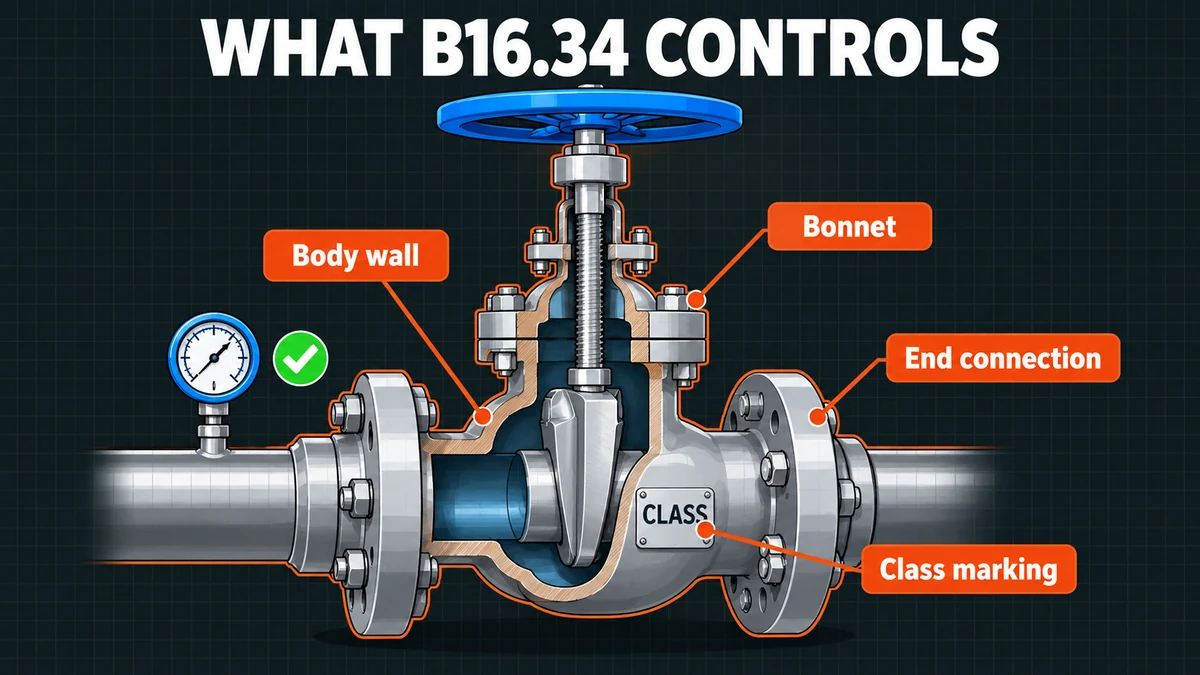
ASME B16.34 is a valve standard that sets pressure-temperature ratings, wall thickness, examination, testing and marking requirements for flanged, threaded and welding end valves.
The standard applies to valves made from listed materials, including carbon steel, alloy steel, stainless steel and nickel alloys. It defines what the manufacturer must build to, and what the buyer can rely on, when a valve is marked with a class.
B16.34 is a product standard, not a piping design code. Piping codes such as ASME B31.3 permit listed valves and refer to the B16.34 rating for the pressure boundary. The piping designer still decides the design pressure and temperature.
What Does the Standard Cover?
ASME B16.34 covers the pressure-containing parts of a valve and the requirements that make a rating meaningful. The table lists the main subjects.
| Subject | What the standard defines |
|---|---|
| Pressure-temperature ratings | Allowable pressure by class, material group and temperature |
| Valve types | Gate, globe, check, ball, plug and butterfly valves |
| End connections | Flanged, threaded, butt weld and socket weld |
| Wall thickness | Minimum body and end wall thicknesses by class and size |
| Materials | Listed material groups and their rating tables |
| Testing | Shell test and closure (seat) test |
| Marking | Manufacturer, rating designation, material and size |
Process, power and oil and gas plants use B16.34 valves widely. Welded end valves are installed with the same joint practices covered in the guide to welding joint types.
What Are Pressure Classes in ASME B16.34?
A pressure class is a dimensionless designation that groups valves with a similar pressure capacity. B16.34 uses classes 150, 300, 600, 900, 1500, 2500 and 4500. A higher number means a higher rating at the same temperature, and the number is not a pressure in psi.
The rating of a valve at a class depends on the material group. The table shows the Group 1.1 carbon steel rating near ambient temperature, which is the highest rating the valve ever carries.
| Class | Rating (psi) | Rating (bar) |
|---|---|---|
| Class 150 | 285 psi | 19.6 bar |
| Class 300 | 740 psi | 51.1 bar |
| Class 600 | 1,480 psi | 102.1 bar |
| Class 900 | 2,220 psi | 153.2 bar |
| Class 1500 | 3,705 psi | 255.3 bar |
| Class 2500 | 6,170 psi | 425.5 bar |
Class 4500 exists for selected materials and sizes, and its values are not listed here. Take the numbers for your material from the table in the edition named in your contract. Group 1.1 values also cover A105, A216 WCB and A350 LF2, which share one rating table.
What Are Material Groups?
A material group is a set of materials in B16.34 that share the same pressure-temperature table. Each valve body and bonnet material belongs to one group, and the group decides which rating table applies. A valve in a different group can have a different rating at the same class and temperature.
| Family | Typical materials | Use |
|---|---|---|
| Group 1.x | Carbon and low alloy steels, such as A105, A216 WCB, A350 LF2 (Group 1.1) | General service, higher temperature service in chromium-molybdenum grades |
| Group 2.x | Austenitic stainless steels | Corrosive and cryogenic service |
| Group 3.x | Nickel and nickel alloys | Severe corrosion and high temperature |
Do not confuse a B16.34 group with a welding P-Number. B16.34 groups set valve ratings, while P-Numbers group base metals for welding qualification. The difference is explained in the P-Number and Group Number guide and the P-Number reference table.
The exact group of each grade is listed in the material table of the standard. Always look up your specific grade, because grades that look similar can fall into different groups.
How Do You Read a Pressure-Temperature Table?
A pressure-temperature table lists the allowable working pressure for each class at a series of temperatures, and the rating decreases as temperature increases. To read it, find the column for your class and the row for your design temperature, then take the value where they meet.
The table below shows Group 1.1 carbon steel for classes 150, 300 and 600. Values are in psi with the bar equivalent in brackets, rounded to one decimal place.
| Class | 100 °F (38 °C) | 200 °F (93 °C) | 300 °F (149 °C) | 400 °F (204 °C) | 500 °F (260 °C) | 600 °F (316 °C) |
|---|---|---|---|---|---|---|
| Class 150 | 285 psi (19.7 bar) | 260 psi (17.9 bar) | 230 psi (15.9 bar) | 200 psi (13.8 bar) | 170 psi (11.7 bar) | 140 psi (9.7 bar) |
| Class 300 | 740 psi (51.0 bar) | 680 psi (46.9 bar) | 655 psi (45.2 bar) | 635 psi (43.8 bar) | 605 psi (41.7 bar) | 570 psi (39.3 bar) |
| Class 600 | 1,480 psi (102.0 bar) | 1,360 psi (93.8 bar) | 1,310 psi (90.3 bar) | 1,265 psi (87.2 bar) | 1,205 psi (83.1 bar) | 1,135 psi (78.3 bar) |
Rating is a pressure at temperature, so the lower rating at higher temperature is the one that governs. Interpolation between listed temperatures is allowed by the standard. Extrapolation beyond the table is not.
How Do You Select a Valve Class?
Valve class selection is a six-step check that compares design pressure with the rating at design temperature. The lowest class that passes is normally the economic choice.
- Define the design conditions. Record the design pressure and the design temperature, plus the fluid, cyclic duty and minimum metal temperature.
- Identify the material group. Find the valve body material in the B16.34 material tables and note its group, for example Group 1.1 for A105, A216 WCB and A350 LF2.
- Open the rating table. Go to the pressure-temperature table for that group and read the rating of each class at the design temperature, interpolating between listed temperatures when allowed.
- Pick the lowest adequate class. Choose the lowest class whose rating at the design temperature is equal to or greater than the design pressure.
- Check ends and special services. Confirm the end flanges or weld ends and check sour service, low temperature, lethal service and corrosion allowance requirements.
- Specify testing, marking and documents. State the shell and seat test requirements, the marking and the material certificates in the purchase specification.
The same design pressure and temperature also drive vessel wall thickness, as shown in the shell thickness calculator. Keep the design conditions consistent across the valve, piping and vessel documents.
Worked Example: Which Class for 40 bar at 250 °C?
A class is chosen by comparing the rating at the design temperature with the design pressure. The inputs are assumed for illustration: a Group 1.1 carbon steel valve (A216 WCB), design pressure 40 bar(g), design temperature 250 °C, with ratings from Table 4.
Now test the same valve at a higher temperature. At 316 °C (600 °F), the Class 300 rating is 570 psi (39.3 bar). That is below 40 bar, so Class 300 fails. Class 600 at the same temperature is 1,135 psi (78.3 bar), which passes with a large margin.
The result shows why the temperature matters as much as the pressure. A valve that passes at 250 °C can fail at 316 °C. The values here are for Group 1.1 only and must be checked against the edition named in your contract.
What Are Standard, Special and Limited Class?
Standard Class is the default rating class in ASME B16.34 and applies to most valves. Special Class and Limited Class are alternative rating classes that change what the valve must meet or where it can be used.
- Standard Class: uses the standard rating tables and wall thickness requirements.
- Special Class: tied to additional examination of the valve body, which allows a rating on that basis.
- Limited Class: restricts the classes and sizes it covers, in return for a different construction basis.
The conditions for Special and Limited Class differ by edition, material and size. Confirm them in the standard before specifying either, and state the class in the purchase order. For the examination methods behind Special Class, see the ASME Section V nondestructive examination overview.
How Do Wall Thickness, Testing and Marking Work?
ASME B16.34 sets minimum wall thickness, a pressure test of the shell and a closure test, and marking that identifies the valve. These requirements make the rating on the nameplate dependable.
- Wall thickness: minimum body and end wall thicknesses are tabulated by class and size. A valve with thinner walls cannot carry the class rating.
- Shell test: a hydrostatic test of the pressure boundary, normally at 1.5 times the 38 °C rating. The valve must show no leakage through the walls.
- Closure test: a seat test for valves that must seal. These are done to B16.34 or to API 598, depending on the specification.
- Marking: the valve is marked with the manufacturer, the rating designation, the body material and the size.
Test pressure is related to the rating, not to the design pressure of the line. For a Class 300 Group 1.1 valve, 1.5 times 51.1 bar gives about 76.7 bar. Check the rounding and hold times in the edition you use.
Which Special Services Change the Selection?
A B16.34 rating covers pressure and temperature only. Other service conditions can add requirements that the rating table does not show, and they must be specified separately.
- Sour service: hydrogen sulfide service adds hardness and material limits. See NACE MR0175 and ISO 15156 for welders and engineers and the guide to sour service.
- Low temperature: carbon steel valves for cold service need toughness, as in A350 LF2. The method is covered in Charpy impact testing, and the vessel rules are in UG-84 impact test requirements.
- Lethal service: toxic fluids bring extra design, fabrication and examination rules. See lethal service applications.
- Long hot exposure: prolonged use of some carbon steels above about 425 °C can convert carbide to graphite, so the standard limits use of those grades at high temperature.
- Welded ends: butt weld valves need welding procedures and, for some materials, preheat and heat treatment. See preheat in welding, the PWHT soak time guide and the Section IX overview for the qualification framework.
How Does B16.34 Relate to B16.5 Flanges?
ASME B16.34 rates the whole valve, while ASME B16.5 rates pipe flanges and flanged fittings. A flanged valve is limited by the lower of its own B16.34 rating and the rating of its end flanges, so both documents apply.
| Item | ASME B16.34 | ASME B16.5 |
|---|---|---|
| Covers | Complete valves | Pipe flanges and flanged fittings |
| Ratings | Valve P-T ratings by class and group | Flange P-T ratings by class and group |
| Wall thickness | Valve body and end walls | Flange dimensions |
| Testing and marking | Shell test, closure test and marking | Marking of flanges |
| Large sizes | Refers to the flange standards for end dimensions | Large diameter flanges are in ASME B16.47 |
Weld end valves avoid the flange limit, so the valve rating governs. In every case, check the piping specification, since the line class can be lower than the valve rating.
Quick Reference: Rating Retained at Temperature
This cheat sheet shows how much of its 38 °C rating each class keeps at 316 °C (600 °F) for Group 1.1 carbon steel. Class 150 loses about half its rating, while classes 300 and 600 keep about three quarters.
| Class | Rating at 38 °C | Rating at 316 °C | Rating retained |
|---|---|---|---|
| Class 150 | 285 psi | 140 psi | 49 percent |
| Class 300 | 740 psi | 570 psi | 77 percent |
| Class 600 | 1,480 psi | 1,135 psi | 77 percent |
What Are Common Mistakes With Valve Ratings?
Most valve rating errors come from reading the class as a pressure, ignoring temperature or using the wrong material group. These mistakes are usually found at design review or after delivery.
Watch for these
- Reading Class 300 as 300 psi. The class is a designation, and the real rating comes from the table.
- Using the 38 °C rating at an elevated design temperature.
- Taking a rating from the wrong material group, or from a flange table instead of the valve table.
- Ignoring the end flange rating on a flanged valve.
- Assuming Special or Limited Class without checking the conditions in the edition.
- Specifying a class without stating testing, marking and certificates in the purchase order.
- Forgetting sour, low temperature and lethal service requirements, which the rating does not cover.
The B16.34 rating is also a ceiling, not a design margin. Piping and vessel codes may require lower pressure limits. Requirements depend on the code edition and contract specification applicable to your project.
Frequently Asked Questions
What is ASME B16.34?
ASME B16.34 is the standard for valves with flanged, threaded and welding ends. It sets pressure-temperature ratings by class and material group, minimum wall thickness, examination, testing and marking. It covers valve pressure boundaries, such as the body and bonnet, and it is used for process, power and oil and gas piping. Piping codes such as ASME B31.3 refer to it for listed valves.
Does Class 150 mean 150 psi?
No. The class number is a dimensionless designation, not a pressure. A Class 150 valve in Group 1.1 carbon steel is rated 285 psi (19.6 bar) at 38 °C, and the rating falls as temperature rises. Writing “150 lb” or “150 pound” is incorrect. Always state the class and read the actual rating from the table at your design temperature.
What is the difference between ASME B16.34 and ASME B16.5?
ASME B16.34 covers complete valves, including body wall thickness, testing and marking. ASME B16.5 covers pipe flanges and flanged fittings, including dimensions and flange ratings. A flanged valve is limited by the lower of its own B16.34 rating and the rating of its end flanges. Check both documents when you specify a flanged valve. For the vessel side, see the Section VIII Division 1 overview.
Why does the valve pressure rating drop as temperature rises?
Ratings follow the allowable stress of the valve material, and allowable stress falls as temperature rises. Group 1.1 Class 300 valves drop from 740 psi at 38 °C to 570 psi at 316 °C, a loss of about 23 percent. Class 150 loses much more, about 51 percent over the same range. This is why the temperature must always be part of the class selection.
What are Standard, Special and Limited Class valves?
Standard Class is the default rating class and applies to most valves. Special Class and Limited Class are alternative rating classes in the standard. Special Class is tied to additional examination of the valve body, and Limited Class restricts the classes and sizes it covers. The conditions differ by edition and material, so confirm them in the edition named in your contract before ordering.
Can I use a valve at its 38 °C rating when the fluid is hot?
No. The 38 °C value is the highest rating on the table and applies only near ambient temperature. At the design temperature you must use the rating from the table at that temperature. A Class 300 Group 1.1 valve rated 740 psi at 38 °C is rated 570 psi at 316 °C. Using the cold value at temperature overstates the capacity of the valve.
What tests does ASME B16.34 require?
The standard requires a shell test of the pressure boundary and a closure (seat) test for valves that must seal, with test pressures related to the rating. The shell test is normally 1.5 times the 38 °C rating, and seat tests are commonly done to B16.34 or API 598. Examination and documentation depend on the class and the purchase specification. See the guide to nondestructive examination methods for the methods used.
Key Terms
- Pressure class
- A dimensionless designation such as Class 300 that groups valves with similar pressure capacity.
- Pressure-temperature (P-T) rating
- The highest allowable working pressure of a valve at a stated temperature.
- Material group
- A set of valve materials that share one rating table in ASME B16.34.
- Shell test
- A hydrostatic test of the valve pressure boundary at a pressure related to the rating.
- Closure test
- A test of the seat sealing of a valve, also called a seat test.
- Interpolation
- A linear estimate of a rating between two listed temperatures.
- Design pressure
- The pressure used to size a system component, taken together with a coincident design temperature.
- Welding end
- A valve end prepared for butt weld or socket weld connection to a pipe.
Conclusion
The ASME B16.34 valve rating is set by the class, the material group and the temperature, and it falls as temperature rises. Read the table for your material group at the design temperature, then choose the lowest class that meets the design pressure.
Check the end flanges, the special services and the test and marking requirements before ordering. Confirm every value against the edition named in your contract, because tables and classes can change between editions.
As a next step, test your knowledge of the pressure vessel side of these decisions with the ASME Section VIII Division 1 pressure vessel quiz.
Standards and References
- ASME B16.34, Valves – Flanged, Threaded, and Welding End, issued by ASME.
- ASME B16.5, Pipe Flanges and Flanged Fittings, issued by ASME.
- ASME B16.47, Large Diameter Steel Flanges, issued by ASME.
- ASME B31.3, Process Piping, issued by ASME.
- API 598, Valve Inspection and Testing, issued by the American Petroleum Institute (API).
About this guide. This guide was prepared by the WeldFabWorld technical team from the standards listed above. Verify every requirement against the code edition and specification applicable to your project.